
Breaksea cod
Breaksea cod is the only species in its genus, a reef anthiadid endemic to southern Australia. It lives in temperate water, reaches 56 cm TL, and is listed as Near Threatened. Its season runs from January to April and again from October to December.
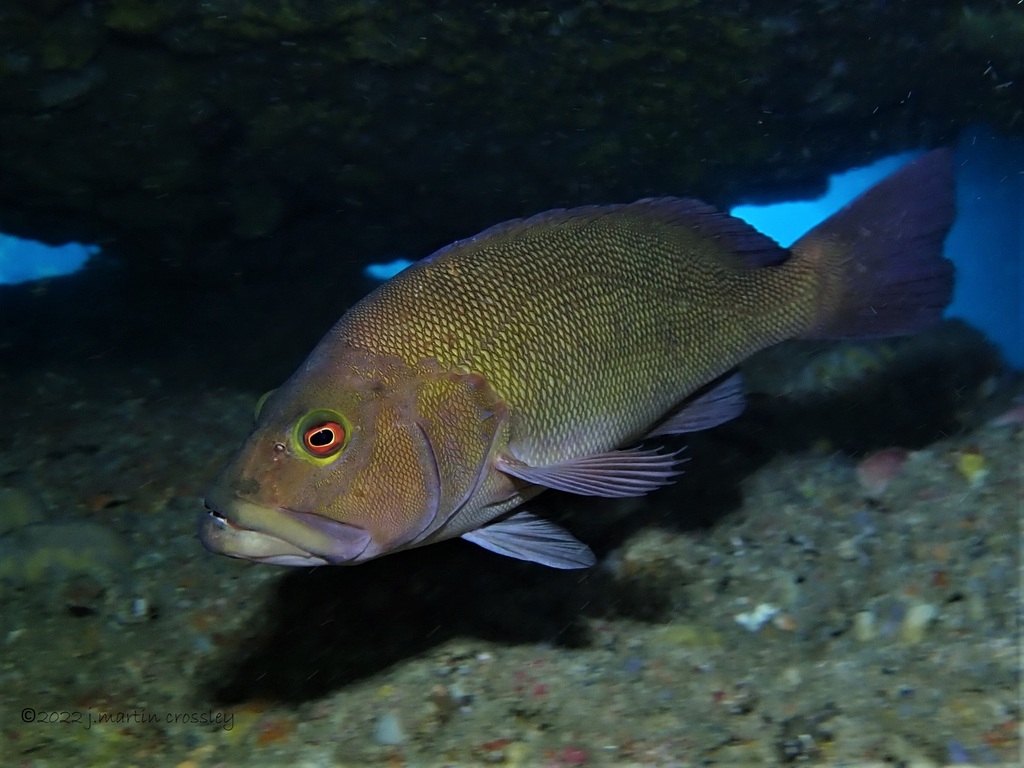
Breaksea cod (Epinephelides armatus) is a fish of the family Anthiadidae. FishBase gives its range as: Eastern Indian Ocean: Endemic to Australia. The scales have pale centres, and body colour is unusually variable, running through yellow, pink, green, brown and grey. It is recorded in temperate water. The recorded maximum is 56 cm TL. IUCN status: Near Threatened (NT). Chinese name: .
Identification
Breaksea cod is named for the large black blotch around the anus, which is why Western Australian anglers also call it black-arse cod. The scales have pale centres, and body colour is unusually variable, running through yellow, pink, green, brown and grey. No other species shares the genus Epinephelides, so there is no close local look-alike. FishBase gives a maximum of 56 cm total length, and the museum figure is around 55 cm. Males grow faster and reach a larger size than females. FishBase gives 30.6 cm as the length at first maturity, while the museum gives maturity at three to four years, around 30 cm for females and 25 cm for males. The two figures agree closely enough to treat 30 cm as the practical mark.
Range and habitat
The species is endemic to Western Australia and lives on coastal reefs from the Recherche Archipelago near Esperance north to Shark Bay. It is usually seen tucked into a cave down to about 35 m, and trawls have taken it in much deeper water to at least 100 m. FishBase records the species as reef-associated and temperate, without a depth range in the capture. The distribution is therefore a long stretch of southern coastline rather than a single reef system. iNaturalist holds 213 observations, chiefly from divers and shore anglers in the south-west.
Age, growth and reproduction
Breaksea cod lives for about 20 years. Unlike many of the cods and gropers, which change sex as they grow, this species appears to be gonochoristic: fish are born male or female and do not change. That matters for management, because a size limit protects one sex differently from the other when the sexes mature at different lengths. The fish is an ambush predator, usually perched on the reef and waiting for a passing fish rather than hunting over open ground. It is also inquisitive, and divers report it approaching closely to inspect them.
Seasonal window
FishBase records spawning in October through April for fish on the lower west coast at 31–32°S. The record does not identify a peak within that window, so the safe reading is a long warm-season spawning period rather than a short pulse. Water temperature and the arrival of the first strong summer swell are better local cues than a calendar date. Beyond that window the fish remain on the reef and can still be caught; spawning timing affects what the stock is doing, not whether fish are present.
Gear and approach
A 7-foot rod built for 10–20 lb line, a 4000-size reel and 20–30 lb braid with a 30 lb leader is enough, since few fish exceed 55 cm. Soft plastics of 4–6 inches on 1/2–1 oz jig heads, whole small fish and strip baits all work. Fish the lure down against the reef rather than mid-water, and be ready to pull hard on the first run, because a hooked fish will try to get back into the cave. Barotrauma is a real issue when fish are taken from deeper water, so carry a release weight if you intend to let fish go.
Edibility and regulations
The species is caught by recreational anglers, though usually as part of a mixed reef bag rather than as a directed fishery. A 2016 Western Australian review of finfish size limits listed the minimum legal length at 300 mm and proposed abolishing it, on the argument that high post-release mortality from barotrauma limits what a size limit can achieve. That paper is a discussion document, so the current rule should be checked with the state fisheries department before keeping a fish. FishBase records it as Near Threatened, with an assessment date of 30 April 2004. Retention depends on the current size and bag rules; whether a reef may be fished at all can be affected by marine park zoning, which is separate from the fish rules.
Where to look
Work the southern Western Australian coast from Esperance and the Recherche Archipelago through Albany and the Capes to Shark Bay. The best ground is limestone or coral reef with caves and ledges, especially where the reef edge drops away from the surrounding sand. Shallow reef in 10–35 m is the classic range for divers and anglers, while deeper trawl ground to 100 m holds fish that rod-and-line anglers rarely reach. Look for reef structure on the sounder, then fish the sand edge rather than the top of the reef.
Where these facts come from
Check these pages before you rely on a size, range or protection status.
- FishBase — Epinephelides armatus — FishBase · T2
- GBIF — Epinephelides armatus occurrence records — GBIF · T2
- IUCN Red List — Epinephelides armatus — IUCN · T1
- Photo record — iNaturalist — iNaturalist · T3
Fish in the same water
These fish live in the same place.


Guides for this water
Technique, gear and safety guides that fit Breaksea cod.