
Skilfish
A large north Pacific deep-water fish, known in Japan as abura-bozu, roughly oil boss. It reaches 183 cm and 91 kg, lives on rocky ground in deep water, and carries so much fat that the flesh is white with it. Once dismissed as inedible, it is now understood as fatty rather than toxic, with a liver that should not be eaten.
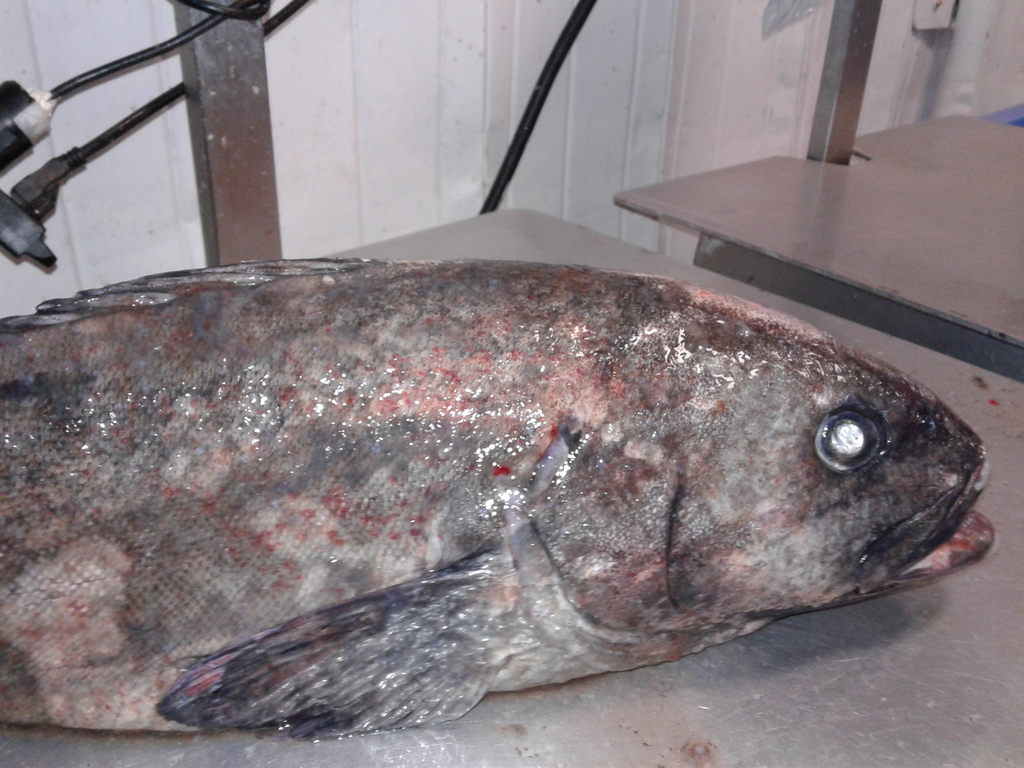
A large north Pacific deep-water fish, known in Japan as abura-bozu, roughly oil boss. It reaches 183 cm and 91 kg, lives on rocky ground in deep water, and carries so much fat that the flesh is white with it. Once dismissed as inedible, it is now understood as fatty rather than toxic, with a liver that should not be eaten.
White spots on a thick-skinned fish sold under the wrong name
Erilepis zonifer is a heavy, elongate fish with a large head and a large mouth. Adults are grey-brown to black-brown with white spots scattered over the back and flanks — the character the Chinese name records — and juveniles are more strongly marked. The skin is thick and the scales are small and hard to scrape off; the dorsal fin runs from spines into soft rays almost without a break. It is not the same family as the sablefish, Anoplopoma fimbria, which is more slender and far less spotted, and which the market also sells under names such as silver cod or oilfish. FishBase gives a maximum of 183 cm total length and 91 kg.
A Pacific range that reaches Japan only at the edges
FishBase records the species across the north Pacific, from Japan and the Bering Sea to Monterey Bay in California. The Japanese account is more specific: the Pacific coast from Hokkaido to Kumano-nada, the Tsugaru Strait, Toyama Bay — where it was newly recorded between 2008 and 2018 — and Kasumi in Hyogo, which is rare on the Japan Sea side. It adds the eastern Okhotsk Sea, eastern Kamchatka, the Aleutians, the Gulf of Alaska down to Monterey and the Emperor Seamounts. The recorded depth band is 0 to 680 m, and the Japanese summary describes rocky ground around 680 m. This is a large benthic predator, so the fishing ground is mid-to-deep rock and steep slope rather than flat sand.
A cold-water fish with no recorded spawning season
The eating season is given as autumn to spring. FishBase labels the species deep-water and places it between 62°N and 36°N, which fits a cold-water fish. Japanese landings are not large, though North Pacific fisheries historically took some volume, and the fish was once better known than the sablefish. Seasonal movement is poorly documented: the Japanese account gives no spawning period at all. That gap is left open here rather than filled with a plausible month. What can be said is that the fish sits in cooler deep water, so summer warming at the surface affects it less than it affects shallow-water species, and the season is set more by access than by a surface-temperature trigger.
Deep boat fishing over rock, not sand
In Japanese waters this is a boat fishery in deep water, worked over mid-depth rock and steep drop-offs. The rig is a heavy branch rig or a boom rig, with squid strips, mackerel chunks or whole sardines as bait. The mouth is large, so bait can be large too, and there is little point in scaling the presentation down. Because the fish may be very big, the rig has to be built to hold a big fish rather than a medium bottom fish. Line is retrieved under control on the way up, since a fast ascent risks a fish swelling from decompression. Large individuals are not lifted and hugged on deck.
Tackle sized for a fish that can reach 90 kg
The boat rod is rated 200 to 300, with an electric reel preferred, PE 8 to 10 main line, 12 to 16 leader, large deep-water hooks or maruseigo 24 to 28, and sinkers of 300 to 500. A large landing net or gaff and thick gloves are part of the kit, not extras. The body carries a lot of mucus over thick skin, so a bare-hand grip slips easily; on deck, a large fish is covered at the head with a wet cloth before anything else is attempted. Deck space should be judged before the fish arrives, because an animal of that size cannot be moved once it is thrashing.
Fat that is glyceride, and a liver that is not food
The flesh is white and extremely fatty, and stays soft even after cooking. The Japanese account says the head, belly and liver are greasy to the point of bitterness, and that a large fish is usually reduced to the two side fillets. Salt-grilling, simmering, frying and hot pot all work in modest quantity. It is often confused with the two wax-ester fish the Japanese sources name, aburasokomutsu and baramutsu, which can cause digestive upset; the account states plainly that this species stores glyceride fat, not wax, and is edible as long as it is not eaten in quantity, while the liver is not food. That distinction is the point of the entry. Japan has no nationwide recreational size or closed season; no published species-level limit was found, and the rules of Hokkaido, Aomori and Chiba remain to be checked, marked deferred. Russian Far East rules do not list the species separately.
Where each fact came from, and the name that misleads
Taxonomy, distribution, depth and length come from FishBase. The Japanese distribution, the nature of the fat, the separation from the wax-ester fish and the eating assessment come from the market encyclopedia; the fishing background comes from the fishing encyclopedia. The Chinese name follows the standard rendering for this family. The older working name used in the project plan is kept only as a warning, because it usually refers to the sablefish and invites exactly the confusion this entry is trying to prevent.
How to catch it
Boat bottom fishing
Fished with the listed approach, matched to the recorded depth and size.
Jigging
Fished with the listed approach, matched to the recorded depth and size.
Where these facts come from
Check these pages before you rely on a size, range or protection status.
- FishBase — Erilepis zonifer — FishBase · T2
- GBIF — Erilepis zonifer occurrence records — GBIF · T2
- IUCN Red List — Erilepis zonifer — IUCN · T1
- Photo record — iNaturalist — iNaturalist · T3
Fish in the same water
These fish live in the same place.

Sablefish
- Family
- Anoplopomatidae
- Depth
- 175–2740 m
- Season
- Jan, Feb, Mar, Apr, May, Dec
Acoupa weakfish
- Family
- Sciaenidae
- Depth
- 1–20 m
- Season
- Jan, Feb, Mar, Apr, May, Jun, Jul, Aug, Sep, Oct, Nov, Dec
American angler
- Family
- Lophiidae
- Depth
- 0–800 m
- Season
- Mar, Apr, May, Jun
Guides for this water
Technique, gear and safety guides that fit Skilfish.