≥38 cm
Australia — Queensland · AU-QLD
Queensland sets a 38 cm minimum size for ruby snapper.
Ruby snapper | Min: 38cm | Limit: 5

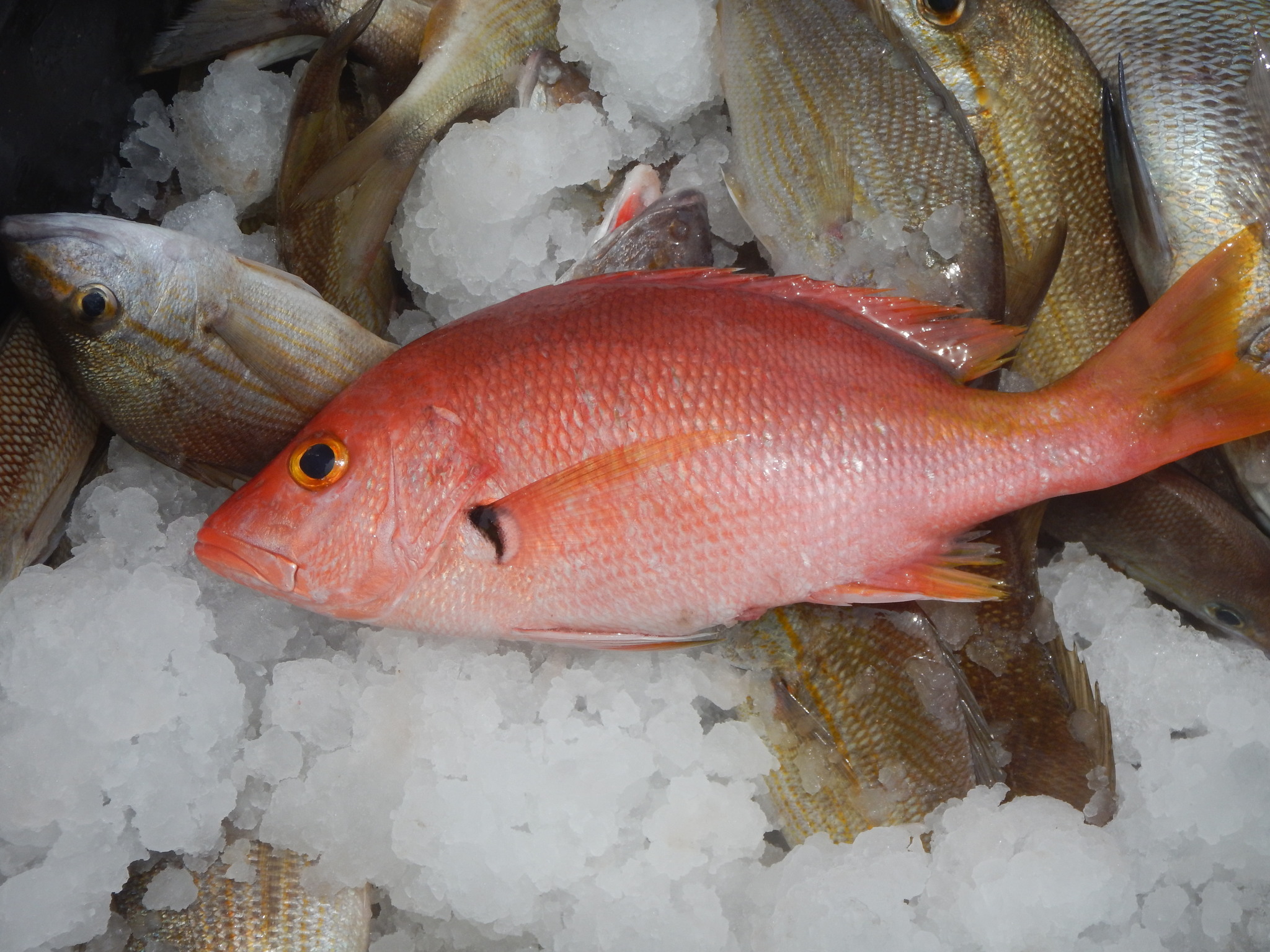
The body is relatively elongate and laterally compressed, pink to red above and white on the lower sides and belly. The nostrils on each side of the snout sit close together, and the lower jaw protrudes slightly. Unlike lehi, the premaxillae are protrusible and the maxilla carries scales. Both jaws have conical teeth with one or several enlarged canines on each side, and the vomer carries a chevron-shaped patch.

The body is relatively elongate and laterally compressed, pink to red above and white on the lower sides and belly. The nostrils on each side of the snout sit close together, and the lower jaw protrudes slightly. Unlike lehi, the premaxillae are protrusible and the maxilla carries scales. Both jaws have conical teeth with one or several enlarged canines on each side, and the vomer carries a chevron-shaped patch. The first gill arch has 17–22 rakers, the dorsal fin is continuous but deeply incised between the spinous and soft portions, and the pectoral fin is long, about 80–90 per cent of head length in fish over 19 cm. The caudal lobes are short for the genus, about 25–30 per cent of standard length. That last point matters, because the name has been misapplied to Etelis coruscans by earlier authors, and the two are not the same fish.
FishBase gives the range as East Africa to the Hawaiian Islands, north to southern Japan and south to Australia, with a record from Three Kings Island, New Zealand. The coordinates run 34°N to 25°S and 35°E to 150°W. Adults are found over rocky bottoms and are benthopelagic, which is why they appear on deep-drop gear rather than on reef flats.
GBIF holds 1,076 records, led by Australia with 228, Mayotte with 206 and the United States with 152, followed by New Caledonia with 117 and the Solomon Islands with 106. The spread across the western and central Pacific matches the range text. iNaturalist has only 11 observations, which is what a 300-metre fish should look like on a photography platform.
No spawning month is recorded, and the depth band makes seasonal water temperature a weak signal. At 200–350 m the annual swing is small, so what changes through the year is the weather above the boat, not the water below it. Plan around swell and wind, and treat the season as open unless a closure is announced.
The one population figure worth carrying is age: maximum recorded age is 35 years. A fish that lives that long is not replaced quickly, which is the practical argument for releasing the largest individuals and keeping only what will be eaten.
The mainstream method is deep bottom fishing with a heavy handline or an electric reel over a 150–350 m slope, baited with whole fish or squid. Deep jigging with a heavy slow-pitch or dedicated deep jig works the same slope when the current allows. Ehu sits deeper than onaga, so the drop is longer and the wait is part of the method; confirm the bottom before lifting, then raise the bait a metre or two so it does not wedge.
Baits are whole fish, squid and cut bait, matching a diet of fishes, larger invertebrates such as squid, shrimps and crabs, and planktonic organisms including pelagic tunicates. Whole baits withstand the descent better than strips.
Line capacity and feedback matter more than brute strength, given a fish that reaches 127 cm with a common length of 65 cm. Use metered braid so the depth is known rather than guessed, and a reel that carries well beyond the deepest water you plan to fish. Keep the boat above the slope so the line hangs as vertically as possible; a diagonal line adds metres and blurs the touch. The sinker should touch bottom without locking into rock, and a single hook or assisted rig is easier to release than a treble.
The retrieve is slow. Keep steady pressure and let the fish vent as it rises; a locked drag on a long drop is how hooks pull. Big fish should be released if there is any doubt about the meat, and the smallest ones always.
FishBase describes it as an important food fish in some areas, marketed fresh or frozen. Hawaii lists ehu in the Deep 7 group, with a non-commercial bag of five fish per person per day across all seven species. During a closure, fishing, possession and sale are prohibited; traps, trawls, bottom longlines and nets are banned; vessels must be registered and marked with a BF number.
In the EEZ a NOAA bottomfish permit is required, the 2025–2027 MHI Deep 7 ACL is 493,000 lb, and the NWHI and Papahānaumokuākea are closed. A non-resident needs an NRMFL to fish recreationally, and anyone selling the catch needs a CML.
The entry uses FishBase for taxonomy, range, meristics, depth, diet and use, GBIF for national records, iNaturalist for the taxon link and 11 observations, and DLNR-DAR, NOAA and the eCFR for the Deep 7 rules. Eleven observations is not a rarity signal at this depth. FishBase gives no maximum weight and no spawning month, though it calls the species an important food fish while the human-use field reads none; that inconsistency is recorded rather than smoothed over. The caudal-lobe measurement is the most useful identification detail, because of the old confusion with E. coruscans. The 90–400 m band is wide, but the usual 200–350 m is the part worth rigging for, and a shallower fish is a bonus.
Fished with the listed approach, matched to the recorded depth and size.
Fished with the listed approach, matched to the recorded depth and size.
These are the published regulations for this fish. Read the number first. The notice below it is the actual regulation.
Queensland sets a 38 cm minimum size for ruby snapper.
Ruby snapper | Min: 38cm | Limit: 5
Queensland sets a possession limit of 5 Ruby snapper.
A possession limit is the total number of fish you may keep at any time, including fish at home or in the freezer; it is not a daily take limit.
Ruby snapper | Min: 38cm | Limit: 5
Every record above names its source and the date it was retrieved. See the regulation register for the full list, or how to read these regulations.
Check these pages before you rely on a size, range or protection status.
These fish live in the same place.
Technique, gear and safety guides that fit Ruby snapper.