
Tope shark
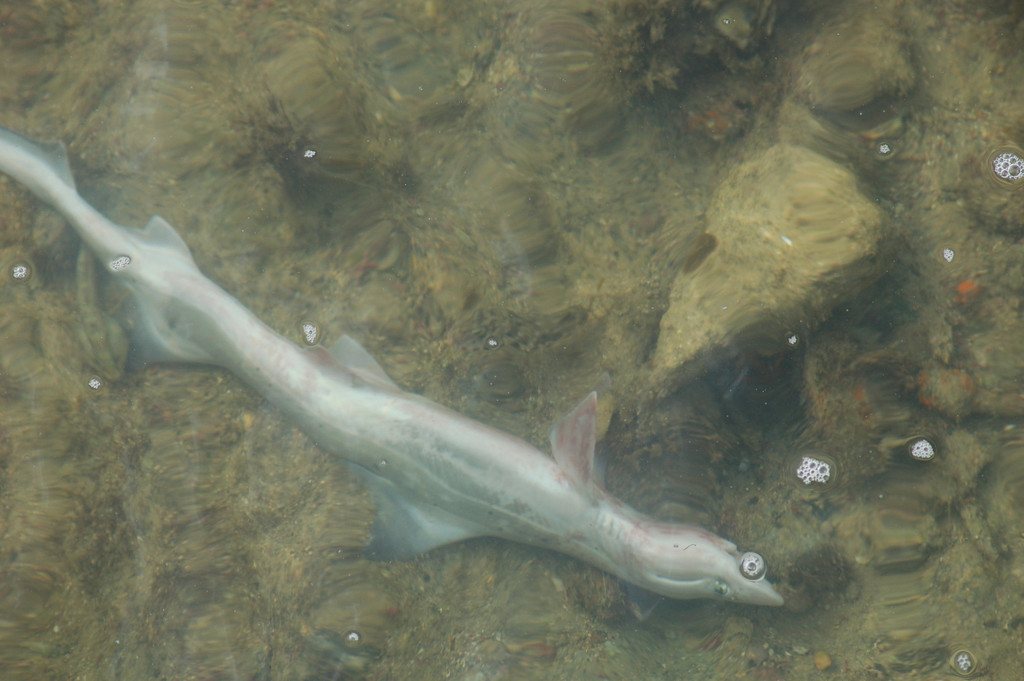
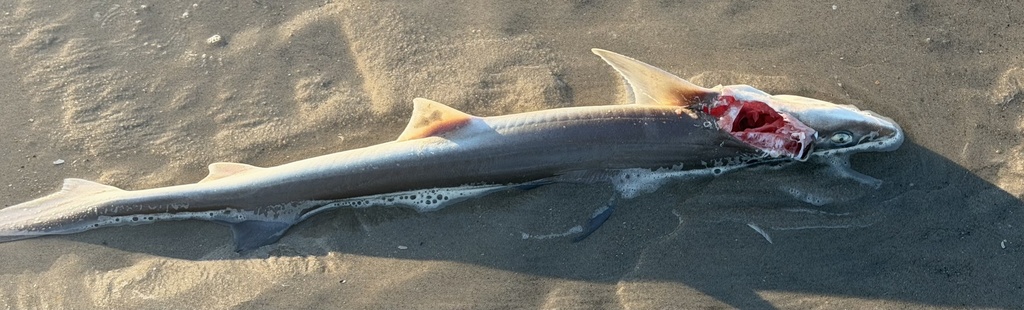
Tope shark is a slim, wide-ranging houndshark of cold to warm temperate seas, the fish British and German anglers simply call tope. It can be met from the surface down to 1,100 m. Fish reach 193 cm TL and 44.7 kg and take a mixed diet of fish, crustaceans, molluscs, worms and echinoderms. The season runs January and December, and a maximum age of 55 years marks it as a slow-growing shark.

Tope shark (Galeorhinus galeus) is a fish of the family Triakidae. FishBase gives its range as: World-wide in cold to warm temperate waters. It is recorded from 0 to 1100 m, in subtropical water. The recorded maxima are 193 cm TL, 44.7 kg, 55 years. Diet includes crustaceans, fishes, molluscs, worms and echinoderms. IUCN status: Critically Endangered (CR). Chinese name: .
Two ledgers for one shark
The tope appears in two kinds of record, and they rarely sit on the same page. In the market ledger it is a highly commercial species, taken for meat, for liver squalene, for fins and for fishmeal. In the conservation ledger it is Critically Endangered, assessed on 14 February 2020, and listed on CMS Appendix II. Both entries describe the same animal, and neither cancels the other.
That split is the reason this article does not start with size or depth. A fisherman who knows only the market side will treat a 160 cm common-length shark as a routine catch. A reader who knows only the CR side will wonder how a fish can be both highly commercial and critically endangered. The answer is that the two ledgers measure different things: one measures what is landed, the other measures what remains.
What the market takes
FishBase records the uses in a short list: human consumption, liver for squalene oil, fins for soup, and fishmeal. The fish is marketed fresh, dried-salted and frozen. FishBase puts the heaviest published specimen at 44.7 kg, the ordinary shark at 160 cm TL, and the sex-specific ceilings at 193 cm TL for males and 195 cm TL for females.
Those numbers describe a shark that is large enough to be worth filleting and small enough to be handled on a small boat. The 44.7 kg figure belongs to a large specimen, not to the common 160 cm fish; no weight is attached to the 160 cm animal. The commercial value is not only in the meat. Squalene from the liver and fins for soup are separate products from the same carcass, which is why a market entry can survive even when the meat price is low.
What the water holds
The maturity figure is the number that changes the picture: Lm 144.1 cm, with a range of 120–185 cm. A 160 cm common-length shark is close to the middle of that maturity range. The maximum reported age is 55 years. No growth curve is printed, but the numbers are enough to show that a fish at the common length is not a young recruit.
Females reach 195 cm and males 193 cm. The two maxima are close, and the maturity range is wide, which is consistent with the page's note that there is pronounced partial segregation by size and sex in some areas. Landing only big females means the gear is selecting one slice of the population, not sampling the whole of it.
A shelf shark under tuna longlines
The habitat sentence is mainly demersal on continental and insular shelves, and also on the upper slopes, from near shore to 550 m. The same paragraph then says the species has been shown to be pelagic in the open ocean: it is frequently caught on floating tuna longlines over deep water, and many New Zealand-tagged specimens have been recaptured in Australia.
That is not a contradiction; it is a shark that uses two layers. The environment line gives 0–1,100 m, usually 2–471 m, and the biology text gives the 550 m shelf-and-slope figure. The 1,100 m maximum is the outer record; the 550 m sentence is the working habitat. The longline note is the part that matters for a boat fishing deep water with a pelagic set: the same species can appear on a shelf bottom rig and on a surface line.
105,620 records and 58 countries
The FishBase country table has 58 native entries, from Iceland and Norway to Chile, New Zealand and South Africa. At the 2026-11-08 query, GBIF returned 105,620 present records, with the United States at 71,936, New Zealand at 13,224, Australia at 10,990, Great Britain at 2,812, Argentina at 1,559, France at 1,267, Ireland at 947 and the Netherlands at 497. iNaturalist holds 655 observations.
A 71,936 figure mostly reflects how much North American longline and trawl work gets reported; New Zealand and Australia also run long-term tagging and observer programmes. It says nothing about how many tope swim off either coast, and nothing about abundance relative to Chile or South Africa.
One spawning row, two months
The spawning table has a single row: Australia, southern waters, January and December. Reproduction is ovoviviparous. No other spawning locality or month appears in the table.
One row is not a global season. January and December are southern-hemisphere summer months, and the row is tagged to southern Australia, not to the whole range. A reader in the North Atlantic cannot move that window across the equator and call it a breeding season. The honest use of the row is local: if the boat is in southern Australian waters in January or December, the source has a record; elsewhere, it does not.
CR, Appendix II, and a highly commercial flag
The IUCN category is Critically Endangered, dated 14 February 2020. CMS Appendix II applies; CITES is Not Evaluated. The fishery is highly commercial, and the species is also a gamefish and a public-aquarium animal. The page calls it harmless to humans.
Critically Endangered is a threatened category, and it sits next to a "highly commercial" flag without any note of a recovery plan. That combination is the article's central tension. The page lists CMS Appendix II but does not translate it into a bag limit. Nothing in the page sets a minimum length or a retention limit, and a CR listing does not by itself close a recreational fishery. The reader has to go to the national rule for the boat's flag state.
Which name goes on the label
The page's English title is Tope, and the alias table adds school shark and soupfin shark. The aliases are regional; the binomial is not. A label written in one country's market does not guarantee the same species in another country's market, which is why the scientific name is the only label that survives the crossing.
WoRMS lists Galeorhinus zyopterus, Galeorhinus australis, Galeorhinus chilensis and Galeus canis as unaccepted names of the same shark. That list matters for searches: a paper, landing sheet or regulation filed under one of those binomials describes this species, not a second shark. For a fishery with three common names and several older scientific names, the synonym list is what prevents a false split.
Where these facts come from
Check these pages before you rely on a size, range or protection status.
- FishBase — Galeorhinus galeus — FishBase · T2
- GBIF — Galeorhinus galeus occurrence records — GBIF · T2
- IUCN Red List — Galeorhinus galeus — IUCN · T1
- Photo record — iNaturalist — iNaturalist · T3
Fish in the same water
These fish live in the same place.
Guides for this water
Technique, gear and safety guides that fit Tope shark.