
Blackspotted smooth-hound
A small shark that is presumably viviparous and matures late: females reach about 95 cm before they breed. The blackspotted smooth-hound usually arrives as bycatch on inshore bottom ground, and whether it goes back is not about one meal but about the next generation.

A small shark that is presumably viviparous and matures late: females reach about 95 cm before they breed. The blackspotted smooth-hound usually arrives as bycatch on inshore bottom ground, and whether it goes back is not about one meal but about the next generation.
A plain shark with black spots and pavement teeth
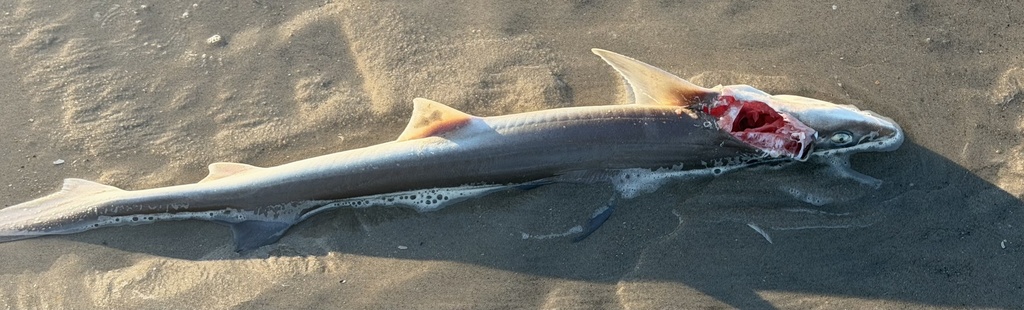
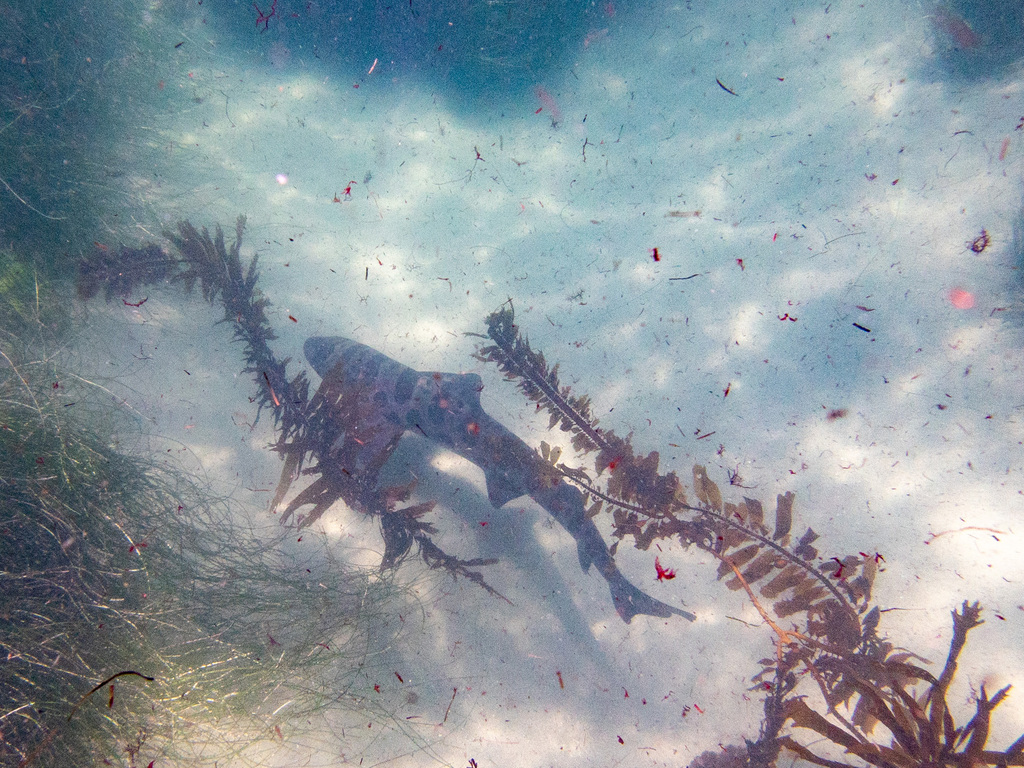
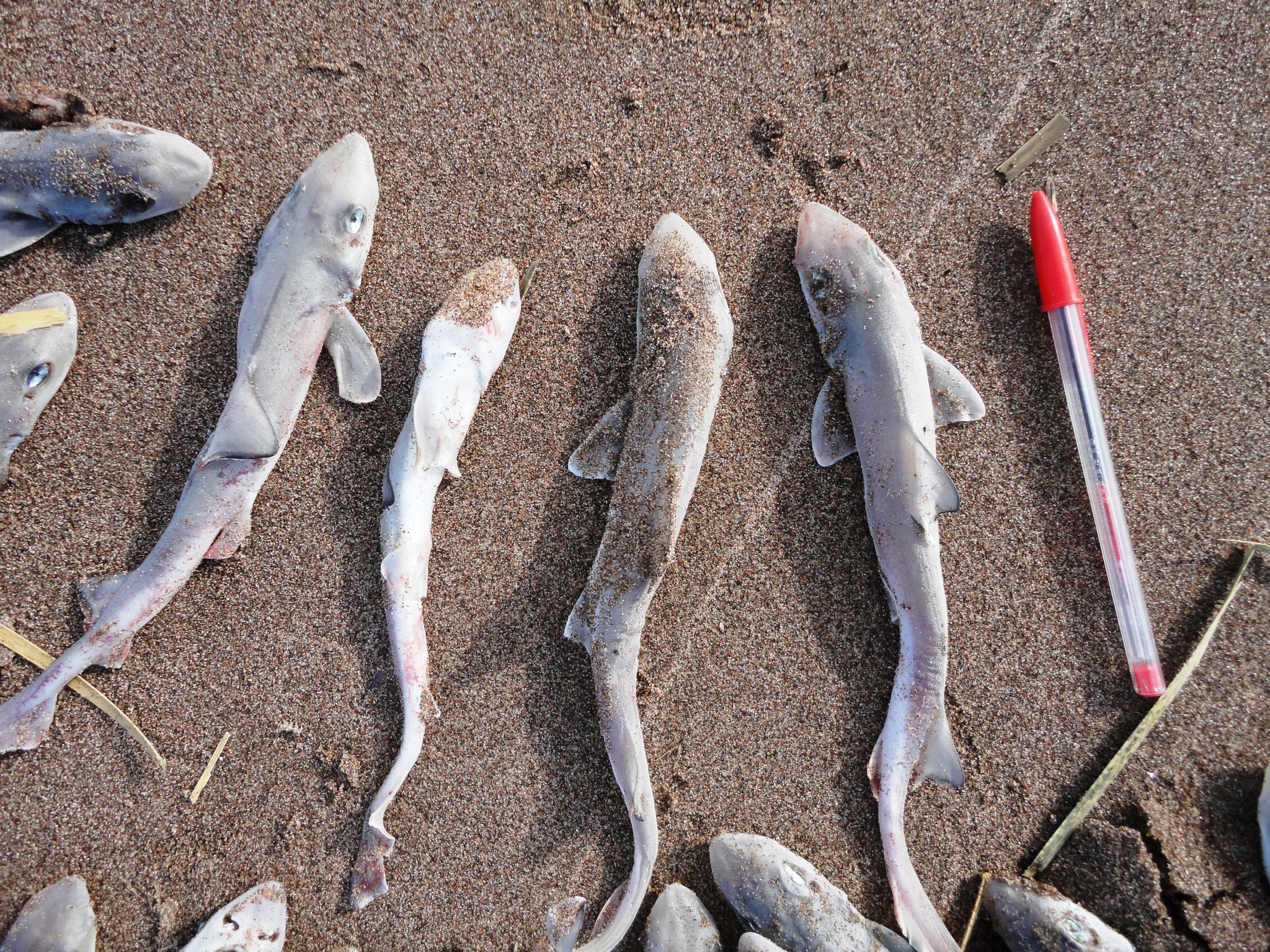
The body is slender, the head flattened, the snout blunt and rounded. There are two dorsal fins, the first starting behind the pectoral base and the second close to the tail. The back is grey-brown with fine dark spots scattered over the flanks and dorsum, the belly paler, and the teeth are small, blunt and paved rather than blade-like. Mustelus mustelus carries fewer, less obvious spots and grows larger; Mustelus asterias differs in spotting and build, and the 80 cm Croatian entry refers to that species, not this one. At the boat, check the teeth, then the spotting, and use body size only as a secondary clue.
Inshore shelf ground, confused with its relatives
FishBase records the species from the Mediterranean to Western Sahara as an inshore continental-shelf shark. It is demersal over sand, mud and mixed ground, recorded from the surface to 250 m, a range taken from the species description because FishBase has no depth field for it. It has long been confused with M. mustelus and M. mediterraneus, and part of the historical data sits under other names, so the range map deserves caution. The ground worth fishing is the inshore sand-mud platform, bay floor and the outside of an estuary, where crustaceans concentrate and match a diet described as probably crustacean-based.
Late maturity and no published pupping season
FishBase says only that the species is presumably viviparous, with no gestation, pupping season or litter size, and gives maturity at about 95 cm, range 60 to 100 cm. Those gaps force a conservative seasonal section: warm spring water brings fish into shallow inshore ground, autumn sends them deeper, and catches follow temperature and prey rather than a calendar. There is no monthly catch data and no known pupping ground. In practice, night sessions after several warm, settled days meet more fish, but that is experience, not a measured pattern.
Bottom baits and a wire trace
From shore, long casts with a running lead on the edge of a sand-mud platform are the standard approach; from a boat, fish the bottom or drift slowly with the bait close to the ground. Crab, prawn and squid fit a crustacean-based diet better than plain fish, though fish bait still takes fish. Use a circle hook so release is quick, and add either a short wire trace or a heavy fluorocarbon leader to cope with pavement teeth. Do not rush the fish to the surface: a shark twists and loads the line, and a hard pull breaks it. If you do not intend to keep it, cutting the line at the water is the fastest handling.
Medium-heavy gear sized for a shark
The usual outfit is an 8 to 9 ft medium-heavy shore rod or a 7 ft boat rod, a 6000 to 8000 spinning reel, 30 to 40 lb braid and a leader of 60 lb fluorocarbon or 40 lb wire, at least an arm's length long. Use a 5/0 to 7/0 circle hook and choose the lead by current. Leave drag in reserve: the first run usually goes sideways along the bottom, and a locked drag pulls the hook. If you measure the fish, support the body with a wet cloth, take total length and return it at once; do not lift it by the tail or press it onto the deck. Short air exposure is the difference between a released shark and a dead one.
Vulnerable, no special size, and no ban to cite
The flesh is firm and suits grilling after bleeding and skinning, but shark meat turns ammoniac quickly if it is not bled and iced at once; no contamination data were available for large individuals. On the rules: at EU level, Regulation (EU) 2019/1241 Annex IX lists no minimum size for smooth-hounds, and Article 2(2) means those MCRS do not automatically bind recreational anglers; Regulation (EC) 1967/2006 Article 17 bans selling recreational catch. Spain requires a regional licence from shore and boat (RD 347/2011) and RD 560/1995 Annex II has no entry for this species. France needs no permit but requires RecFishing registration from 16, and the 2012 Mediterranean arrêté lists no smooth-hounds. Italy requires the annual MASAF communication; Greece has no licence and a 5 kg daily limit; Croatia requires a licence with a 5 kg limit plus one heavier fish, and its national 80 cm figure belongs to Mustelus asterias, not this species. Turkey's 2024/21 table was not retrieved. The species is assessed Vulnerable, so release is the default. No species-specific retention ban was found here, which is not the same as a legal ban, and it does not make retention unrestricted. Nature-conservation law in some range states was not verified; check current notices before you go.
What the record says and what it does not
The 190 cm maximum total length, 120 cm common length, 95 cm maturity and the Vulnerable assessment of 2020 come from FishBase. The depth field is missing, so the 0 to 250 m figure comes from the species description FishBase reproduces. The English Wikipedia summary on the same page gives 1.5 m, which conflicts with the 190 cm field; this entry follows the field and logs the difference. Reproduction is recorded only as presumably viviparous, with gestation and pupping grounds unknown.
How to catch it
Shore casting
Fished with the listed approach, matched to the recorded depth and size.
Night fishing
Fished with the listed approach, matched to the recorded depth and size.
Where these facts come from
Check these pages before you rely on a size, range or protection status.
- FishBase — Mustelus punctulatus — FishBase · T2
- GBIF — Mustelus punctulatus occurrence records — GBIF · T2
- IUCN Red List — Mustelus punctulatus — IUCN · T1
- Photo record — iNaturalist — iNaturalist · T3
Fish in the same water
These fish live in the same place.
Guides for this water
Technique, gear and safety guides that fit Blackspotted smooth-hound.