
Blackmouth catshark
The blackmouth catshark is a small deep-slope shark in the family Pentanchidae, ranging through the Northeast Atlantic from the Faroe Islands and Trondheim south to Senegal and into the Mediterranean. Its depth record spans 55 to 1873 metres, though it is usually taken between 150 and 1200, which places most of the population beyond ordinary recreational range. Only a minor commercial fishery is recorded and there is no gamefish tag, so it is largely a bycatch and observation species.
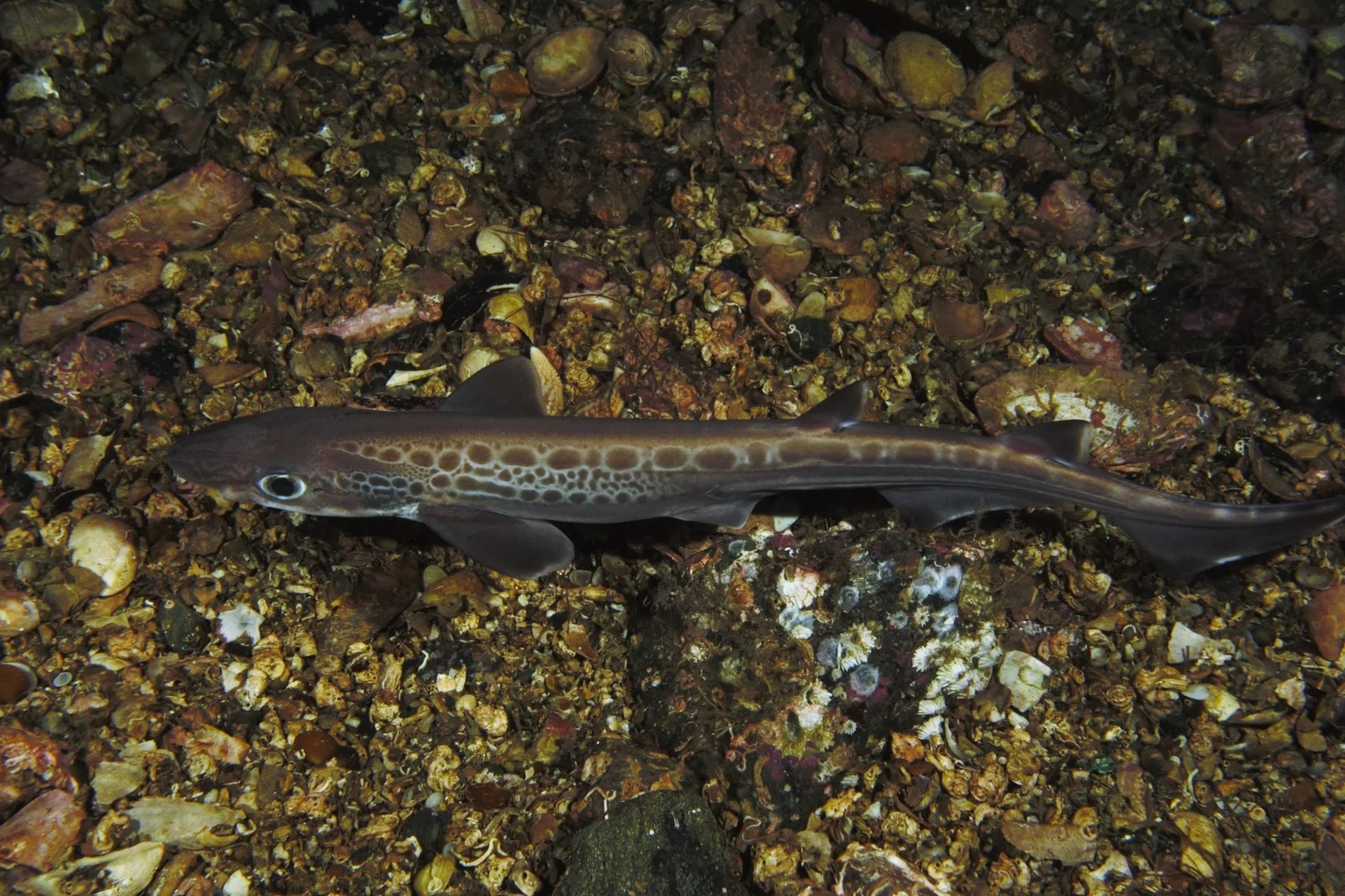
The blackmouth catshark is a small deep-slope shark in the family Pentanchidae, ranging through the Northeast Atlantic from the Faroe Islands and Trondheim south to Senegal and into the Mediterranean. Its depth record spans 55 to 1873 metres, though it is usually taken between 150 and 1200, which places most of the population beyond ordinary recreational range. Only a minor commercial fishery is recorded and there is no gamefish tag, so it is largely a bycatch and observation species. Adults reach about 75 cm and 1.4 kg, and the species is listed as Least Concern.
Identification
Fin counts, vertebrae, body shape and cross-section are all absent from the capture for this species. The page has to be built from lengths, a name and a description. Maximum length is 75.0 cm total length for males, 90.0 cm for females and a common length of 50.0 cm; maximum weight is 1.4 kg, and first maturity is 64.7 cm with a range opening at 56 cm. The male maximum and the maturity figure sit about ten centimetres apart, so a full-grown male has a very short adult window by length. The female figure is larger than the male maximum, which may be dimorphism or may be two records from different samples; the capture does not say.
Wikipedia supplies the field marks: a black interior to the mouth, pale-edged brownish saddles and blotches along the back and tail, and a saw-toothed crest of enlarged denticles. The common name comes from the first of those. English entries divide between blackmouth catshark (FAO and iNaturalist), black-mouthed dogfish (Britain, the Azores, Isle of Man), blackmouth cat shark (South Africa) and blackmouthed dogfish (Spain); Chinese gives and Japanese Macke.
Habitat and distribution
Depth is 55–1873 m, usually 150–1200 m. Wikipedia puts the species at 150–1400 m, which agrees on the usual band and contradicts the extreme top: the 55 m record is either exceptional or outside the source Wikipedia used. The range runs from the Faeroe Islands and Trondheim south to Senegal, plus the Mediterranean; Wikipedia extends the northern end to Iceland. Both are plausible for a slope shark, and the record does not resolve which northern limit is current.
The family is Pentanchidae in FishBase and in the Wikipedia article, while the iNaturalist summary text still says Scyliorhinidae. That is a legacy classification carried in a summary, not a second identification. The habitat keyword is open-water; Wikipedia places the fish on or near muddy bottoms, so the two descriptions are looking at different parts of the same slope.
The country table holds 40 native entries and no introduced ones. GBIF carries nine distribution rows — three without a country, Sweden 2, Denmark 1, Greece 1, Israel 1, Norway 1 — and iNaturalist holds 87 observations. For a shark recorded from forty countries, those numbers are close to empty, which fits an animal taken mostly as deep-trawl bycatch and rarely photographed.
Season and fishing approach
There are no spawning rows at all. The only reproductive figure is the 64.7 cm maturity length. A usual depth of 150–1200 m is beyond most recreational gear, so an angler meets this fish as an accident at the deep end of a boat drift rather than as a target. The 55 m top is within reach, but it is the outlier of the record, not the address.
The fisheries entry is minor commercial, and threat to humans is Harmless. Neither adds a method: there is no gamefish tick and no technique in the capture.
Edibility and regulations
Least Concern, assessed 31 August 2020. CITES and CMS are both Not Evaluated, which is a statement about listing, not about status. The human-use line is minor commercial only; there is no gamefish entry, no aquaculture entry and no public-aquarium entry.
No regulation is carried in the record. For a deepwater shark taken as bycatch, retention and discard rules are set nationally or regionally and will not appear here; check them before keeping one. The page can say what the fish is and where it lives, and very little about what to do with it.
Where these facts come from
Check these pages before you rely on a size, range or protection status.
- FishBase — Galeus melastomus — FishBase · T2
- GBIF — Galeus melastomus occurrence records — GBIF · T2
- IUCN Red List — Galeus melastomus — IUCN · T1
- Photo record — iNaturalist — iNaturalist · T3
Fish in the same water
These fish live in the same place.

Acoupa weakfish
- Family
- Sciaenidae
- Depth
- 1–20 m
- Season
- Jan, Feb, Mar, Apr, May, Jun, Jul, Aug, Sep, Oct, Nov, Dec

American angler
- Family
- Lophiidae
- Depth
- 0–800 m
- Season
- Mar, Apr, May, Jun

American eel
- Family
- Anguillidae
- Depth
- 0–464 m
- Season
- Jan, Feb, Mar, May, Jun, Jul
Guides for this water
Technique, gear and safety guides that fit Blackmouth catshark.