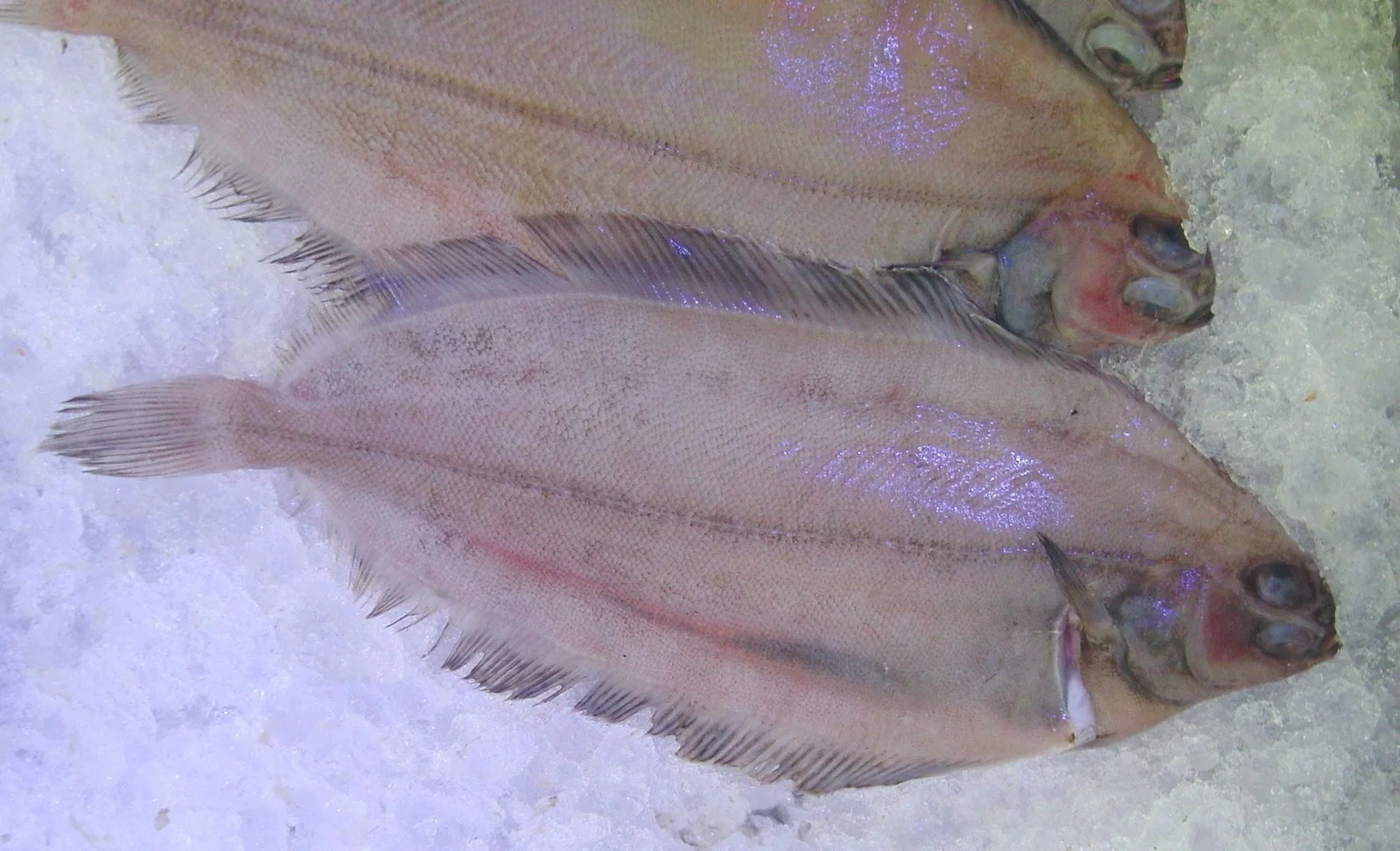
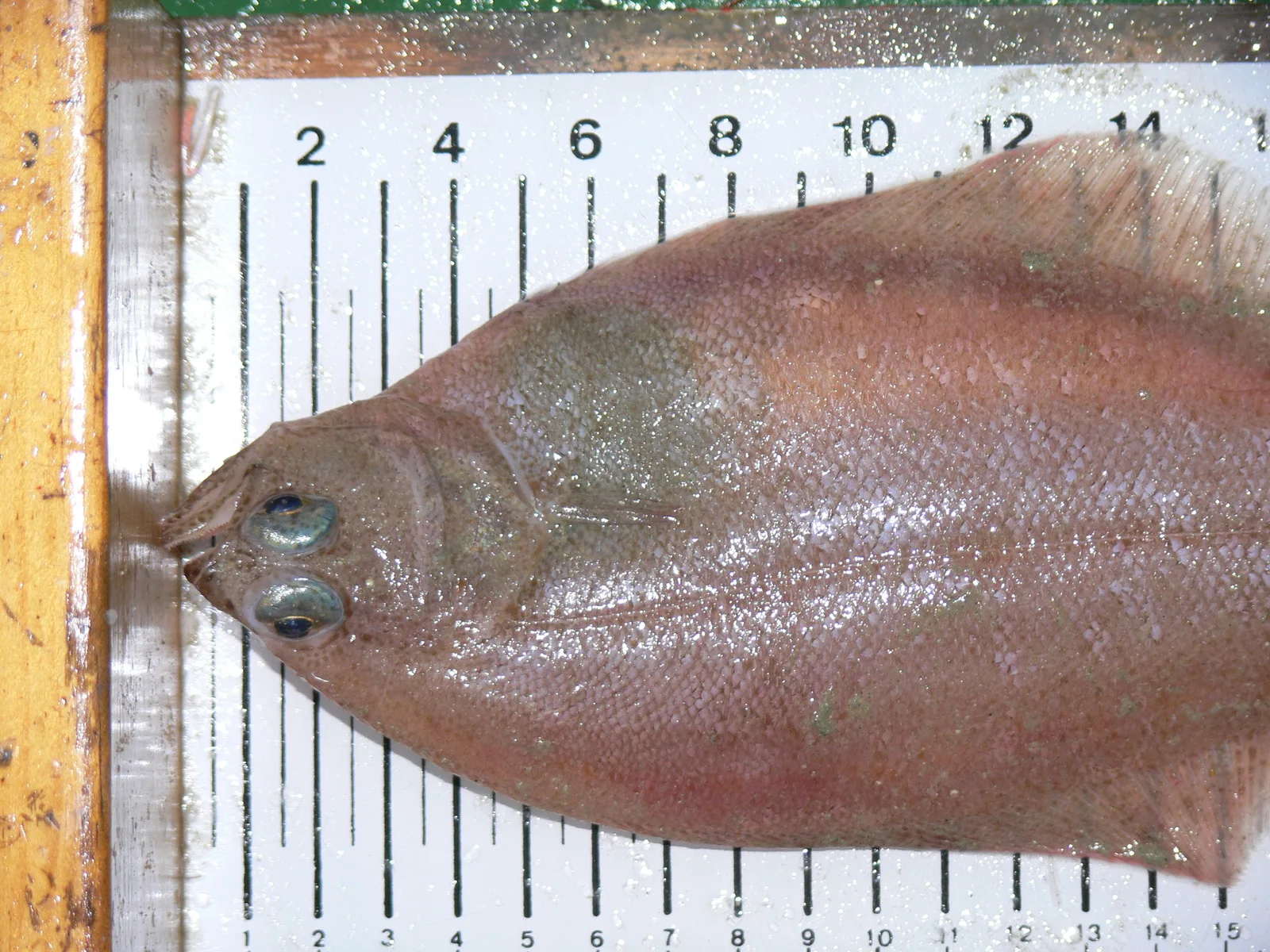
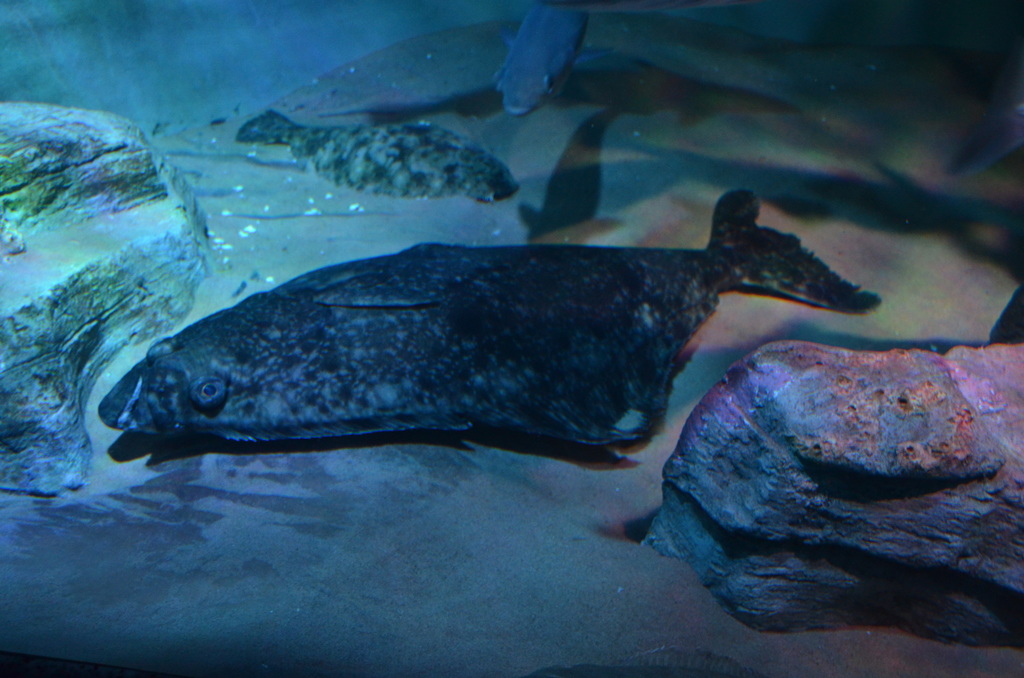
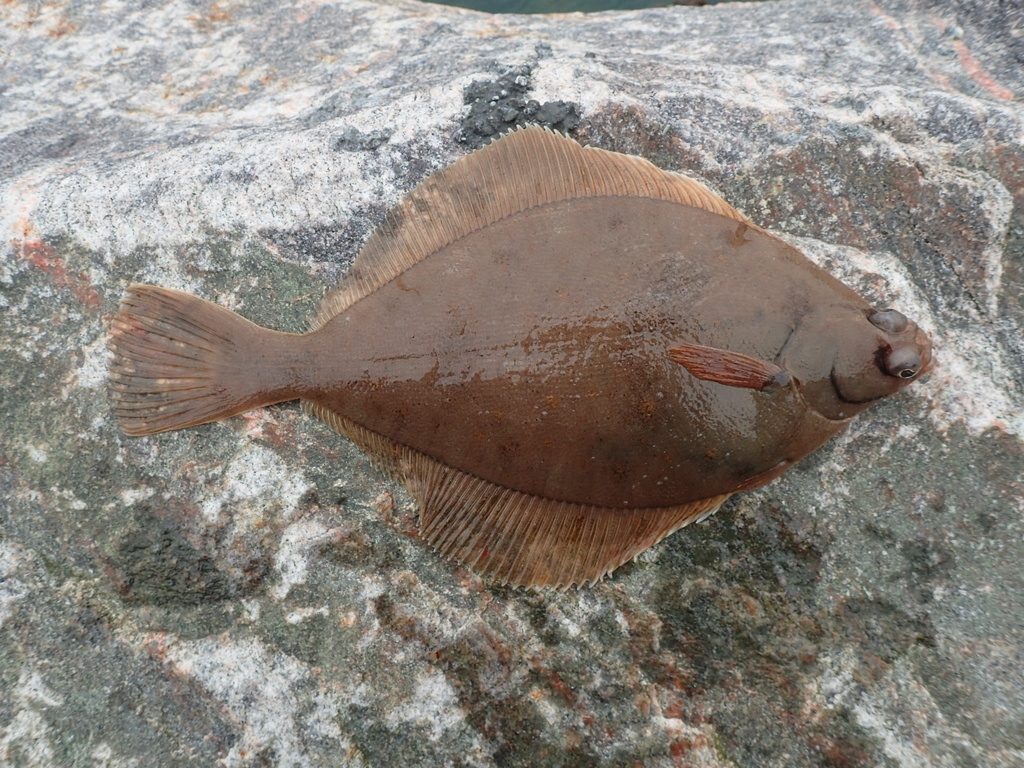
Witch flounder is a slender, soft-bottom flatfish of the family Pleuronectidae, found on both shores of the North Atlantic and into the adjacent Arctic. It feeds over mud between roughly 18 and 1570 m, with a usual band of 45–366 m in cold water of 2–6 °C, and grows to about 60 cm and 2.5 kg. The species is assessed Vulnerable and is landed commercially as a food fish. No gamefish use is recorded, and its muddy, often deep habitat makes it a boat or net fishery rather than an angling target.
Names for a fish sold as sole
FishBase gives Witch flounder as the principal English name, then Craig fluke, Gray sole, Grey sole, Grey-sole, Whitch and Witch. Wikipedia's opening sentence adds pole flounder and Torbay sole to the same list. The trade names are the interesting part: two of them call the fish a sole, and a third names a Devon bay. Chinese is , with the simplified as a variant.
The scientific name describes the head. The lineage note in the capture glosses Glyptocephalus as Greek glyptes, a carver, plus kephale, a head. reads as "beautiful-head flounder", which is almost the opposite compliment. Latin says the head looks carved; Chinese says it looks fine. Both are naming the same feature, and neither is a description of the whole fish.
A page with this many English names needs to fix one for its title and list the rest. Witch flounder is the FishBase principal and the iNaturalist preferred name, so it serves as the heading; the soles and the flukes belong in the alias list, where a reader arriving from a fishmonger's slab will find them.
A carved head and long fins
The morphology block is unusually full for this dataset. Dorsal soft rays 95–120, anal soft rays 85–102, anal spines zero, body short and/or deep, cross-section compressed. Dorsal spines and vertebrae are blank. The counts describe a flatfish whose dorsal and anal fins run most of the body length: nearly a hundred rays on each, no spiny section, and a deep, thin body.
Those numbers are also the only key the page has. Family Pleuronectidae, order Pleuronectiformes; the capture carries no eye-side note and no photograph description, so the fin counts do the separating work that a key would normally do. A count of 95–120 dorsal rays is high even among flatfishes, and a reader with a specimen can use it.
The empty fields matter as much as the filled ones. Without vertebrae, the page cannot compare the witch with its congeners on the one count that often settles flatfish identifications. The block is better than most in this batch and still not a key.
Two to six degrees
The environment line is one of the few in this dataset with a real temperature band: marine, demersal, oceanodromous, depth 18–1570 m with a usual 45–366 m, 2–6 °C, temperate, 70°N–36°N and 79°W–26°E. Two to six degrees is cold water, and narrow. It explains the latitude range better than any other field: a fish with that thermal window cannot live far south of 36°N in the western Atlantic.
The depth figures need the same reading as on other pages. Eighteen metres is shallow; 1570 is abyssal by angling standards. The usual band, 45–366 m, is the operative one, and its lower end is already beyond most recreational gear.
Habitat keywords are muddy and deep, and the diet is crustaceans, fishes and worms. Mud is the important word: this is a soft-bottom flatfish, not a fish of rock or weed. Three prey groups suggest a generalist feeder on the bottom, though the capture does not say how the diet shifts with size.
Both shores, one short sentence
FishBase's geographical text is a single line: the North Atlantic and adjacent Arctic Ocean. No coastlines, no seas, no subspecies. The seventeen country rows carry the geography instead, all native, from Canada and Greenland through Iceland and the Faroes to Spain and the contiguous United States. None is introduced.
Wikipedia supplies what the database sentence leaves out: the species occurs on both sides of the North Atlantic, on muddy beds, in quite deep water, and has some importance in northern European fisheries as a food fish. That is not a range description either, but it adds the bottom type and the human use, which together explain why the country list looks the way it does.
GBIF returns 21 rows: nine without a country code, Belgium 3, Sweden 3, France 2, and Denmark, the United Kingdom, Ireland and Norway one each. Sixteen rows mark the taxon present, two native and two doubtful, with one row carrying no status. iNaturalist holds 70 observations — a low count for a fish that is commercially landed.
Seven months of spawning
Two rows are carried. Eastern Atlantic runs May–September; north-east Atlantic runs March–September. The second row is the wider one and contains the first, so the capture describes a spring-to-autumn spawn with the north-east starting two months earlier.
That is a long season by the standards of this dataset, where several species have a single narrow month block. It also spans the whole temperature window recorded for the species, but the capture gives no thermal trigger, so the length of the season cannot be tied to the 2–6 °C band.
Wikipedia adds no spawning information. The page can say when and where the rows place spawning, and cannot say what starts or ends it.
Sixty centimetres and twenty-five years
The size line gives a maximum of 60.0 cm SL for a male or unsexed fish, a length at first maturity of 30.4 cm. Maximum published weight is 2.5 kg, and the maximum reported age is 25 years. No common length is recorded. Every length in the table is standard length, so the figures are internally consistent, and the page should not convert them to total length on its own authority.
Maturity falls at roughly half the maximum, which puts most adults inside the breeding population and makes the largest fish the oldest. Twenty-five years is a long life, and the combination of a half-maximum maturity and a long lifespan is the profile of a stock that turns over slowly.
Vulnerable, and fished as food
The IUCN assessment, dated 12 February 2021, places the species in the Vulnerable category. The human-use line is a single flag: commercial, with no gamefish entry. Wikipedia's phrase, "some importance in fisheries as a food fish" in northern Europe, matches the flag without enlarging it.
The record therefore holds a conservation assessment and a commercial fishery in the same bundle and no landing figures to connect them. That is not a contradiction; it is an incomplete file. A reader who wants to know whether the Vulnerable listing changed the fishery will not find the answer here, and the page should say so.
Mud at forty-five metres
The usable picture is compact: a cold-water flatfish of both North Atlantic shores, on mud, usually 45–366 m, spawning from March to September, maturing at 30 cm, living 25 years, assessed Vulnerable and landed commercially.
For an angler, the depth and the bottom are the whole of the practical advice. A fish that usually sits below 45 m over mud is a boat target, and the capture contains no method, bait or regulation for it. It also carries no gamefish flag, which is the record's way of saying that rod-and-line capture is not the use this species is known for. Anyone keeping one should check the local rule first.
Regulations before you keep it
These are the published regulations for this fish. Read the number first. The notice below it is the actual regulation.
Minimum size1
The minimum size for Witch flounder in Spain is ≥28 cm.
| Mendo (Gliptocephalus cynoglossus) | 28 |
Every record above names its source and the date it was retrieved. See the regulation register for the full list, or how to read these regulations.
Where these facts come from
Check these pages before you rely on a size, range or protection status.
-
FishBase — Glyptocephalus cynoglossus
— FishBase · T2
-
GBIF — Glyptocephalus cynoglossus occurrence records
— GBIF · T2
-
IUCN Red List — Glyptocephalus cynoglossus
— IUCN · T1
-
Photo record — iNaturalist
— iNaturalist · T3