
Steller's flounder
A cold-water flounder of the northwest Pacific, fished from Hokkaido and Tohoku and sold in Kanto under another name. It feeds on sandy mud shallower than 100 m, spawns at three different times depending on the sea area, and is valued less for its watery flesh than for its roe in spring.

A cold-water flounder of the northwest Pacific, fished from Hokkaido and Tohoku and sold in Kanto under another name. It feeds on sandy mud shallower than 100 m, spawns at three different times depending on the sea area, and is valued less for its watery flesh than for its roe in spring.
A flounder the market sells under another name
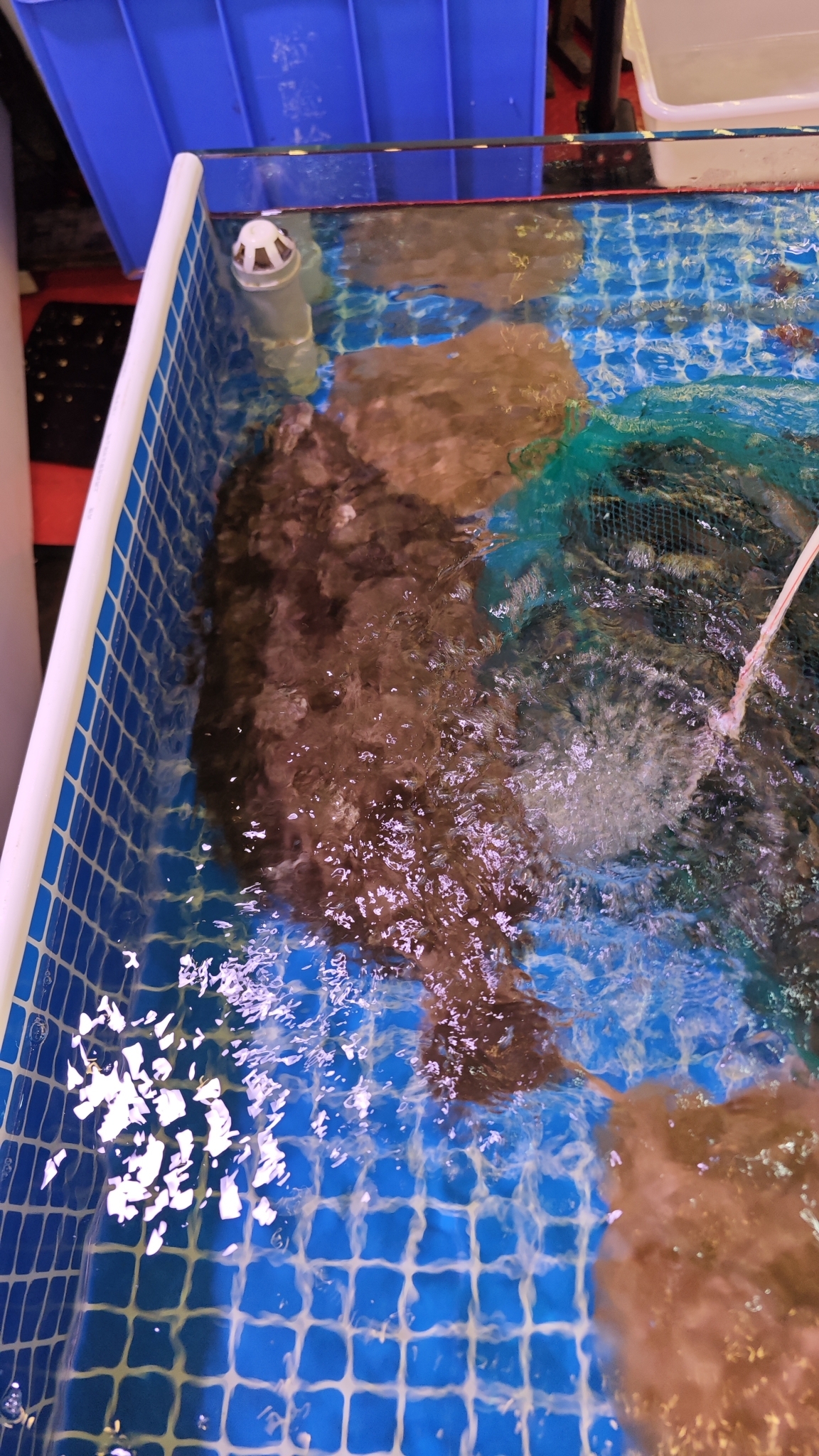
Glyptocephalus stelleri is oval and compressed, with both eyes on the right side, the eyed side grey-brown to black-brown and the blind side white. The scales are small and come away easily, and the lateral line runs almost straight. Against other members of the genus it has a shallower body and a longer head. In colour and scale texture it is close to the flounder sold in Kanto simply as kurogarei, and the market frequently does not separate the two. The Japanese account says outright that almost nobody knows the standard name kurogashira-garei. Confirming the species needs lateral-line scale counts, gill rakers and mouth position; a photograph is not enough.
A depth range that spans shelf and slope
FishBase records it from the north Pacific: the Sea of Japan, the Tatar Strait, the southern Kuril Islands to Kamchatka, and the western Bering Sea. The Japanese account covers all Hokkaido coasts and the Tohoku Pacific coast, and adds the northern east coast of the Korean peninsula through Primorye to southern Sakhalin, the Amur and the Kurils. It puts the fish in sandy mud shallower than 100 m, while FishBase gives 8 to 1600 m, usually 15 to 800 m. The wide band reflects trawl records that reach down the slope. For rod and line, the shallower Japanese figure is the useful one, and it matches what shore and coastal-boat anglers actually reach.
Three spawning seasons for one species
Spawning is not one season but three, and the source lists them by sea area: late February to mid-March in the Mashike district of the Japan Sea, mid-April to mid-May on the Pacific and Okhotsk coasts, and late April to late May in Nemuro Bay. That spread is one species responding to different water temperatures, and merging it into a single national spawning season would erase the useful detail. In the Kanto market the peak arrives from spring into summer, and the Japanese account treats a well-developed roe as the sign of the season. Spring to early summer is therefore both the best eating and the period of heaviest landings. Autumn fish have recovered condition but carry immature roe and are rated lower. The three dates are a temperature record as much as a calendar one, so a trip should be planned around the sea area being fished rather than around the species name alone.
Small hooks on a lead that drags
Shore anglers cast from the beach or breakwater; boat anglers use a small bottom rig. Sandworm, green worm, shrimp and squid strips all work, and the mouth is small enough that hook sizes stay modest. The rig fishes on the bottom with the lead dragging lightly across the sand, because the fish feeds on small benthic animals and takes without commitment. Kanto boats commonly take it alongside the marbled flounder and the slime flounder. The bite reads as a run of light taps; striking at the first one usually misses, and the line should be allowed to keep moving before the rod is lifted.
Sinker shape over sinker weight
A 2.7 to 3.3 m casting rod with a 15 to 25 lead covers the shore; the boat version is a 1.8 to 2.1 m rod with a 30 to 60 lead. Main line is 1.5 to 2.5 nylon or PE 0.8 to 1.2, leader 1 to 1.5, hooks maruseigo 10 to 13. On sand and mud the shape of the sinker matters more than its weight: a flat lead does not bury itself and suits soft ground, while a slim lead in shell beds cuts snagging. The leader can be kept simple, and the hook point should stay exposed so that a fish sucking at the bait meets the point rather than the bend.
Cheap, uniform, and valued for its roe
The flesh is white, translucent and watery, and it loses freshness quickly. Salt-grilling, simmering, frying and drying are the usual treatments, and simmered roe is a Kanto standard. The Japanese account calls it cheaper than the marbled flounder, consistent in size, and one of the flounders most likely to appear in a supermarket or a canteen. Japan has no nationwide recreational minimum size or closed season. No published species-level restriction was found; the prefectural and cooperative rules of Hokkaido, Aomori and Miyagi still need checking and are marked deferred. On the Russian Far East side, table 4 of the basin rules sets a 21 cm recreational minimum for the group of other Far Eastern flounders, and this species falls under that general item rather than a line of its own; the current table governs.
Where each fact came from, and the seasons left apart
Taxonomy, distribution and the wide depth range come from FishBase. The 100 m figure, the three regional spawning periods, the market confusion and the eating assessment come from the market encyclopedia; the fishing and bait detail from the fishing encyclopedia; the 21 cm figure from table 4 of the Far East basin rules. The three spawning periods are listed as three, not averaged into one.
How to catch it
Boat bottom fishing
Fished with the listed approach, matched to the recorded depth and size.
Where these facts come from
Check these pages before you rely on a size, range or protection status.
- FishBase — Glyptocephalus stelleri — FishBase · T2
- GBIF — Glyptocephalus stelleri occurrence records — GBIF · T2
- IUCN Red List — Glyptocephalus stelleri — IUCN · T1
- Photo record — iNaturalist — iNaturalist · T3
Fish in the same water
These fish live in the same place.

Joyner's tonguefish
- Family
- Pleuronectiformes
- Depth
- 10–130 m
Slime flounder
- Family
- Pleuronectiformes
- Depth
- 15–800 m

Acoupa weakfish
- Family
- Sciaenidae
- Depth
- 1–20 m
- Season
- Jan, Feb, Mar, Apr, May, Jun, Jul, Aug, Sep, Oct, Nov, Dec
Guides for this water
Technique, gear and safety guides that fit Steller's flounder.