
Slime flounder
A large, thick-bodied flounder that produces so much mucus that it comes aboard slippery and slack-skinned. It lives on sandy mud deeper than 50 m, grows slowly, and is prized in Kanto and Tohoku from winter to early spring, above all for its ovaries. In western Japan it is little known and cheap.
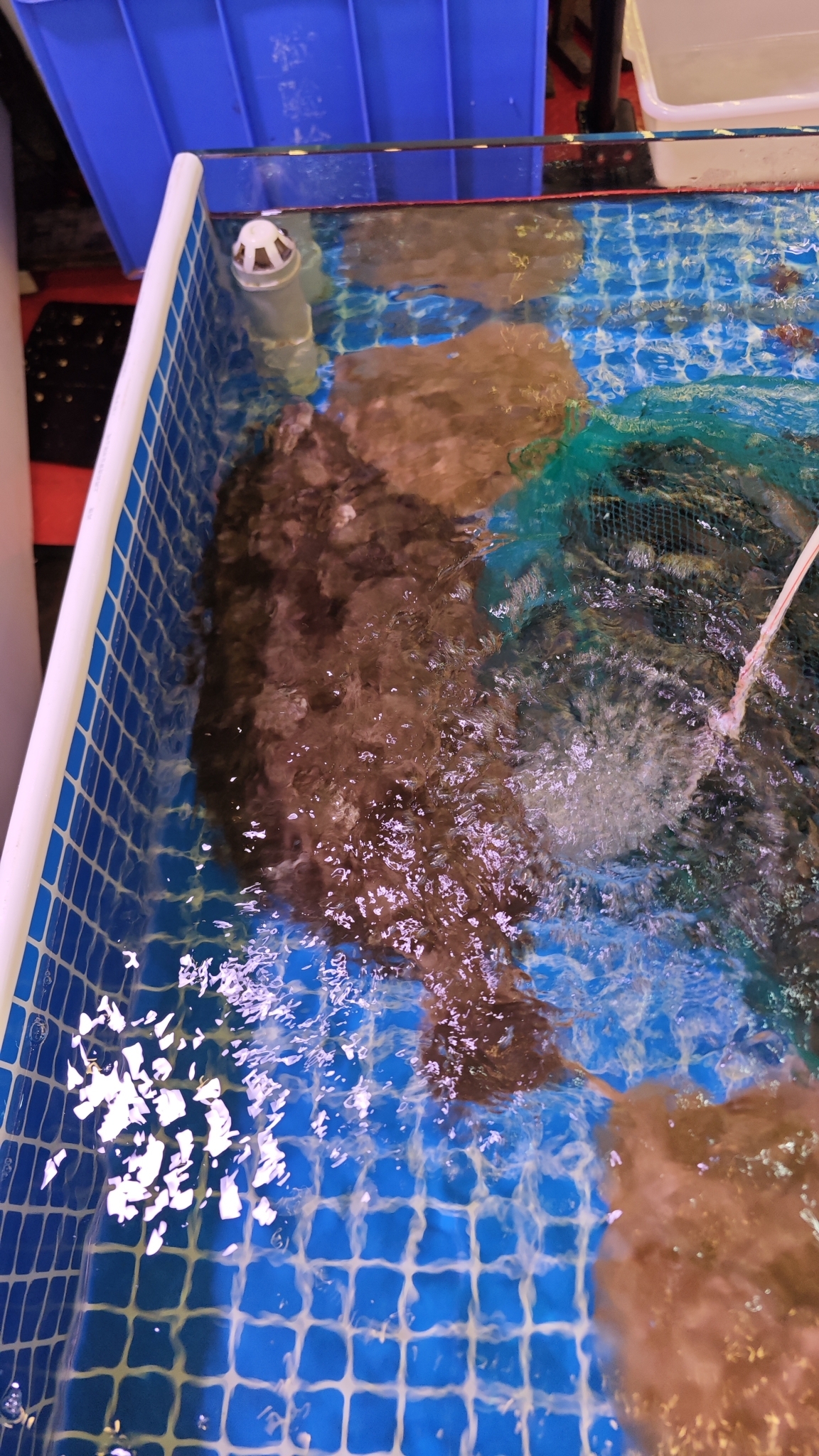
A large, thick-bodied flounder that produces so much mucus that it comes aboard slippery and slack-skinned. It lives on sandy mud deeper than 50 m, grows slowly, and is prized in Kanto and Tohoku from winter to early spring, above all for its ovaries. In western Japan it is little known and cheap.
A flounder that hides under its own slime
Microstomus achne is an oval flounder, slightly short and thick, with both eyes on the right, a small mouth and a short snout. Its most obvious feature is the volume of mucus it produces: the fish comes aboard slippery and slack-skinned, which is where the Japanese name baba, old woman, comes from, and which is also the first thing that confuses a new angler. The scales are extremely fine and hard to scrape clean, and the skin is tough. The dorsal and anal fin rays are unbranched and the caudal fin is rounded. Against the other oil flounders and Steller's flounder it is thicker and slimier; against the stone flounders its mouth is smaller and its body shorter. FishBase gives 60 cm standard length and 1.8 kg, but a 34 cm fish at seven years is closer to the usual large individual, so 60 cm should be read as a rare ceiling.
Two depth ranges with different ceilings
FishBase puts the species in the northwest Pacific, from central Japan northward, with the southern Kurils, Sakhalin, the Sea of Japan, the Yellow Sea, the Bohai Sea and the East China Sea. The Japanese account lists all Hokkaido coasts, the Japan Sea coast from Aomori to Tsushima, the Pacific coast from Aomori to Chiba's Boso Peninsula and Sagami Bay, and Aichi, adding the south and east coasts of Korea, Peter the Great Bay as rare, Sakhalin and the Kurils. The depth figures diverge: FishBase gives 15 to 800 m, usually 20 to 610 m, while the Japanese account gives 50 to 450 m. The upper limits are far apart and both are kept. In practice the fishing ground is sandy mud deeper than 50 m; the shallow inshore is not its main area.
Slow growth, large females, roe that sets the price
There is seasonal movement between the water off Hokkaido and the water off Sanriku, and spawning takes place shallower than 100 m in March and April. Growth is slow and females grow larger than males: 8 to 9 cm at age one, 12 to 15 cm at two, 20 cm at three, 24 cm at four, 25 cm at five, 27 cm at six and 34 cm at seven. The market season is written as summer to winter, but the price peak comes in winter and early spring and falls away from late February into April as the roe swells. An over-developed ovary makes the flesh watery and the flavour thin, so a buyer should avoid the most swollen fish. The best eating and the highest price do not sit in the same week.
Mostly a bycatch, and rigged accordingly
This is not a shore angler's target. Most records are bycatch from rockfish and bottom-fishing trips; the Hitachi Port notes describe it arriving while the rod was set for soi. To fish for it deliberately, take a boat to sandy mud deeper than 50 m and use a branch rig or a boom rig, with squid strips, sandworm or fish strips as bait. The mouth is small and the fish hugs the bottom, so the lead has to press the bait onto the mud and the leader should not be long. It swallows deeply, so the strike waits for the line to move clearly rather than for the first tap.
A long soft leader on soft ground
The boat rod is 1.8 to 2.1 m, rated 30 to 50, with a manual or small electric reel, PE 1 to 2 main line, 2 to 3 leader, and maruseigo 12 to 14 or branch hooks. In deep water with current, the lead goes heavier and the leader shorter. On sand and mud the opposite applies: a longer, softer leader lets the bait lie naturally. Because the mouth is small, an oversized hook tends to catch only the lip, which loses fish at the surface. Sinker shape and leader length do more work here than hook pattern.
The ovaries are the point
Simmering is the standard treatment, and a large female cooked with its ovaries is the most valued form. The ovaries and the milt are rated top class; broth, meunière, wakasa-yaki, salt-grilling and drying are all used. The mucus has to be scraped off before cooking, and the fine scales are hard to remove. After cooking, the flesh tightens moderately and keeps a good fibre, though raw it is not especially savoury. On the Japanese side there is no nationwide recreational minimum size. Whether the prefectural and cooperative rules of Hokkaido, Aomori and Iwate set a species-level limit was not checked one by one here, and is marked deferred. On the Russian Far East side, the basin rules treat other Far Eastern flounders as one group with a 21 cm recreational minimum, and this species is in that group; the measurement runs from the tip of the snout to the base of the middle caudal rays.
Where each fact came from, and the two depth ceilings
Taxonomy, distribution, depth and length come from FishBase. The Japanese distribution, the mucus, spawning, growth, market position and cooking come from the market encyclopedia; the Russian minimum from table 4 of the Far East basin rules, where it sits in a group item rather than a species line. FishBase's 800 m and the Japanese 450 m are listed together, with no single value chosen.
How to catch it
Boat bottom fishing
Fished with the listed approach, matched to the recorded depth and size.
Where these facts come from
Check these pages before you rely on a size, range or protection status.
- FishBase — Microstomus achne — FishBase · T2
- GBIF — Microstomus achne occurrence records — GBIF · T2
- IUCN Red List — Microstomus achne — IUCN · T1
- Photo record — iNaturalist — iNaturalist · T3
Fish in the same water
These fish live in the same place.

Joyner's tonguefish
- Family
- Pleuronectiformes
- Depth
- 10–130 m

Steller's flounder
- Family
- Pleuronectiformes
- Depth
- 8–1600 m

Acoupa weakfish
- Family
- Sciaenidae
- Depth
- 1–20 m
- Season
- Jan, Feb, Mar, Apr, May, Jun, Jul, Aug, Sep, Oct, Nov, Dec
Guides for this water
Technique, gear and safety guides that fit Slime flounder.