
Black goby
The black goby is a large-bodied member of the Gobiidae, growing to 25.3 cm and living about five years. It occurs along the eastern Atlantic from Mauritania to Trondheim and throughout the Mediterranean and Black Sea, over sand, mud, estuaries and seagrass. FishBase puts it at 1–96 m, usually 1–50 m, in water of 8–24 °C.
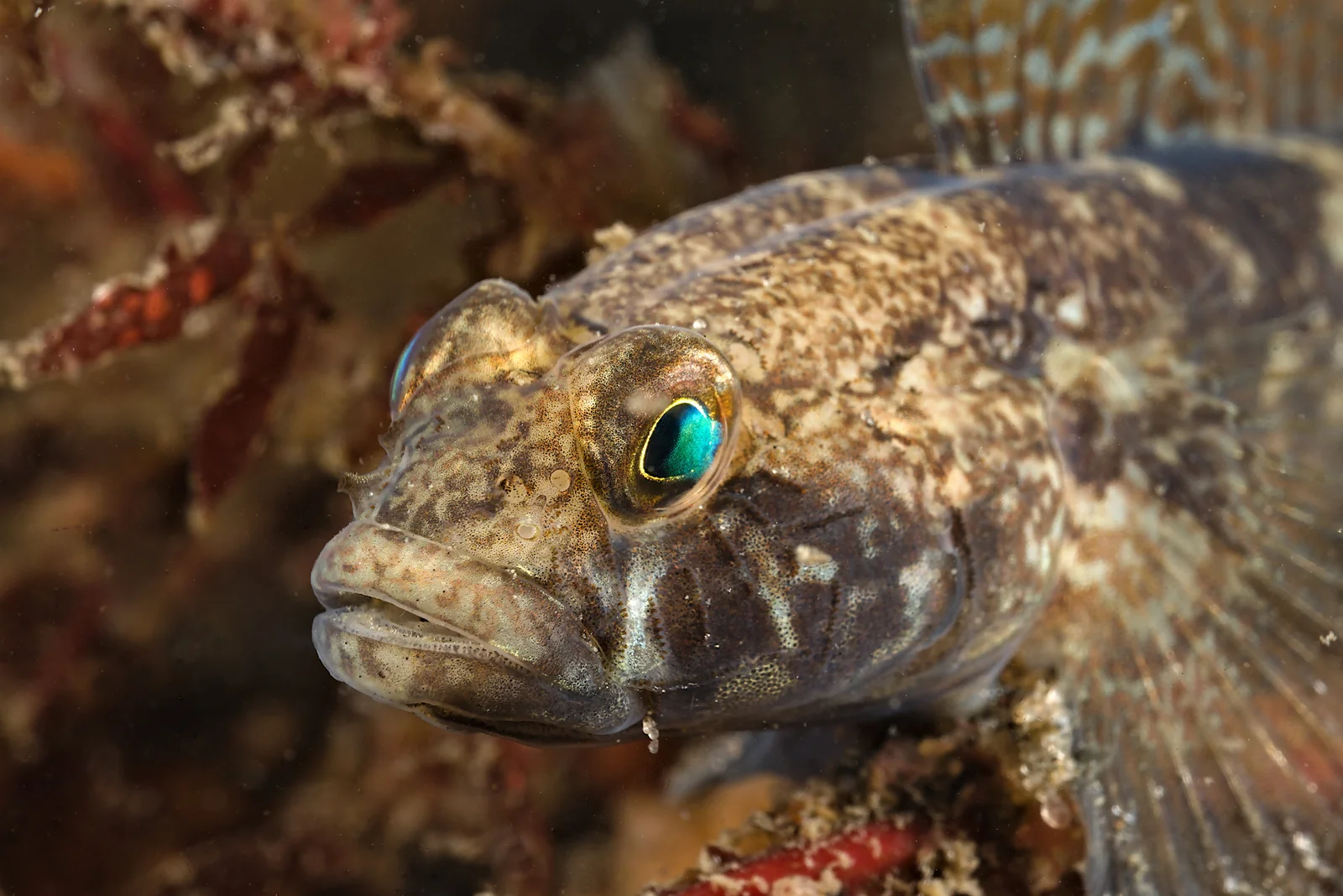
The black goby is a large-bodied member of the Gobiidae, growing to 25.3 cm and living about five years. It occurs along the eastern Atlantic from Mauritania to Trondheim and throughout the Mediterranean and Black Sea, over sand, mud, estuaries and seagrass. FishBase puts it at 1–96 m, usually 1–50 m, in water of 8–24 °C. It is not a recreational target: the fisheries entry reads "of no interest", with the aquarium trade as the only recorded use. Anglers may meet it as bycatch in shallow inshore cover, but there is no documented method for targeting it, and IUCN assessed it as Least Concern in 2014.
Identification
Black goby reaches 25.3 cm total length, matures at 11.4 cm and lives up to five years. There is no common length and no weight, so maturity is the only measurement between zero and the maximum. For a goby, 25 cm is large; most of the family are finger-length. More limiting still, the record carries no fin counts at all — the dorsal, anal and vertebral fields are empty, and morphology is listed among the declared gaps. This capture cannot key the fish; it can only describe its size and its name.
Taxonomy places it in Gobiidae, order Gobiiformes. The lineage note traces Gobius to the Latin gobius, a gudgeon, so the genus name predates the family as a concept. Chinese naming is ; English and iNaturalist both use Black Goby.
Habitat and distribution
The text range runs along the eastern Atlantic and through the Mediterranean and Black Sea: North Africa from Cape Blanc in Mauritania east to the Suez Canal, and north up the Atlantic coast to Trondheim in Norway and the Baltic. The country table lists 45 entries, all native and none introduced. That is a wide sweep for a fish of this size, and it crosses three salinity regimes.
The environment line gives marine and brackish, demersal, 1–96 m with a usual 1–50 m, 8–24 °C, between 66°N and 20°N and 18°W and 42°E. Freshwater is absent from that line, yet the habitat keywords include freshwater. The fields disagree; since the environment line is the structured one, treat freshwater as marginal rather than typical. Wikipedia adds estuaries, lagoons and inshore water over seagrass and algae.
GBIF holds only 23 distribution rows, six without a country code; Belgium 6, the Netherlands 3 and Sweden 2 lead the rest. iNaturalist has 3,593 observations. The gap is large but points at recording effort rather than a rare fish.
Season and fishing approach
Five spawning rows are carried, spanning March to September. The Baltic Sea May–August; the North Sea May–August; Naples March–May; Varna in Bulgaria April–September; Veerse Meer in the Netherlands April–June. The two northern seas share a window, while the Mediterranean and Bulgarian rows start earlier and one runs longer. No single month is common to all five.
The record offers no method and no angling status: fisheries is marked "of no interest", the only other use is the commercial aquarium trade, and gamefish is blank and listed as missing. Wikipedia confirms the aquarium trade and describes a diet of invertebrates with occasional small fish. An angler will find no technique here. What the capture does support is where to look — sand, mud, estuary, coast and seagrass, from 1 m down, in water of 8–24 °C.
Edibility and regulations
Nothing in the record supports a food fishery: fisheries is "of no interest", weight is missing and there is no gamefish tick. The only commercial use noted is the aquarium trade. The IUCN entry is Least Concern from 15 July 2014; neither CITES nor CMS has assessed the species; it is Harmless to humans. No bag limit, closed season or minimum size was captured. Listing status does not authorise a take — check local rules before keeping one.
The species is better known as a tank animal than as a landing, and the capture's use fields say the same. For a page about catching, that is the honest limit: distribution and habitat are documented, capture is not.
Where these facts come from
Check these pages before you rely on a size, range or protection status.
- FishBase — Gobius niger — FishBase · T2
- GBIF — Gobius niger occurrence records — GBIF · T2
- IUCN Red List — Gobius niger — IUCN · T1
- Photo record — iNaturalist — iNaturalist · T3
Fish in the same water
These fish live in the same place.
Round goby
- Family
- Gobiidae
- Depth
- 0–30 m
- Season
- Apr, May, Jun, Jul, Aug, Sep

Yellowfin goby
- Family
- Gobiidae
- Depth
- 1–6 m
- Season
- Jan, Feb, Mar

Acoupa weakfish
- Family
- Sciaenidae
- Depth
- 1–20 m
- Season
- Jan, Feb, Mar, Apr, May, Jun, Jul, Aug, Sep, Oct, Nov, Dec
Guides for this water
Technique, gear and safety guides that fit Black goby.