
Round goby
The round goby is a bottom-dwelling goby from the Black, Azov and Caspian Sea basins, and since 2004 it has also established itself in North America through ballast-water discharge. It occupies rocky, sandy and brackish shallows from the surface to about 30 m, tolerating 4–20 °C. FishBase lists it as a commercial species and an occasional bait fish; it reaches 35 cm and 381 g but is not a recognised gamefish.
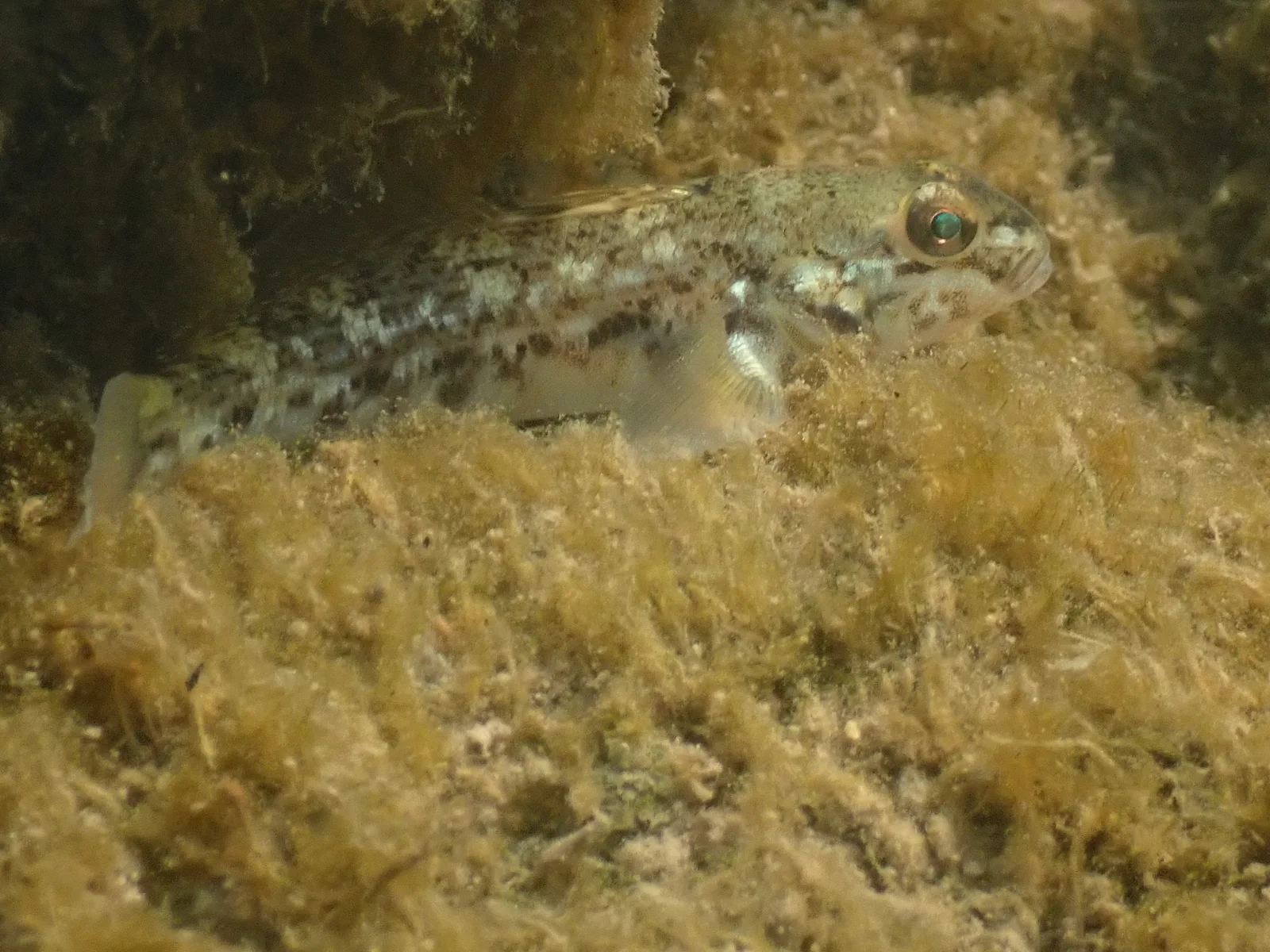
The round goby is a bottom-dwelling goby from the Black, Azov and Caspian Sea basins, and since 2004 it has also established itself in North America through ballast-water discharge. It occupies rocky, sandy and brackish shallows from the surface to about 30 m, tolerating 4–20 °C. FishBase lists it as a commercial species and an occasional bait fish; it reaches 35 cm and 381 g but is not a recognised gamefish. Where it is abundant it is more often an annoyance to bait anglers than a quarry, though its IUCN status remains Least Concern.
Identification
The record holds two sizes belonging to different fish: a maximum of 35.0 cm total length and a first-maturity range that opens at 4 cm. The second figure has no upper bound — FishBase prints "4 - ?" — so it is a lower edge, not a size class. Between them sit a maximum published weight of 381.42 g and a reported age of six years. That weight reads as a pound conversion.
Counts are 7–8 dorsal spines, 12–17 dorsal soft rays, one anal spine, 9–14 anal soft rays and 31–34 vertebrae. Body shape and cross-section were left empty.
Round goby is the principal name in both FishBase and iNaturalist. The vernacular table adds Black spotted goby from Britain, Caspian round goby from Uzbekistan and Ginger goby from Britain and Russia. Chinese entries alternate between and ; the extra character marks Neogobius against Gobius, not a separate species.
Habitat and distribution
Marine, freshwater and brackish are all ticked. The species is demersal and amphidromous, recorded from 0 to 30 m in water of 4–20 °C, between 60°N and 36°N. A 30 m ceiling is the whole fishable column at most shore marks. Habitat keywords are rocky, sandy and brackish; the diet list holds fishes and molluscs.
The range sentence names the Sea of Azov, the Black Sea and the Caspian basin, then adds remarks that are not geography: adverse ecological impact reported by several countries, and accidental introduction to North America in 2004 with ballast water. Those belong to management history and should not be read as range.
The 27-entry country table splits 12 native against 15 introduced. Germany and Sweden, the two countries this page is filed under, are on the introduced list, and that single split changes what "local" means here. GBIF's 147 rows lean to the invaded edge — Belgium 16, Netherlands 11, Poland 9, Estonia 8, Sweden 8, Germany 7 — while iNaturalist holds 6,432 observations. Recording density follows the invasion, not the origin.
Season and fishing approach
Four spawning rows: Eastern Europe April–September; a second row with no locality and the same months; upper Detroit River May–July; Volga estuary and Caspian Sea May–September. Two are place-specific, two are labels wide enough to cover half a continent, and the Detroit row sits inside the introduced range, so native and invaded timing are mixed without labels.
Six years is the oldest reported age. A fish that can mature from 4 cm turns over fast: a mark that held fish last autumn can be empty this autumn with no change in ground.
No method is recorded, which matters little at 0–30 m, where breakwater, dinghy and kayak reach the whole column. Rocky or sandy brackish ground is the search description the record supports. Small hooks and small baits suit a fish with no published common length; the 35 cm maximum is exceptional and should not set tackle. Amphidromy describes the native basins, not the ballast-water populations.
Edibility and regulations
Least Concern, assessed 30 May 2022. It is a global category for a species native in one basin, introduced in another and a problem in several countries; it says nothing about a single mark.
Uses read: commercial fisheries, commercial aquarium trade, bait occasionally, with no gamefish entry. Threat to humans is recorded as "Potential pest", an ecological label rather than a handling warning.
Where introduced, the rule is likely written for an invasive animal, not a quarry, and is absent here. Check national and regional text before keeping one. One floor: 4 cm is the earliest maturity record; below it, no spawning role is recorded.
Where these facts come from
Check these pages before you rely on a size, range or protection status.
- FishBase — Neogobius melanostomus — FishBase · T2
- GBIF — Neogobius melanostomus occurrence records — GBIF · T2
- IUCN Red List — Neogobius melanostomus — IUCN · T1
- Photo record — iNaturalist — iNaturalist · T3
Fish in the same water
These fish live in the same place.
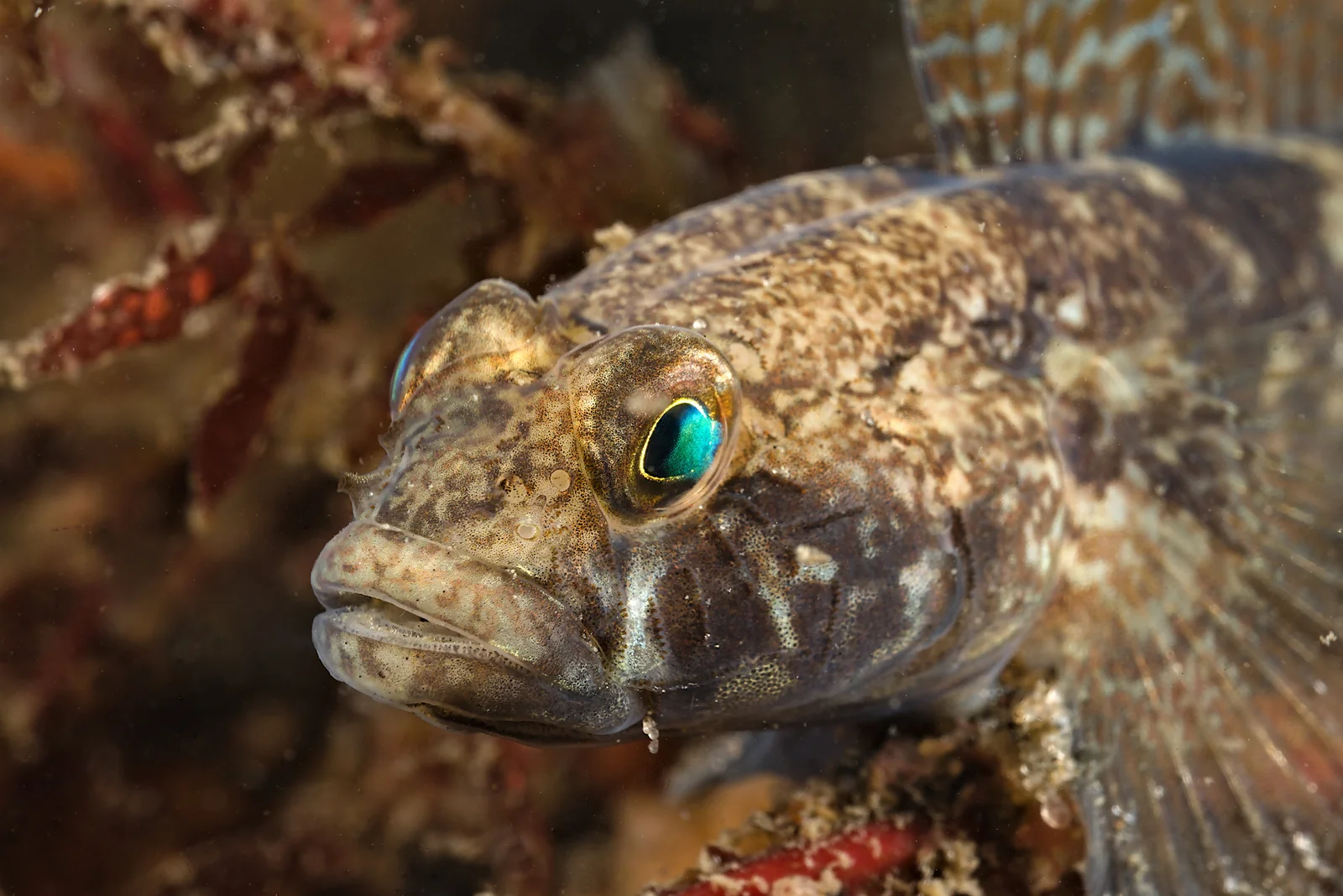
Black goby
- Family
- Gobiidae
- Depth
- 1–96 m
- Season
- Mar, Apr, May, Jun, Jul, Aug, Sep

Yellowfin goby
- Family
- Gobiidae
- Depth
- 1–6 m
- Season
- Jan, Feb, Mar

Acoupa weakfish
- Family
- Sciaenidae
- Depth
- 1–20 m
- Season
- Jan, Feb, Mar, Apr, May, Jun, Jul, Aug, Sep, Oct, Nov, Dec
Guides for this water
Technique, gear and safety guides that fit Round goby.