
Glasseye
Start with the fin count: ten dorsal spines with 12 to 13 soft rays, three anal spines with 13 to 14 soft rays. Then colour, which in this genus is not a reliable field mark — silvery pink, mottled red and solid red all occur, with faint dark dots on the median fins. The pelvic fins are an useful exclusion: dusky or pale, but without distinct spots.
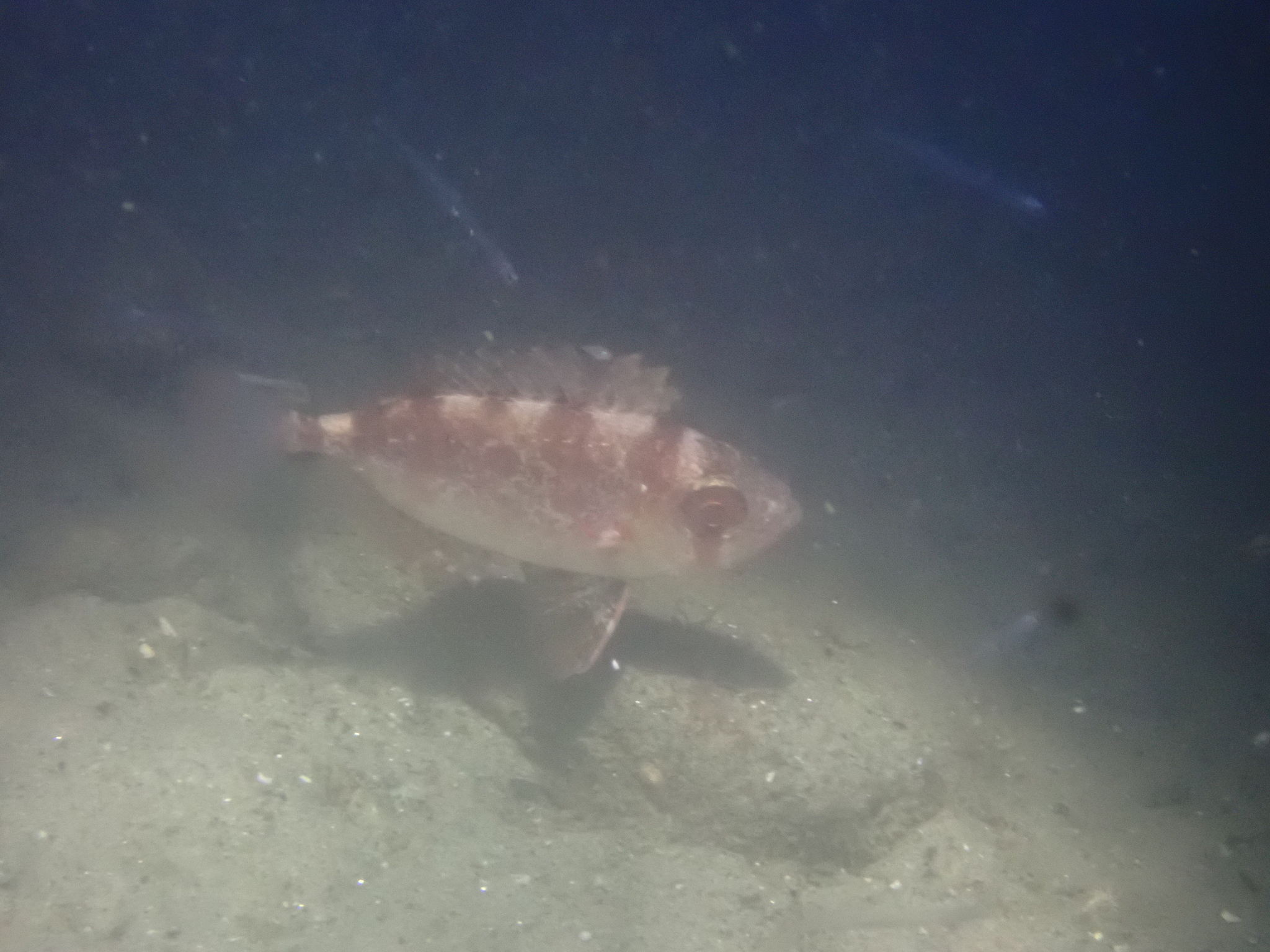
Start with the fin count: ten dorsal spines with 12 to 13 soft rays, three anal spines with 13 to 14 soft rays. Then colour, which in this genus is not a reliable field mark — silvery pink, mottled red and solid red all occur, with faint dark dots on the median fins. The pelvic fins are a useful exclusion: dusky or pale, but without distinct spots. There is a further detail on the cheek, where the section of the preopercle behind the sensory canal is striated and lacks scales. The eye is outsized for the head, the family trait that gives the fish both its English and its Chinese name. Size runs to 50.7 cm, but the common length is 20 cm, so most encounters are with a hand-length fish.
A range that was once the whole ocean
FishBase now states the range in one line: the Atlantic and the southwest Indian Ocean, with a note that the species was formerly treated as circumglobal. That sentence rewards slow reading. The older circumglobal concept included Pacific populations; after revision the name covers a narrower area, while the Hawaiian name aweoweo stays in local use. The fishing advice below is written for Hawaiian inshore reef, and identification or regional records should be checked against current local taxonomy. Habitat is lagoon and seaward reef, primarily around islands, and juveniles are pelagic, which explains how the fish turns up far from land. Depth is recorded from 3 to 300 m, with a usual band of 3 to 35 m; the shallow end is a ledge, and the deep end is beyond recreational reach.
The clock is dusk, not the calendar
No spawning months are recorded, so this section works from daily rhythm instead. By day the fish hides under or beside ledges, usually alone or in small groups, and gathers in numbers at dusk. That turning point is steadier than any month. In the half hour around sunset, fish that were spread out converge, and an angler already in position catches the move. The species is nocturnal, and the diet list — octopus, pelagic shrimp, stomatopods, crabs, small fish and polychaetes — describes a hunter in low light rather than a grazer. One further note is unusual: the fish is known to produce sound. The subtropical range runs 33°N to 32°S, wide enough that the same month means different water at either end, so local experience does not transfer.
Fishing the edge of the light
Set the lamp first; that decides most of the outcome. The boundary between lit water and shadow is where fish collect, so do not aim every light at one point — leave a gradient and the fish come closer. Baits are small shrimp, squid strip or a scrap of fish, on a modest hook. Let the bait sink below eye level and then lift it gently; the mouth is large but the take is wary, and a bait suspended mid-water is often ignored. Under a ledge and along the shaded face of a harbour wall are the two reliable positions, and both can be fished by day if the bait is worked deeper. Since the diet is crustacean and fish, shrimp and squid together cover it better than fish alone. On the hook, turn the head away from the rock immediately; give it a second and the leader is cut.
Light tackle, short fight
Build for 50.7 cm and 2.7 kg while expecting a 20 cm fish most nights. Fine braid with a fluorocarbon leader about an arm long is enough; abrasion resistance matters more than stealth here. Use a small wide-gap single hook with a strong shank, because reef fishing does not allow a long, patient fight. Sinkers should be cheap and light — if one wedges, leave it rather than dragging the rig across coral. Winch the fish clear of the ledge before lifting, and use a small net opening so it does not jam in a narrow gap. Keep cutters within reach; if a fish jams, cutting is cheaper than pulling.
Eating, ciguatera, and Hawaiian rules
The fish is marketed fresh. One safety item is explicit in the record: ciguatera poisoning has been reported for this species, so large reef specimens and fish of unknown origin deserve caution, and raw preparation is a poor idea. Hawaii's rules stack in three layers. The person comes first: an NRMFL for non-resident recreational saltwater fishing, and a CML if any fish is to be sold. The species layer is HAR 13-95 for size and bag limits, with gear under HAR 13-74. The place layer is the strictest — MLCDs, FRAs and other managed areas are closed outright, and the boundaries follow the Division's maps and notices for the year. This fish has no entry of its own in the species table, so no specific size or bag figure can be quoted; the general provisions still bind.
What the record does not resolve
Most of this entry rests on one FishBase record, with 775 iNaturalist observations and both photographs accounted for separately, a GBIF species key used only for cross-checking, and two Division of Aquatic Resources pages for the state rules. What readers should carry away is a naming mismatch rather than a data gap: FishBase now restricts the range to the Atlantic and southwest Indian Ocean while noting the old circumglobal treatment, yet aweoweo remains the working local name. The entry records the mismatch without resolving it.
How to catch it
Shore fishing
Fished with the listed approach, matched to the recorded depth and size.
Boat fishing
Fished with the listed approach, matched to the recorded depth and size.
Where these facts come from
Check these pages before you rely on a size, range or protection status.
- FishBase — Heteropriacanthus cruentatus — FishBase · T2
- GBIF — Heteropriacanthus cruentatus occurrence records — GBIF · T2
- IUCN Red List — Heteropriacanthus cruentatus — IUCN · T1
- Photo record — iNaturalist — iNaturalist · T3
Fish in the same water
These fish live in the same place.

Guides for this water
Technique, gear and safety guides that fit Glasseye.