
Moontail bullseye
FishBase gives this bigeye a depth range of 0 to 250 m. The biology text on the same page describes it on outer reef slopes and deep lagoon pinnacles from 8 to at least 80 m. Both statements are true and they are not the same statement. The wide figure is the outer envelope of everything ever recorded; the narrow one is where the fish is actually encountered.
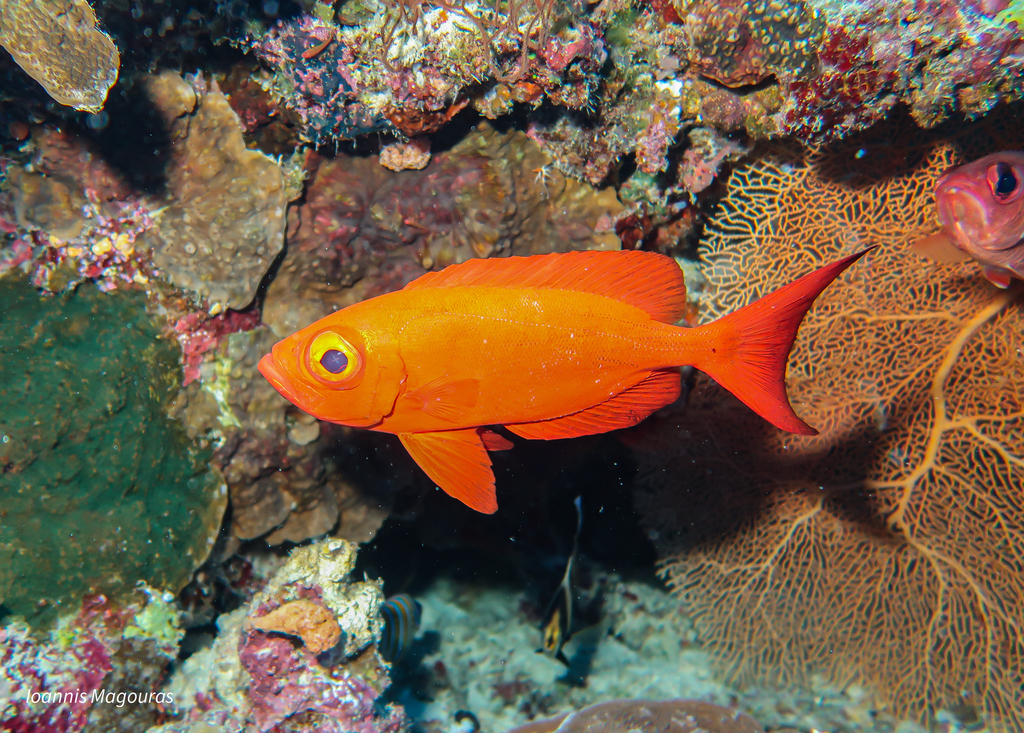
FishBase gives this bigeye a depth range of 0 to 250 m. The biology text on the same page describes it on outer reef slopes and deep lagoon pinnacles from 8 to at least 80 m. Both statements are true and they are not the same statement. The wide figure is the outer envelope of everything ever recorded; the narrow one is where the fish is actually encountered. An angler who reads 250 m as a target will spend a lot of money on electric reels for a fish usually caught in the top third of that range.
Red that turns silver
The body is entirely red, or can change quickly to silvery with about six red bars or large spots on the upper side; the caudal and pelvic fin membranes are blackish at the tips. That colour switch is a warning for identification: two photographs of the same fish can look like two species. The fin formula is D X, 13-15 and A III, 13-16, the pelvic fins are long and reach past the spinous part of the anal fin, and the caudal fin is distinctly emarginate. The preopercular spine is poorly developed and becomes reduced or invisible in adults over 12.5 cm, so it cannot be used on the fish you are most likely to catch.
Under the ledge at noon
During the day the fish hangs under ledges or hovers beside coral heads, in small aggregations, sometimes in schools in oceanic locations. That is a visual problem before it is a bait problem: the fish is in shadow, close to structure, and often facing away. A bait dropped straight down the face of the coral will pass it; a bait presented from the side, at the depth of the ledge, has a better chance. At night the same fish is away from the reef and higher in the water, which is why the night shift fishes shallower than the noon shift.
Where 8 to 80 sits inside 0 to 250
The depth record includes 0 because the species occasionally reaches the surface; it includes 250 because deep drops have taken it there. Neither end is the fishing depth. The workable band is the reef slope: 20 to 60 m covers most marks, and 80 m is the deeper end of the described habitat. Distribution runs from the Red Sea and southern Africa to French Polynesia, north to southern Japan and south to Australia, with a report from Easter Island.
Small bait, slow presentation
The diet is small fish, crustaceans and other small invertebrates. Baits should match: a whole small fish, a prawn, a strip of squid. The mouth is large but the hook hold is shallow, so a slow lift rather than a hard strike sets better. On the drift, a bait held a metre or two off the bottom is more useful than one on the sand, because the fish is hovering rather than feeding on the deck.
Minor commercial, major aquarium
FishBase lists minor commercial fishing and commercial aquarium trade. The IUCN category is Least Concern, assessed 10 March 2015. The threat-to-humans field says harmless, and no ciguatera report is recorded there; a large reef predator is still handled on local advice. Resilience is high, with a doubling time under 15 months, a growth coefficient of 0.5 to 0.7 and a recorded fecundity of about 13,133 eggs. In Thailand, entry to the Similan and Surin park reefs is shut for the monsoon, and the fisheries management plan layers on closed seasons and gear limits. Vietnam's 2017 fisheries law runs MPAs alongside a banned-gear list. Malaysia closes the core zones of Tioman, Redang and Perhentian, with state-level size and gear rules under the 1985 Fisheries Act.
Why the eyes are the point
Big eyes, red colour and a habit of sitting in shadow are a package for low light. The fish is built to see at depths and at hours when the angler cannot. That is the practical argument for fishing the change of light rather than the middle of the day, and for keeping the presentation slow: the fish can see the bait long before the angler sees the fish. The 0 to 250 m figure reads differently once that is clear. It describes where the fish can live, not where to find it.
Red is a depth effect
Red light disappears quickly with depth, which is why the same species looks crimson at 40 m and pale silver in the livewell. The colour change is rapid and reversible, so photographs taken on deck rarely match the fish in the water, and identification should not rest on which version the camera caught. Look at the fin margins, the spine count and the scale rows; the body colour is the least stable character on the fish.
How to catch it
Boat bottom fishing
Fished with the listed approach, matched to the recorded depth and size.
Handline
Fished with the listed approach, matched to the recorded depth and size.
Where these facts come from
Check these pages before you rely on a size, range or protection status.
- FishBase — Priacanthus hamrur — FishBase · T2
- GBIF — Priacanthus hamrur occurrence records — GBIF · T2
- IUCN Red List — Priacanthus hamrur — IUCN · T1
- Photo record — iNaturalist — iNaturalist · T3
Fish in the same water
These fish live in the same place.

Guides for this water
Technique, gear and safety guides that fit Moontail bullseye.