
Black marlin
Black marlin is a large istiophorid billfish of the Indo-Pacific, from tropical and subtropical waters, with occasional strays into temperate seas. It lives from the surface to 915 m, reaches 465 cm FL and 750 kg, and feeds on crustaceans and fish. It is recorded in most months of the year, in water of 15 to 30 °C.
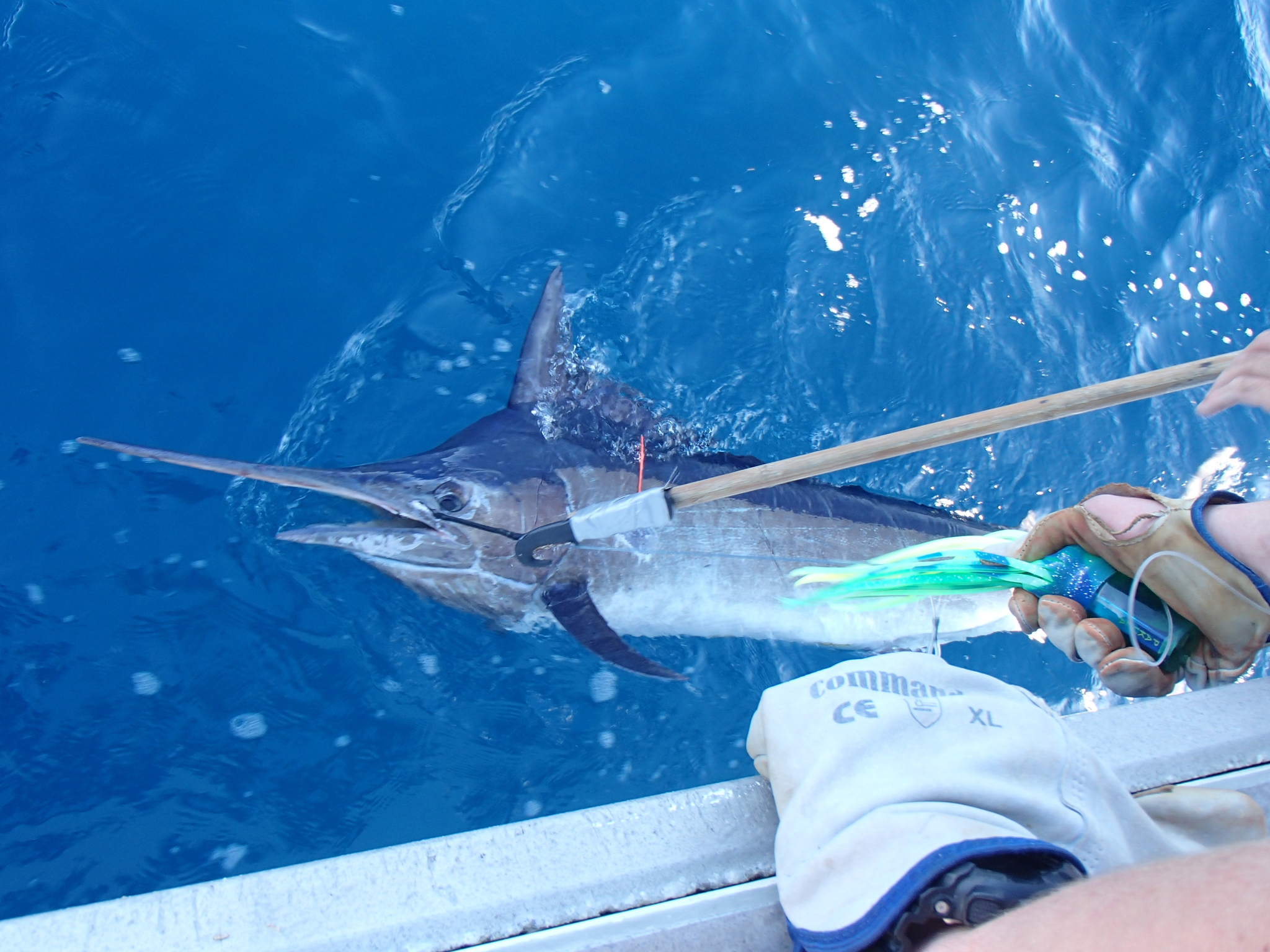
Black marlin (Istiompax indica) is a fish of the family Istiophoridae. FishBase gives its range as: Indo-Pacific: tropical and subtropical waters, occasionally entering temperate waters. Stray individuals migrate into the Atlantic Ocean by way of the Cape of Good Hope, but the existence of Atlantic breeding stocks is unlikely. It is recorded from 0 to 915 m, in subtropical water at 15–30 °C. The recorded maxima are 465 cm FL, 750 kg. Diet includes crustaceans and fishes. IUCN status: Data Deficient (DD). Chinese name: .
A record and a routine fish
FishBase puts the ceiling at 465 cm FL and 750 kg; the common figure is 380 cm TL. The numbers share one box, so they read as one curve: a big fish is 465, a normal fish is 380. They are not. The 465 cm is a fork length from a specific capture; the 380 cm is a total length from a different data set. A 380 cm TL fish is shorter than a 380 cm FL fish, because TL runs to the caudal tip while FL stops at the fork. The routine fish is further below the record than the raw numbers suggest.
Maturity length and age are both blank in that box. Without a maturity point there is no source-based line between a young fish and a breeding one, and an invented line would be worse than the blank.
What fork length leaves out
Fork length excludes the bill and the tail tips. On a billfish the bill is a large fraction of the outline, so a fish photographed nose to tail can look much longer than its FL. The 465 cm FL is not the length from the lower-jaw tip to the end of the upper tail lobe; anyone quoting a video length should say which end points were used.
The alias list carries the same problem: "Pacific black marlin", "silver marlin", "short nosed sword fish" and "swordfish" all appear for the same fish. A record filed under one alias may not surface under another.
The 915-metre line and the 200-metre band
The environment box gives 0–915 m; the usual band is 0–200 m. The 915 m is an extreme record; the 200 m is the band where the species is normally met. The biology text puts it in the upper layers above the thermocline, often near shore, islands and coral reefs. A 915 m drop is not a fishing plan. The ratio between the two is about four and a half.
What grows a 750-kilogram fish
The reproduction text gives 27–28°C and about 40 million eggs; age and maturity are blank. The record fish is therefore a capture with a spawning context but no age. The page supports the direction — a large pelagic fish at the rare end of a wide size distribution — and nothing more.
The spawning table records Hainan in May–June, the northwestern Coral Sea in October–December, Cairns in August–November, the South China Sea in May–June, Taiwan region in August–October, and the Timor Sea in January–March and October–December. These are opposite hemispheres, not one season seen from different places.
The 27–28°C spawning window
The 27–28°C figure is a spawning figure, not a comfort range. The environment box separately gives 15–30°C for the species as a whole. A 15°C sea surface is inside the range but outside the recorded spawning window; the two numbers should not be merged into "black marlin like 15–30°C water".
For a trip plan, the spawning records work better as a calendar of places than as a promise. The Coral Sea and Cairns records cluster in the austral spring and summer; the Hainan and South China Sea records fall in the northern spring. A boat that plans by "summer" without naming the hemisphere can arrive in the wrong season.
Tackle for the 380-centimetre fish
The routine fish is the one a charter is likely to see, and 380 cm TL is the better starting point for gear. The 465 cm and 750 kg record is not a drag setting or a leader specification. No common weight is listed, so the record weight can only be called an outlier.
The FishBase distribution list names 77 countries and territories, but the occurrence data is uneven: GBIF returns 1,177 records, with 518 from Australia, 360 from Chile, 35 from the United States, 22 from New Zealand, 21 from China, 19 from South Africa, 16 from Mexico and 16 from Mozambique. The distribution text calls it Indo-Pacific and treats Atlantic individuals as strays around the Cape of Good Hope with no breeding stock. The map agrees.
Where the records actually come from
The iNaturalist taxon page adds 65 observations. That is not a contradiction of the GBIF total; it is a different kind of record, photographed fish from boats and dive sites rather than museum specimens. For a rare, large, migratory species a small photo count is expected.
The taxonomy has its own record problem: WoRMS accepts Istiompax indica (Cuvier, 1832) and lists Tetrapturus indicus, Makaira marlina, Istiompax australis and Istiompax dombraini as unaccepted. An old capture may be filed under a name a current search will not return.
What to write on the release card
The card should record fork length, not a nose-to-tail estimate, and say which alias the fish was logged under. The 465 cm FL record and the 380 cm TL common length are both legitimate entries; mixing them into one "maximum 465 cm" statement turns a record into a routine expectation. The 750 kg weight belongs to a specific published capture and should be carried with that qualifier.
The useful reading is not the maximum in each row but the gap between the maximum and the routine: 465 cm FL against a common 380 cm, 750 kg against no published common weight, and 915 m against a usual 0–200 m band. A boat that plans for the routine fish is fishing the part of the distribution the records actually support.
Where these facts come from
Check these pages before you rely on a size, range or protection status.
- FishBase — Istiompax indica — FishBase · T2
- GBIF — Istiompax indica occurrence records — GBIF · T2
- IUCN Red List — Istiompax indica — IUCN · T1
- Photo record — iNaturalist — iNaturalist · T3
Fish in the same water
These fish live in the same place.
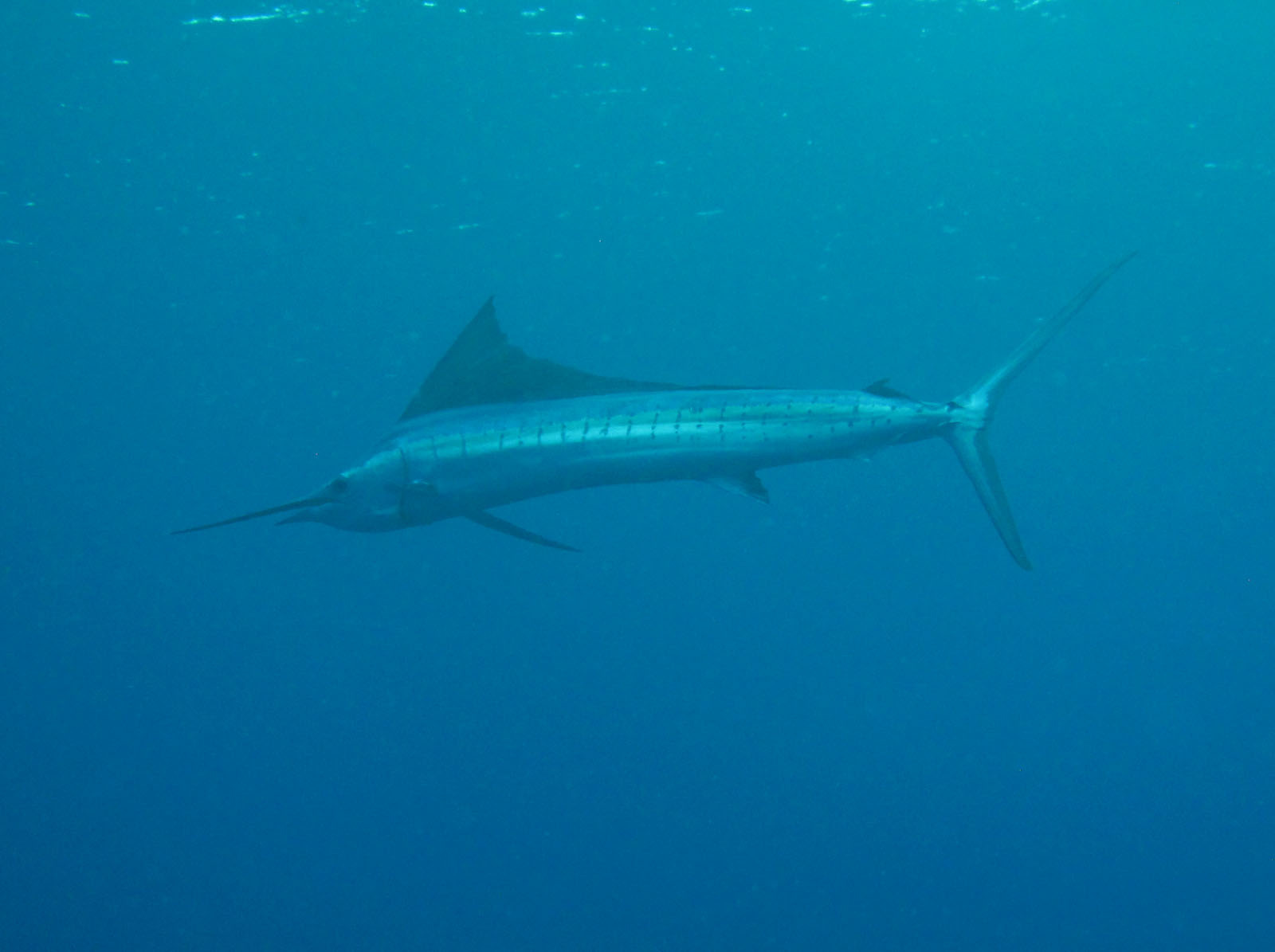
Atlantic sailfish
- Family
- Istiophoridae
- Depth
- 0–200 m
- Season
- Jan, Feb, Mar, Apr, May, Jun, Jul, Aug, Sep, Oct, Nov, Dec

Atlantic white marlin
- Family
- Istiophoridae
- Depth
- 0–150 m
- Season
- Apr, May, Jun
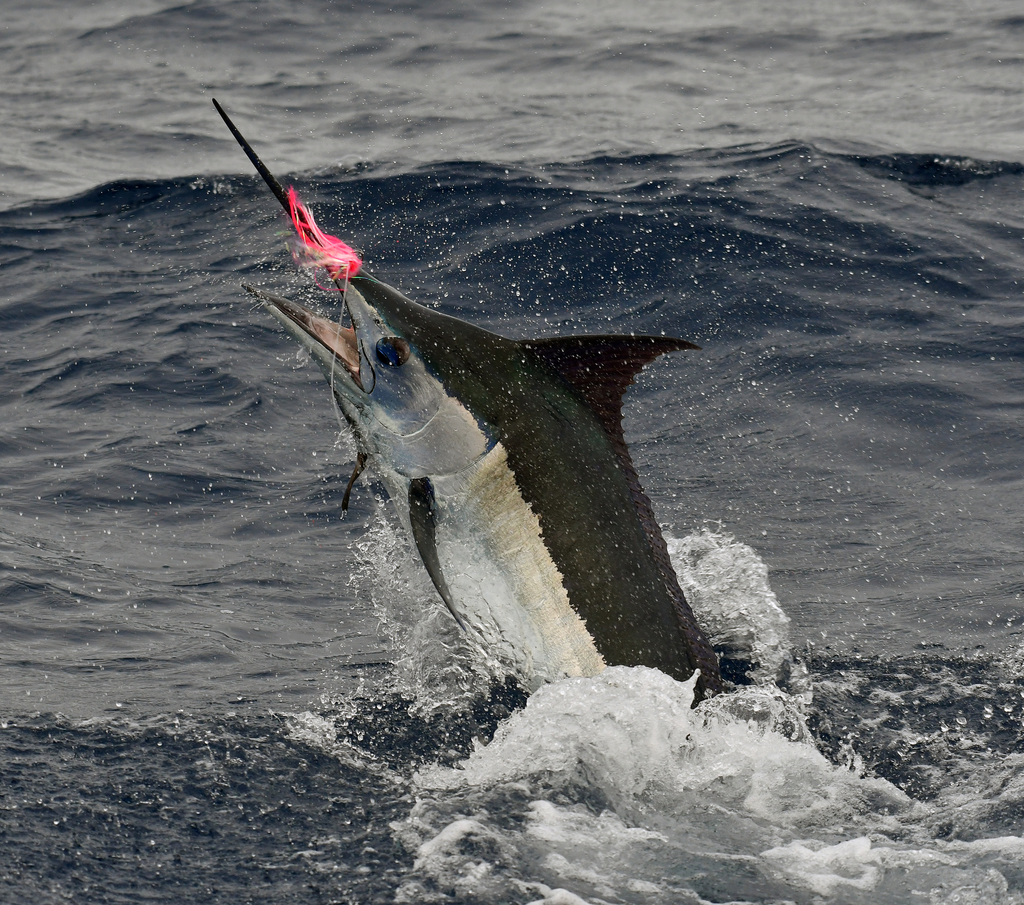
Blue marlin
- Family
- Istiophoridae
- Depth
- 0–1000 m
- Season
- Jul, Aug, Sep
Guides for this water
Technique, gear and safety guides that fit Black marlin.