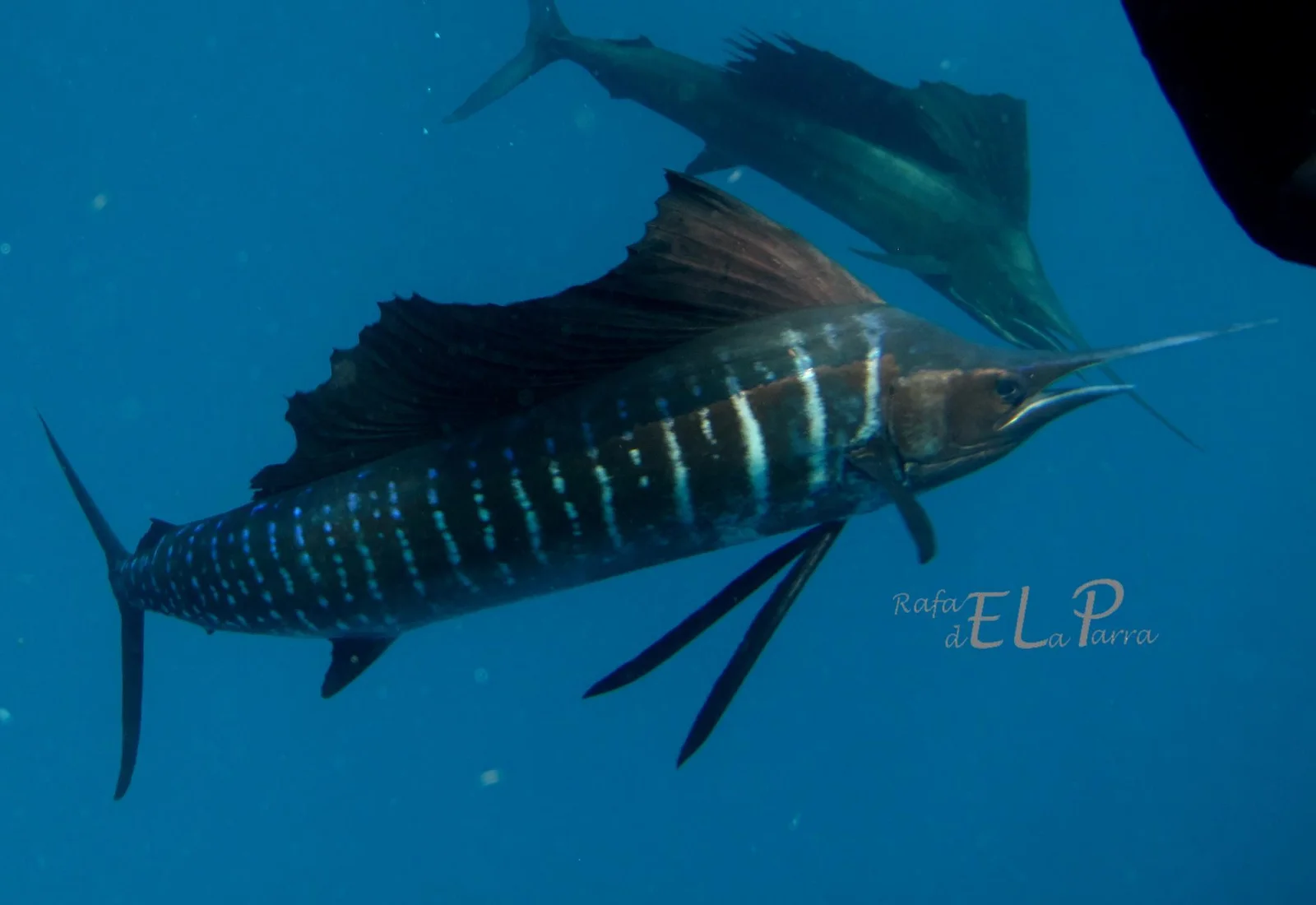
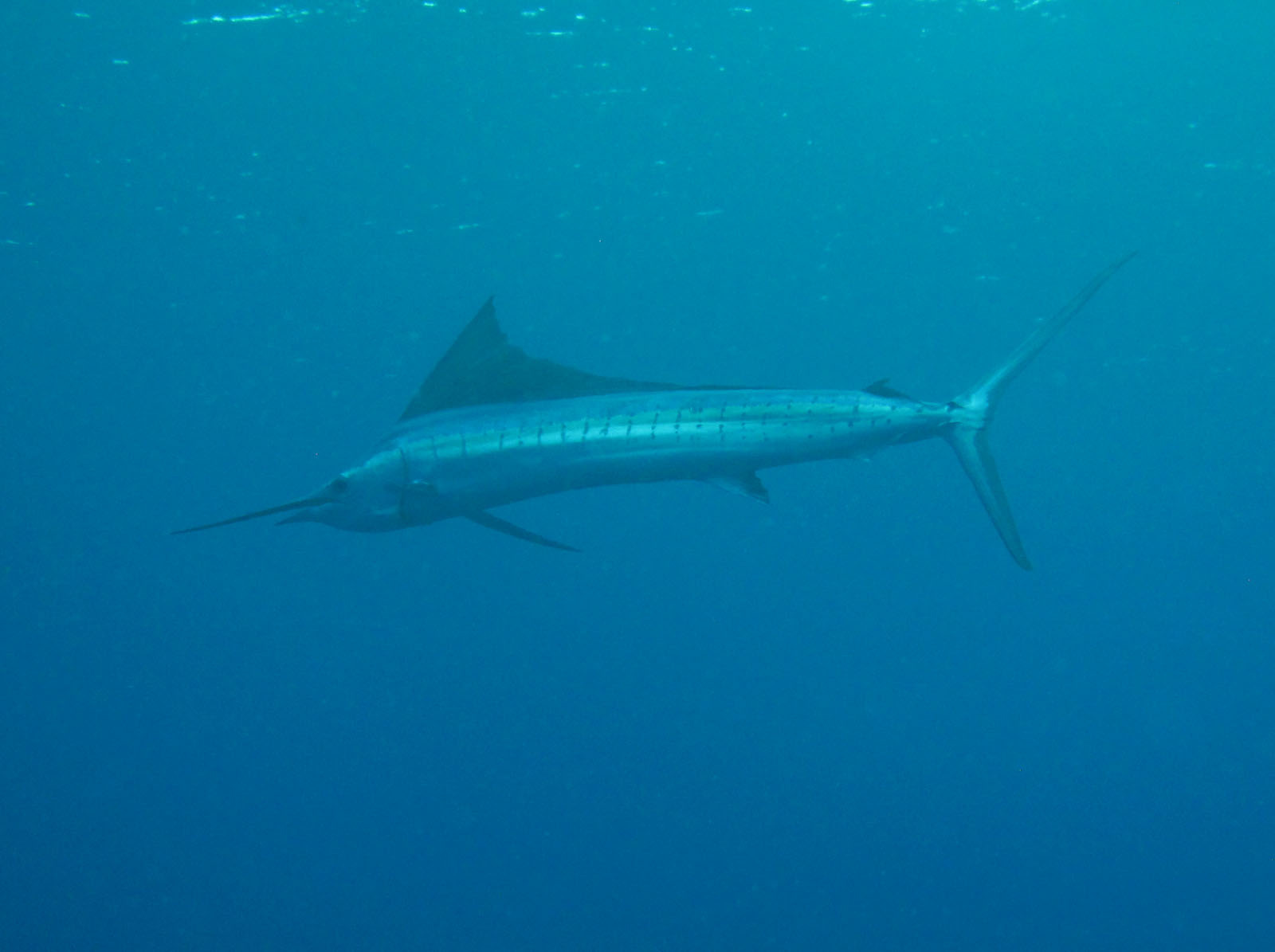
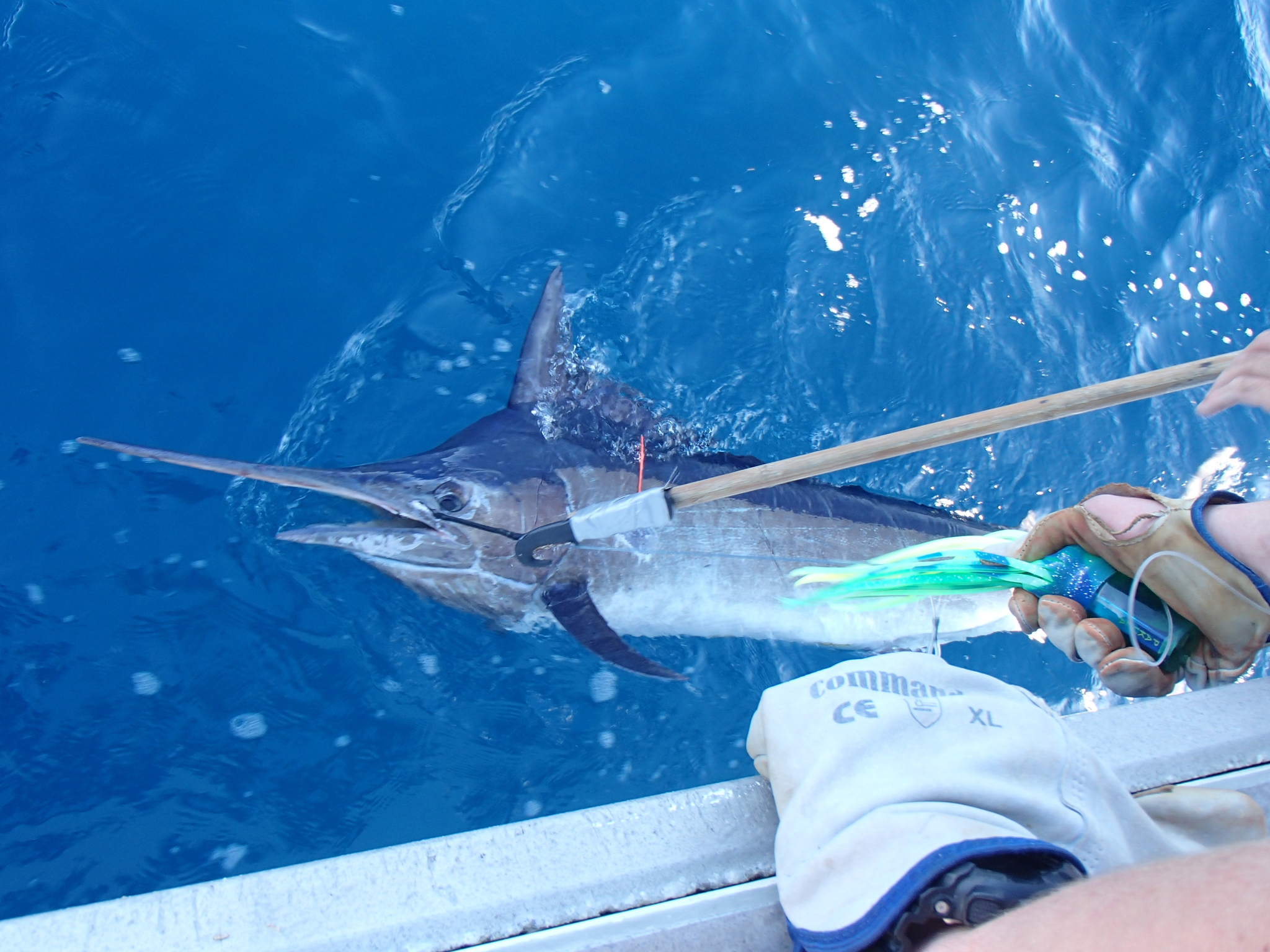
Indo-Pacific sailfish (Istiophorus platypterus) is a fish of the family Istiophoridae. FishBase gives its range as: Indo-Pacific: tropical and temperate waters approximately 45°- 50°N and 40°-35°S in the western Pacific, 35°N and 35°S in the eastern Pacific; 45°S in western Indian Ocean and 35°S in eastern Indian Ocean. Entered Mediterranean Sea from Red sea via Suez Canal. It is recorded from 0 to 200 m, in subtropical water. The recorded maxima are 348 cm FL, 100.2 kg, 13 years. Diet includes crustaceans, fishes and molluscs. IUCN status: Vulnerable (VU). Chinese name: .
Three blanks, not three zeros
FishBase gives the depth as 0–200 m and the usual range as "30 - ? m". The size box gives "Maturity: Lm ?, range ? - 150 cm". The distribution text adds a third: "Some authors recognize a single worldwide species... but we follow Nakamura 1990... retaining Istiophorus platypterus for the Indo-Pacific sailfish and Istiophorus albicans for the Atlantic sailfish".
Three different kinds of missing: an unrecorded upper bound, an absent maturity point with only a range top, and a taxonomic disagreement the page settles by choosing a side. None gets a plausible number invented here.
Thirty metres, and no ceiling
The usual band starts at 30 m. The ceiling of that band is not printed. What is printed is a maximum depth of 200 m and a biology sentence: "Oceanic and epipelagic species usually found above the thermocline".
That sentence supplies the missing ceiling. The page will not say how deep that band reaches, but it does say the fish sits above a boundary a sounder can find. So begin at 30 m and stop at the thermocline, not at a depth in metres.
The same paragraph adds a horizontal limit: "Most densely distributed in waters close to coasts and islands". One vertical cue and one horizontal cue, both on the page.
No maturity length, only the top of a range
"Maturity: Lm ?, range ? - 150 cm" is the whole maturity entry. The upper end of a recorded range is not a maturity length. With no lower bound and no Lm point, the page supplies no size at which a fish becomes a breeding fish.
The rest of the box is fuller: maximum 348 cm fork length, common length 270 cm total length, heaviest published weight 100.2 kg, maximum reported age 13 years. The two lengths are not the same measure, and without a conversion the gap between record and routine cannot be read off as a percentage.
For a release decision this leaves nothing. A size rule has to come from a jurisdiction.
One species or two
The taxonomy blank is consequential. FishBase states the split and its reason: the two sailfish are kept apart "in recognition of the differences between them". WoRMS accepts Istiophorus platypterus and lists 23 synonyms, among them Xiphias platypterus, Scomber gladius, Histiophorus gladius and Istiophorus orientalis.
The photo record does not follow the split. The iNaturalist taxon ID attached here is 119719, with 558 observations, and the record returned under it is named Istiophorus platypterus. The Atlantic sailfish page resolves to the same ID. The platform holding the photographs treats the two as one animal; FishBase treats them as two.
The consequence is a counting problem, not an identification problem. A photo count described as "Indo-Pacific sailfish" may include Atlantic fish; a GBIF total may not, because GBIF keys occurrences to a taxon key rather than a photo label. The two numbers should never be added.
The latitude is written three times
The environment box gives 50°N–43°S. The distribution paragraph then gives a different set: "approximately 45°- 50°N and 40°-35°S in the western Pacific, 35°N and 35°S in the eastern Pacific; 45°S in western Indian Ocean and 35°S in eastern Indian Ocean".
The two statements are different claims. The box allows 50°N everywhere; the text allows 50°N only in the western Pacific and 35°N in the eastern Pacific. The species also "entered Mediterranean Sea from Red Sea via Suez Canal", which puts it outside the Indo-Pacific the same paragraph names.
The occurrence set goes further. GBIF returns 3,558 present records, and the largest national block is the Faroe Islands with 675, followed by Mexico 385, Australia 363, the United States 331, Great Britain 170, Costa Rica 120, Germany 100, Japan 79, Italy 78 and Taiwan region 59.
The Faroe Islands sit near 62°N, north of every latitude on the page and outside the subtropical band. Great Britain and Germany are also north of the stated limits, and neither is in the Indo-Pacific. The page offers no explanation.
Spawning: year-round, with a local summer peak
The biology text says the species "seems to spawn throughout the year in tropical and subtropical waters of the Pacific with peak spawning occurring in the respective local summer seasons". It describes pairs or two or three males chasing one female, and eggs about 0.85 mm across.
The spawning table is thinner. It has two rows: São Paulo, Brazil, 1971–1979, marked November–February, and a second row whose locality is the phrase "tropical and subtropical waters of the Pacific", marked for every month. The two rows differ in resolution rather than in conclusion: one dated local study in the southern summer, one basin-wide statement with no month at all.
The table establishes how narrow the record is: one dated Brazilian study and one ocean-wide phrase. The "local summer peak" comes from the biology text, not the table.
What the record actually contains
The GBIF shape is dominated by the Faroese block: 675 of 3,558 records, nearly a fifth of the total. For a species whose page describes an Indo-Pacific distribution, the record centre and the written range point in different directions.
The common-name table is the opposite kind of evidence: 249 names for one fish, including Bayonet-fish and Billfish. A table that large is what a wide-ranging, widely landed, frequently misidentified fish looks like.
WoRMS adds 23 unaccepted combinations. A catch entered under Histiophorus gladius or Istiophorus orientalis cannot be found by querying the present name, one more reason a regional total can be lower than the landings.
Turning the blanks into a plan
The plan follows the blanks. Start the depth search at 30 m, where the usual band begins; top it at the thermocline, the only ceiling the page names. Work near coasts and islands, where the page puts the fish. Neither instruction needs the missing bound.
Do not build a size rule from the page: no Lm, no lower bound, and 150 cm is the top of a range, not a threshold.
Search both names. The genus is split here and merged on iNaturalist, so a query using only one name will lose part of the record. And do not treat 675 Faroese records as evidence of a northern stock; the page offers no support for one.
On the card, write fork length for the 348 cm maximum and total length for the 270 cm common fish, and never convert one into the other without the formula the page withholds. Three question marks do not stop a trip. They only stop the trip from pretending it has numbers it does not have.
Regulations before you keep it
These are the published regulations for this fish. Read the number first. The notice below it is the actual regulation.
Bag limit1
1 fish per angler per day · counts as 5 fish against the 10-fish daily limit
Mexico · MX
Mexico permits only one sailfish (pez vela) per angler per day, counting as five fish of other species against the ten-fish daily limit.
Clause 4.7.1.
Cuando se trate de marlin, pez vela, pez espada y tiburón, el límite máximo por pescador y día será de un solo ejemplar de cualquiera de estas especies, el cual será equivalente a cinco ejemplares de otras especies.
Every record above names its source and the date it was retrieved. See the regulation register for the full list, or how to read these regulations.
Where these facts come from
Check these pages before you rely on a size, range or protection status.
-
FishBase — Istiophorus platypterus
— FishBase · T2
-
GBIF — Istiophorus platypterus occurrence records
— GBIF · T2
-
IUCN Red List — Istiophorus platypterus
— IUCN · T1
-
Photo record — iNaturalist
— iNaturalist · T3