
Porbeagle
Porbeagle is a large, stout lamnid shark built for cold water, with centres of distribution in the North Atlantic and the temperate southern hemisphere. It tolerates a wide band, roughly 1 to 23 degrees C, and has been recorded from the surface down to 1,360 m. Fish reach 350 cm TL and 230 kg, feed on fish, and can live 65 years, which makes it one of the slower-growing sharks an angler might meet.
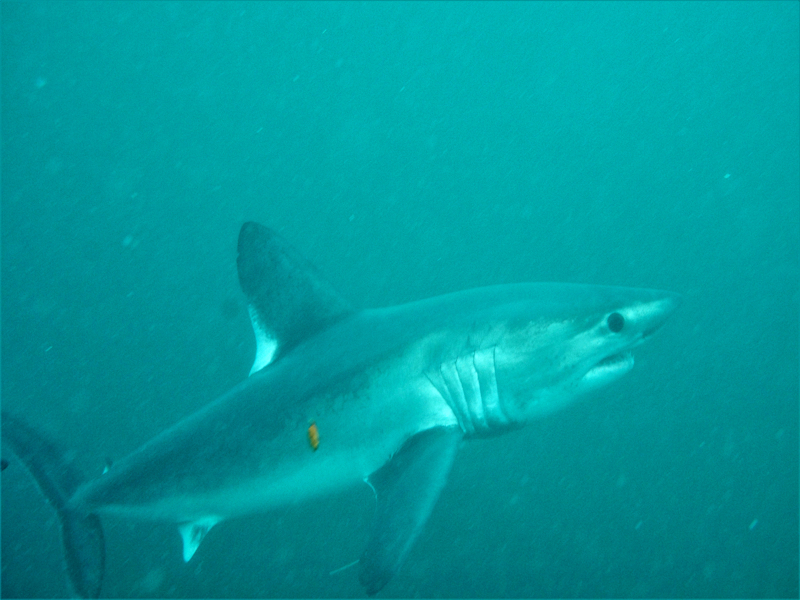
Porbeagle (Lamna nasus) is a fish of the family Lamnidae. FishBase gives its range as: Circumglobal, amphitemperature with centers of distribution in the North Atlantic and temperate water of the southern hemisphere; not in equatorial seas. Also in the Mediterranean. It is recorded from 0 to 1360 m, in boreal water at 1–23 °C. The recorded maxima are 350 cm TL, 230 kg, 65 years. Diet includes fishes. IUCN status: Vulnerable (VU). Chinese name: .
A trade file, not a size limit
Most of what an angler needs to know about a protected shark is what the protection actually prohibits. For the porbeagle, the binding international instrument is CITES Appendix II, adopted at the 2013 Conference of the Parties and implemented in the EU through the wildlife trade regulation. Appendix II does not ban catching the fish. It requires that exports and imports be permitted and that the exporting country find the trade non-detrimental to the species. That distinction matters: a CITES permit is a trade document, not a fishing licence. Catch, release and photograph a porbeagle in the North Sea and no CITES paperwork is involved. Sell its meat or fins across a border and the paperwork is the whole point.
The conservation file is separate
The IUCN assessment, made in 2018, places the porbeagle in the Vulnerable category. That is a population judgment based on decline, not a trade rule. The two systems answer different questions, and a reader who treats one as the other will either overestimate the paperwork or underestimate the problem. The practical use of the IUCN listing is to set your own release threshold: this is not a species to keep for the table when a breeding female is on the line.
There is no reef to read
The porbeagle is pelagic-oceanic, recorded from the surface to 1,360 m but usually fished in the top 300 m. It ranges across boreal and temperate water from 76°N to 59°S, in temperatures from about -1 to 23°C. That profile tells you there is no bottom structure to locate. On a reef you read rock; here you read the water. The shelf break, the temperature change and the bait are the structure. A porbeagle is not an ambush fish waiting behind a rock; it is a pursuit predator working the open water along those edges. FishBase also flags the species as traumatogenic, which on a shark of this size means the teeth, and the animal is strong enough to bend a hook before you see it. A wire trace and a heavy leader decide whether you land the fish or lose the rig.
Where the shelf ends
GBIF holds 49 distribution statements for the species across 12 countries and territories: Belgium, Brazil, Chile, Denmark, France, Greece, Israel, Norway, New Zealand, Portugal, Sweden and the United Kingdom. The list is a map of where records exist, not a promise that the shark is there every month. For a North Sea angler, the useful part is the cluster of North Atlantic countries and the absence of shallow southern North Sea records. The animals are offshore, along the shelf edge and in deeper water, not in the tidal channels.
The body is built for open water
The FishBase account puts the ceiling at 350 cm and 230 kg. The same page records a maximum age of 65 years. A fish that lives that long and grows that large does not rebuild a population quickly. Females enter the breeding stock at around two metres, which is a large shark by any inshore standard. The body shape and the pelagic range point to a fish eater, not a bottom scavenger; the teeth and the speed are for holding fast-moving prey in open water. That size also sets the tackle: a 350 cm shark is not a light-tackle target, and a long fight on light line is the worst outcome for an animal you mean to release.
The season is a temperature band
FishBase records the porbeagle as boreal, with a temperature range from about -1°C to 23°C. That is the closest thing to a season in the data: the shark follows water it can tolerate and the bait that lives in it. In the North Atlantic the northern limit is cold, the southern limit is warm, and the movement between them is not a fixed calendar. Read the sea temperature and the bait reports before you read a fishing forum's "season". A warm summer in the southern North Sea is not the same thing as a porbeagle season; the fish can simply be further north or further offshore.
Keep and season are separate questions
Nothing in Appendix II tells you whether the shark on your line may go in the boat. The permit regime governs export and import of the animal and its parts; the right to catch one is a fisheries question with a fisheries authority. Check the landing state's rule on the species before the trip: some jurisdictions prohibit targeting it outright, others allow incidental capture with release, and a closed area can remove the water regardless of what the species list says. Size and count, where they exist at all, come from the same national or regional instrument, never from the CITES text. For a Vulnerable, slow-growing shark the default is release; the legality of keeping one is decided on the shore you return to, by that shore's rulebook.
Where to look
The species is circumglobal in temperate water, with centres in the North Atlantic and the southern hemisphere, and it is absent from equatorial seas. GBIF's 49 records are spread across both hemispheres, from Brazil and Chile to Norway and New Zealand. iNaturalist has 184 observations, far more than a rare bycatch and far fewer than a common coastal shark. Look offshore, along the shelf edge and the 200-to-300-metre line, in water inside the temperature band. Take the release tools, not the kill box: a two-metre female at the boat may be decades old.
Where these facts come from
Check these pages before you rely on a size, range or protection status.
- FishBase — Lamna nasus — FishBase · T2
- GBIF — Lamna nasus occurrence records — GBIF · T2
- IUCN Red List — Lamna nasus — IUCN · T1
- Photo record — iNaturalist — iNaturalist · T3
Fish in the same water
These fish live in the same place.
Guides for this water
Technique, gear and safety guides that fit Porbeagle.