Salmon shark
The body is fusiform with no spines in the dorsal or anal fins. The first dorsal fin is uniformly dark and has no pale rear tip, which is the fastest way to separate it from the porbeagle and other large lamnids at sea. The ventral surface is white with dusky blotches, and the boundary between dark back and pale belly is sharp.
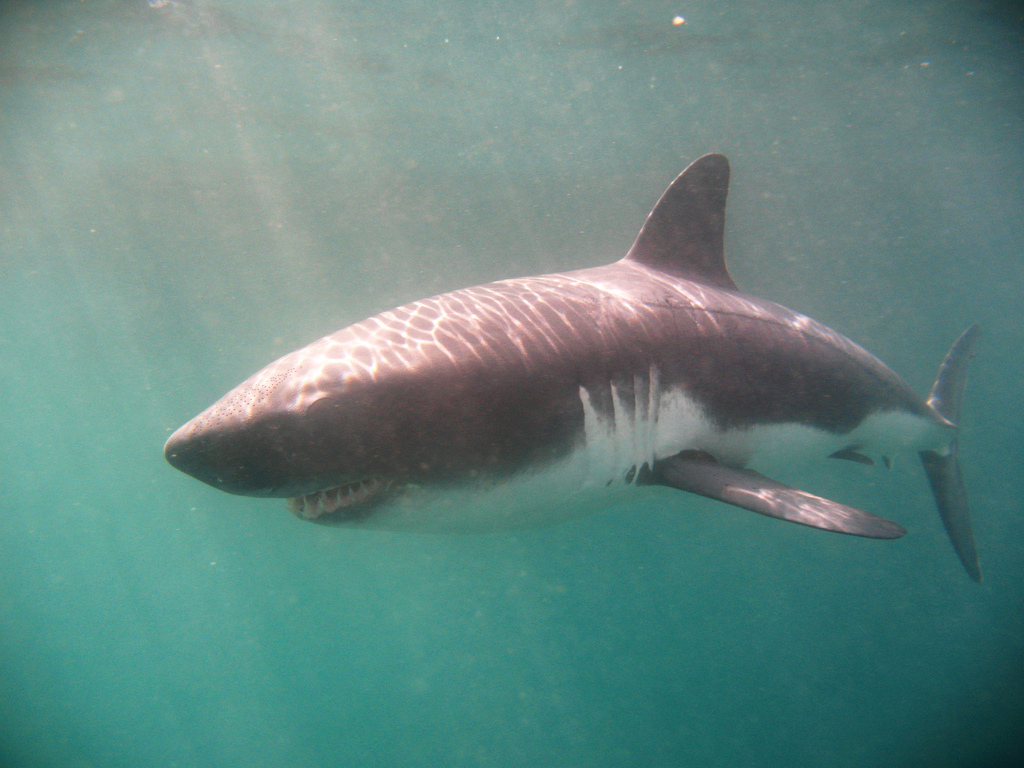
The body is fusiform with no spines in the dorsal or anal fins. The first dorsal fin is uniformly dark and has no pale rear tip, which is the fastest way to separate it from the porbeagle and other large lamnids at sea. The ventral surface is white with dusky blotches, and the boundary between dark back and pale belly is sharp. Juvenile great white sharks are heavier through the body with a larger caudal fin; a salmon shark is slimmer, with a more pointed snout and the dark, unmarked first dorsal. If identification is uncertain, release the fish as a large shark without bringing it aboard.
Habitat and behaviour
FishBase records the North Pacific, from Japan, Korea and the Sea of Okhotsk to the Bering Sea, and south to southern California and Baja California. It is pelagic, recorded from the surface to 650 m and usually from the surface to 152 m. The species makes long north-south migrations: in summer it follows salmon and herring along high-latitude coasts and shelf edges, and in winter it moves south into temperate water. GBIF holds 1520 records, 1379 from the United States, 35 from Canada and 32 from Japan. That is a sparse sample of sightings, not a measure of abundance.
Seasonal window
FishBase records no spawning months. Both Alaska and British Columbia allow one fish per day with no stated seasonal window, and practical effort centres on the summer salmon run. Water temperature is the main clue: the fish follows cold water and bait, retreating deeper or northward when the surface warms. That is an editorial reading. Early morning and evening are the best times to see a dorsal fin at the surface; through the day the fish cruise in the upper and middle water column.
Gear and approach
Use a heavy boat rod, a large-capacity conventional reel, enough braid, an abrasion-resistant fluorocarbon or fine-wire leader, and a large circle or dedicated shark hook. Set the drag before the first run, which is the strongest, and never handle the line by hand. Salmon sharks have sharp teeth, so use long pliers for the hook and keep fingers away from the mouth. Support the pectoral fins and belly for a photograph, and release the fish quickly. A short wind-on leader keeps the connection within the rod's reach, and a flying gaff is not needed for a fish that will be released. Keep the reel in low gear for the final lift.
Edibility and regulations
The flesh is reddish and can be fried or grilled; bleed and ice the fish promptly. IUCN status is LC, assessed in 2018, and neither CITES nor CMS has evaluated the species.
Alaska: one per day, one in possession, two per year, with a harvest record.
British Columbia: one salmon shark per day.
Washington: the current text was not obtained; check the current notice.
California: the recreational limit was not confirmed in the public summary; check the current notice.
Where to look
Distribution, size and morphology come from FishBase, occurrences from GBIF, and images from iNaturalist. The migration account is an editorial synthesis of distribution and season, not a tagged study. The Alaska and British Columbia limits are confirmed, while Washington and California remain gaps. Identification and release practice for large sharks differ by jurisdiction, so check each one before the trip. The practical approach is to plan around bait and water temperature rather than a fixed mark.
How to catch it
Boat drift fishing
Fished with the listed approach, matched to the recorded depth and size.
Jigging
Fished with the listed approach, matched to the recorded depth and size.
Where these facts come from
Check these pages before you rely on a size, range or protection status.
- FishBase — Lamna ditropis — FishBase · T2
- GBIF — Lamna ditropis occurrence records — GBIF · T2
- IUCN Red List — Lamna ditropis — IUCN · T1
- Photo record — iNaturalist — iNaturalist · T3
Fish in the same water
These fish live in the same place.
Guides for this water
Technique, gear and safety guides that fit Salmon shark.