
Striped marlin
One row of this record calls the fish commercial; the next calls it a gamefish. The summary goes further, saying it is a desirable commercial and game fish and that conservation measures restrict its commercial landings. Those are not competing descriptions of the animal. They are two ledgers kept by two industries over the same 290 cm body, and the numbers below explain why both can be true at once.

One row of this record calls the fish commercial; the next calls it a gamefish. The summary goes further, saying it is a desirable commercial and game fish and that conservation measures restrict its commercial landings. Those are not competing descriptions of the animal. They are two ledgers kept by two industries over the same 290 cm body, and the numbers below explain why both can be true at once.
Two ledgers for the same body
The human-use row says "Fisheries: commercial; gamefish: yes", with no aquaculture and no aquarium trade. Commercial means the fish enters a market; gamefish means it will take a trolled lure and fight in a way that sells trips. Neither label says how many fish move through which channel.
The summary adds the detail the table omits: conservation measures are in place to restrict commercial landings. That sentence does not say the restriction works, how strict it is, or where it applies. It says the two uses are administratively separated — a market fish with a cap, and a sport fish without one. An angler reading only the first label would miss the cap; a reader seeing only the second would miss that the same fish is sold.
What the market weighs
The record maximum is 420 cm TL; a typical fish measures 290 cm; the heaviest specimen weighed 440 kg, and the oldest fish was 9 years. First maturity is 210 cm.
The common fish is 69% of the maximum. The page gives one weight, not a range, so the 440 kg figure cannot be placed on the length curve. What is clear is that a 290 cm fish is a large animal by any measure, and that the 440 kg figure belongs to a different specimen from the 420 cm one. The record does not say they were the same fish, and no reader should merge them.
Maturity at half the maximum
First maturity at 210 cm is exactly half the maximum length. That is a wide gap, and it has a practical consequence: a fish at 210 cm is only beginning to spawn, while a fish at 290 cm has had years of reproductive life. The source does not give an age at maturity, so the gap cannot be converted into years.
For release practice, the 210 cm line is the only defensible threshold in the record. Below it, the source does not count the fish as mature; above it, the fish is mature but the page says nothing about how much of the population is above the line. The 9-year maximum age is a separate fact and should not be used to estimate growth.
The top hundred metres
The environment entry spans 0–200 metres, with a temperature envelope of 20 to 25°C. The summary describes an epipelagic predator that hunts during the day in roughly the top 100 metres, often near the surface, with sardines and other pelagic forage fish as chief prey.
The 200 metre figure is the edge of the recorded range; the 100 metre figure is where the feeding happens. For a trolling spread, that is an instruction to keep the lures in the upper layer and to look for the temperature band rather than the depth contour. The 20–25°C window is narrow enough to be useful: a 26°C surface is outside the recorded envelope, and a 19°C surface is outside it on the cold side.
A horseshoe in the Pacific
FishBase describes the Indo-Pacific range as tropical, subtropical and temperate, and notes that the Pacific distribution forms a horseshoe-shaped pattern unlike that of other billfishes and tunas. The coordinates run from 46°N to 49°S and from 19°E to 69°W.
GBIF's distribution layer returns only six records, covering Chile, Colombia and Mexico, with localities labelled East Pacific, Indo-West Pacific and Global. The difference is not a range disagreement. A six-record layer reflects which national checklists have been published, not where the fish swims; the Chilean entry even carries a written range from Arica to 35°S. FishBase's 75-country table is the better map, and the GBIF layer is a reminder that checklist coverage is uneven.
The iNaturalist taxon page holds 206 observations. A photographic sample at that size is not a survey, and it does not fill the gap left by the six GBIF records; it only shows that the fish is seen often enough to be photographed.
Eleven rows, nine months
The spawning table has eleven entries. They cover January, February, March, May, June, September, October, November and December; April, July and August do not appear.
Nine months of records and three absent months are not evidence of a closed season. The table is a collection of regional observations, each naming a sea or region but none giving a spawning depth, so an empty month may mean no spawning, no sampling, or a month that fell between two studies. What the table does support is that spawning is not confined to a short spring window: it is recorded across most of the year in different parts of the range.
Least Concern with a landing restriction
Least Concern, assessed in May 2021, is the IUCN category carried by this species. The summary, at the same time, says commercial landings are restricted.
An assessment and a management measure answer different questions. Least Concern describes the extinction risk of the species as assessed; a landing restriction describes what one fishery is allowed to do. A species can be globally Least Concern and still have a cap on one fleet, and a cap can exist without the species being threatened. The record keeps both statements, and the article will not turn either into a population estimate.
Two numbers and a temperature
Carry 210 cm and 290 cm: the first is the maturity line, the second is the typical fish. Carry 20–25°C as the working window and keep the lures in the top 100 metres.
Treat 420 cm, 440 kg and 9 years as record-book facts, not as expectations. The two ledgers — commercial and gamefish — are both real, and the landing restriction in the summary is the one line that connects them.
Where these facts come from
Check these pages before you rely on a size, range or protection status.
- FishBase — Kajikia audax — FishBase · T2
- GBIF — Kajikia audax occurrence records — GBIF · T2
- IUCN Red List — Kajikia audax — IUCN · T1
- Photo record — iNaturalist — iNaturalist · T3
Fish in the same water
These fish live in the same place.
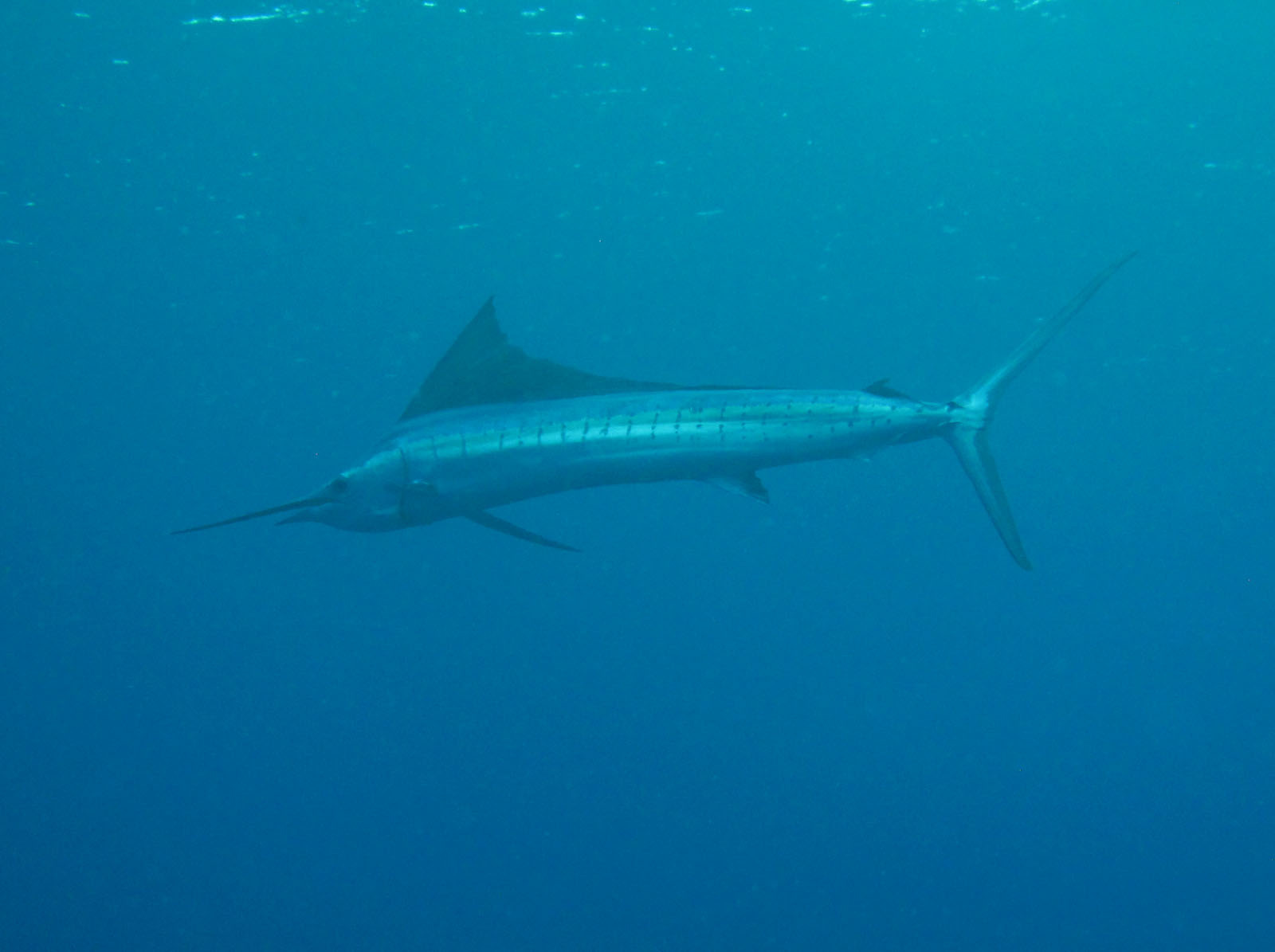
Atlantic sailfish
- Family
- Istiophoridae
- Depth
- 0–200 m
- Season
- Jan, Feb, Mar, Apr, May, Jun, Jul, Aug, Sep, Oct, Nov, Dec

Atlantic white marlin
- Family
- Istiophoridae
- Depth
- 0–150 m
- Season
- Apr, May, Jun
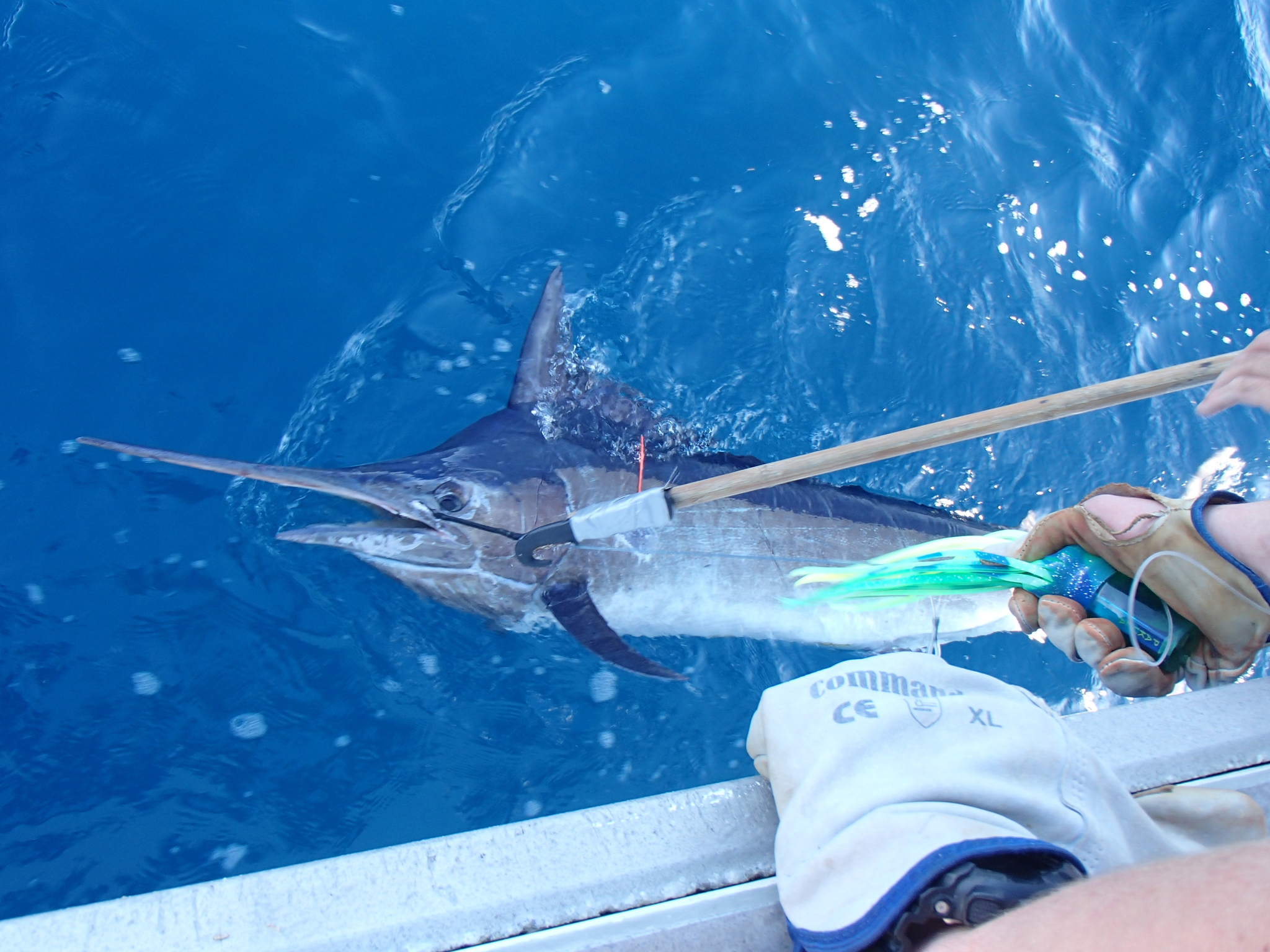
Black marlin
- Family
- Istiophoridae
- Depth
- 0–915 m
- Season
- Jan, Feb, Mar, May, Jun, Aug, Sep, Oct, Nov, Dec
Guides for this water
Technique, gear and safety guides that fit Striped marlin.