
Brassy chub
Count first: ten or eleven dorsal spines with 13 to 15 soft rays, three anal spines with 12 to 14 soft rays, 17 to 20 pectoral rays, 26 vertebrae. Horizontal scale rows alternate gold and blue, the back is metallic blue and the belly white, and roughly 23 to 29 golden lines run along the flank, those above the lateral line curving with it.
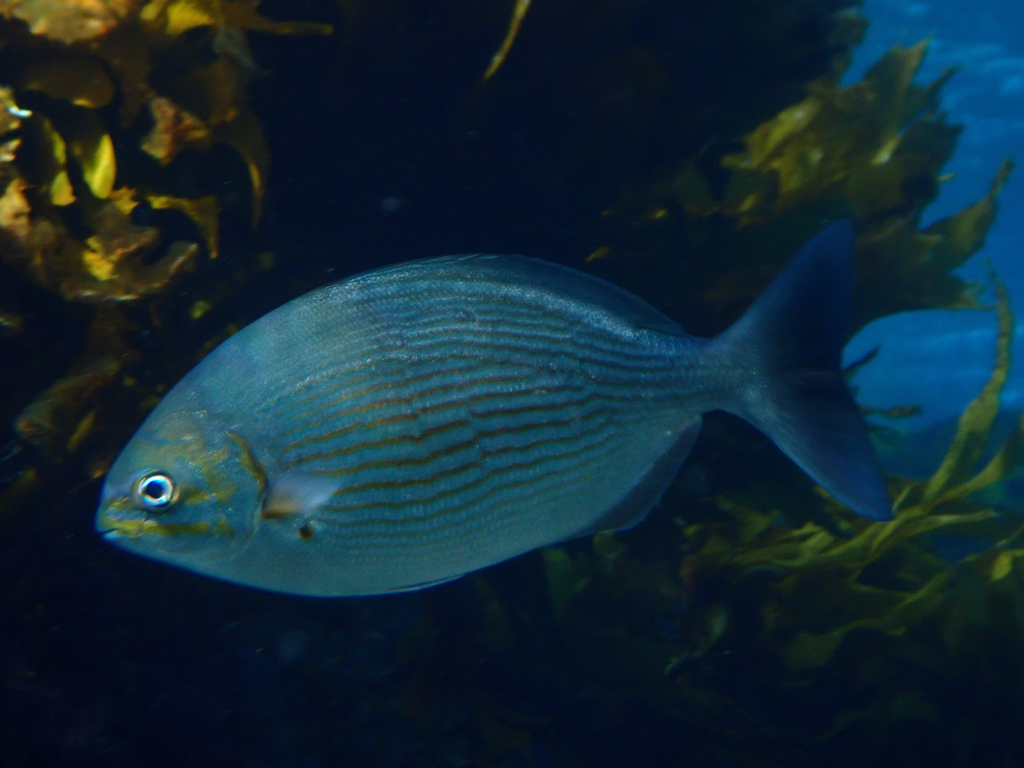
Count first: ten or eleven dorsal spines with 13 to 15 soft rays, three anal spines with 12 to 14 soft rays, 17 to 20 pectoral rays, 26 vertebrae. Then read the pattern. Horizontal scale rows alternate gold and blue, the back is metallic blue and the belly white, and roughly 23 to 29 golden lines run along the flank, those above the lateral line curving with it. The head carries a steady mark: a golden streak running from the snout to just behind the front edge of the eye. Gill rakers are diagnostic within the genus, 16 to 23 on the lower limb and 5 to 10 on the upper. One caveat belongs here rather than in a footnote: in Hawaii and across the Indo-Pacific, what is called nenue is a Kyphosus species complex, regularly confused in the field with K. bigibbus, K. pacificus and others, and separating them means counting fin rays and reading head markings. Nenue is a local name, not a scientific one. Note also that the dorsal and anal fins are very low, which is why the fish looks almost rectangular.
A world map and a shallow band
The range is circumtropical: from the eastern Pacific across the Pacific to the Indian Ocean and the Red Sea, and on into the eastern and western Atlantic and the Mediterranean. Latitude spans 35°N to 38°S and longitude 25°E to 133°W, which is close to a world map. Depth is the practical number: 0 to 40 m only. This is a shallow reef fish that never requires a long run offshore. The habitat wording leans on exposure — hard, algae-coated bottoms on surf-swept outer reef flats, in lagoons and on seaward reefs, with adults close to shore and juveniles drifting with flotsam near the surface in open ocean, sometimes in mangroves. Adults and juveniles therefore occupy different places, and a dense school off a rocky point may be the same species as a lone fish under floating weed far out.
Seasons hide in the stomach, not the calendar
No spawning months are recorded, but the diet gives the year a shape. Adults are carnivorous in summer and autumn and switch in winter to the brown alga Endarachne binghamiae. That is not a temperature record, yet it changes bait choice: shrimp and fish flavours suit the warm half of the year, algae and bread the cold half. Reproduction is oviparous and says nothing about timing. The tropical range runs 35°N to 38°S, wide enough that winter at one end is nothing like winter at the other, so experience does not travel. The dependable rhythm is the swell: fish on an outer flat follow the white water, and surge and water level decide which part of the reef they are working.
Drifting a bait through the wash
Nenue is an omnivore leaning vegetarian, and bread, algae and shrimp all work. The productive position is the white water behind the shorebreak, where fish pick up algae fragments and small organisms broken loose by the swell; the bait has to move with the wash rather than sit still. A float rig suits the terrain: a small float carrying weed or bread drifts across the reef face and is taken as the school passes. A bottom bait on a rocky shore also works — light-to-medium rod, small hook, bread or shrimp sinking beside the rock — but wet rock and sudden sets are the real hazard. The mouth is built for cropping, so hooks should not be large, and the bait needs a soft portion the fish can grip. Once hooked, steer the fish away from the wash at once, or the next wave wraps the line.
Rod, leader and a short leash
Seventy centimetres is the maximum and 50 cm the common length, which is a substantial reef fish, so the rod needs some backbone while the leader stays fine enough to be taken. A longer shore rod helps in the surge, lifting line off the rock; the reel should cope with short, hard runs, with the drag set from the middle. Braid for abrasion resistance, then a fluorocarbon leader long enough to absorb rock contact. On the float rig, a small float and light lead let the bait travel instead of anchoring it. Use a medium wide-gap single hook with a strong but not heavy shank. After the strike, lead the fish sideways off the white water and the reef crest before thinking about landing it, and take the gap between sets if you have a net. Cutters are part of the kit; in the surge, cutting off a snag beats hauling on it.
Eating, and the Hawaiian rulebook
The record calls it a good food fish, and nenue holds a steady place in local Hawaiian eating. Two permits matter here, and they do different jobs: an NRMFL for a non-resident fishing salt water, a CML only if fish will be sold. Size and bag figures sit in HAR 13-95, gear in HAR 13-74, and they are consulted separately. The real trip hazard is the place rule — MLCDs, FRAs and managed areas are closed to taking, with boundaries reset each year by Division maps and notices. The current species table gives this fish no separate size or bag line, which is a gap in the table, not permission to keep everything.
The uncertainty that stays open
The species description, including fin-ray counts and head markings, is FishBase's. Observation data come from iNaturalist, 3058 records, the largest tally of the five species here; the GBIF page served only as a key check; the Hawaii rules come from the Division. Uncertainty is taxonomic rather than numeric: K. vaigiensis belongs to an Indo-Pacific complex, this entry follows the FishBase characters, and atypical field fish should be recorded rather than named. Spawning months and maximum age are both missing, which is why the season section starts from diet.
How to catch it
Shore fishing
Fished with the listed approach, matched to the recorded depth and size.
Boat fishing
Fished with the listed approach, matched to the recorded depth and size.
Where these facts come from
Check these pages before you rely on a size, range or protection status.
- FishBase — Kyphosus vaigiensis — FishBase · T2
- GBIF — Kyphosus vaigiensis occurrence records — GBIF · T2
- IUCN Red List — Kyphosus vaigiensis — IUCN · T1
- Photo record — iNaturalist — iNaturalist · T3
Fish in the same water
These fish live in the same place.
Guides for this water
Technique, gear and safety guides that fit Brassy chub.