
Stonebream
Stonebream is a Kyphosidae sea chub from Inhaca Island in southern Mozambique to False Bay in South Africa. It has six to eight dorsal spines, three anal spines, a deep oval body and a small mouth. It reaches 50 cm SL with a common length of 18 cm, 2.6 kg, maturity at 30 cm and a maximum age of 10 years. Bait, float fishing and soft plastics in the surge are the methods listed.
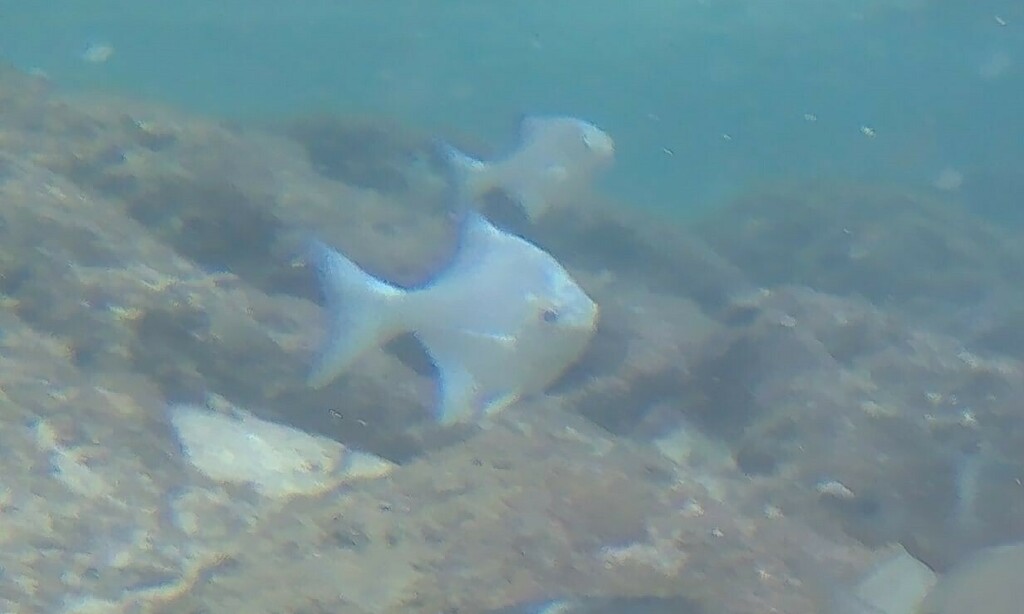
Neoscorpis lithophilus is a Kyphosidae sea chub recorded from Inhaca Island in southern Mozambique to False Bay in South Africa. It has six to eight dorsal spines with 20 to 25 soft rays, three anal spines with 23 to 26 soft rays, a deep oval body and a small mouth. FishBase gives 50 cm standard length, a common length of 18 cm, 2.6 kg, maturity at 30 cm and a maximum age of 10 years. It grazes benthic algae and small invertebrates in the surf zone and is taken almost entirely from the shore.
Identification
A sea chub with a deep, oval body, a small head and a blunt snout. Despite the local name stonebream it is not a sparid: the dorsal fin has six to eight spines followed by 20 to 25 soft rays, and the anal fin has three spines and 23 to 26 soft rays. Those long soft sections separate it from similar-sized bream.
Colour is uniform olive-grey to brownish above, paler below, with no bars, spots or stripes. The mouth is small and the teeth are incisiform, set in a narrow band for grazing rather than crushing.
FishBase gives 50 cm standard length, a common length of 18 cm, 2.6 kg, maturity at 30 cm and a maximum age of 10 years. Most shore-caught fish are well below that.
Distribution and Habitat
Western Indian Ocean: from Inhaca Island in southern Mozambique south to False Bay in South Africa. It is a warm-temperate shore species, not a deep-reef fish.
The practical ground is the white water over rock ledges, gullies and surge channels within casting range of the shore; it does not feature in deep boat catches.
Because it lives where waves break, catch rates follow sea state more than tide height: a moderate swell that stirs the weed fishes better than flat calm.
Habits and Diet
It grazes benthic algae and takes small invertebrates, mainly crustaceans, molluscs and worms, from the rock surface. The small mouth limits it to small items; it grazes and picks rather than hunts.
It moves with the surge instead of holding one spot, which is why a bait that drifts with the water outfishes one pinned to the bottom.
FishBase publishes no monthly spawning data. With maturity at 30 cm against a common length of 18 cm, much of the shore catch is immature.
Fishing Methods and Gear
Light shore bait fishing is standard: a small piece of prawn, sandworm or squid on a size 1 to 1/0 hook, a light ball sinker or none at all, cast into the white water and allowed to wash through a gully.
A float keeps the bait off the weed and moves it with the surge, and is better on weedy ground.
Small soft plastics work in the wash but hook-up rates are lower against the small mouth. Use a 9 to 10 ft light shore rod, a 3000 to 4000 reel, 15 to 20 lb braid and a 20 lb fluorocarbon leader, and expect to lose tackle on the reef.
Seasonal Window
Present year-round; the warm months are most consistent, but fish are caught in every month.
The classic window is the first day of a dropping swell, with the water still coloured and moving. Flat, clear water pushes fish into the gullies or deeper.
Early morning and late afternoon are the productive hours, and rocky points also fish at night.
Edibility and Handling
Good but modest eating: white flesh firm enough for pan-frying or soup, a common shore-caught meal in the Eastern Cape.
Gut and ice promptly. The body is thick and holds heat, so a cooler beats a dry bag on a long session.
Releasing fish below 30 cm is the simplest conservation action available, since so much of the shore catch never reaches maturity.
Regulations and Conservation
South Africa: stonebream (Neoscorpis lithophilus) appears in the recreational linefish table with a bag limit of five per person per day and no minimum size; this entry should be re-checked against the current Annexure 7 text before publication. A recreational permit is required, and boat-based fishing needs a vessel licence.
IUCN: Not Evaluated. No global Red List assessment exists, so the species' status rests on South African catch data rather than an international benchmark.
There is no second jurisdiction in the range. All management decisions for this fish are made in South Africa.
How to catch it
Bait fishing
Float fishing
Soft plastic in the surge
Where these facts come from
Check these pages before you rely on a size, range or protection status.
- GBIF — Neoscorpis lithophilus occurrence records — GBIF · T2
- IUCN Red List — Neoscorpis lithophilus — IUCN · T1
- Photo record — iNaturalist — iNaturalist · T3
Fish in the same water
These fish live in the same place.
Guides for this water
Technique, gear and safety guides that fit Stonebream.