
Halfmoon
The halfmoon is the fish most often mistaken for an opaleye: same deep body, same habit of grazing rock, but blue-grey instead of near-black, with a clear yellow tail. It leans harder on kelp and offshore reef than the opaleye does, and Southern California catches come mostly from reef edges in warm years. Snout shape, eye height and the yellow tail separate the two; body depth alone does not.
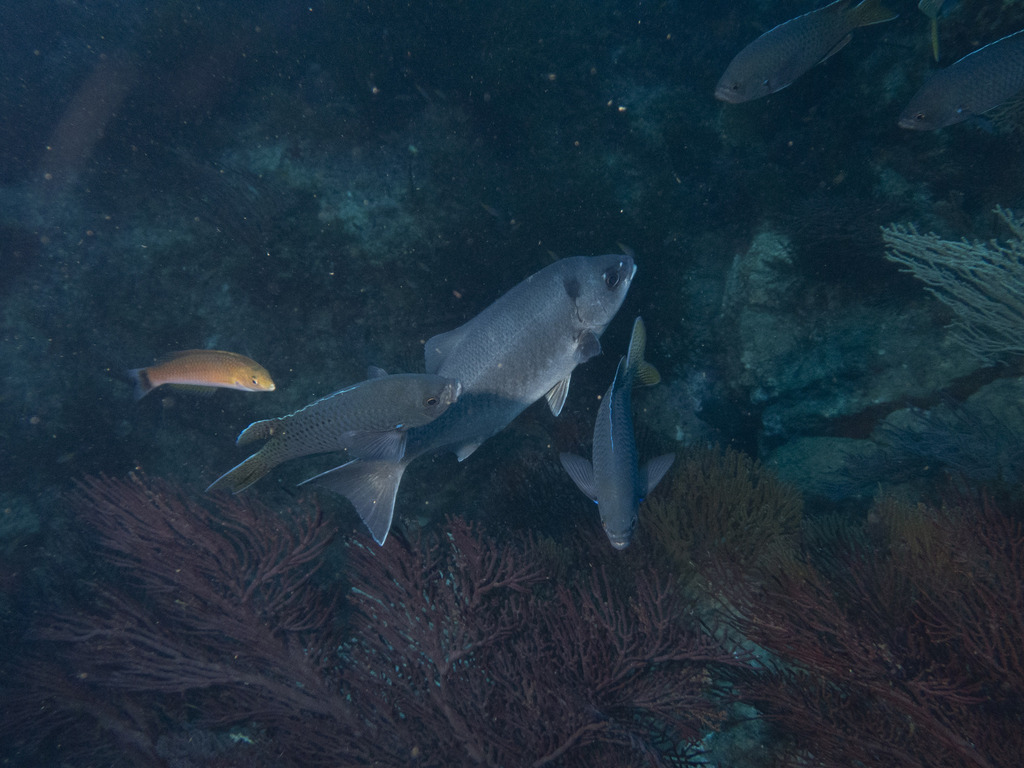
The halfmoon is the fish most often mistaken for an opaleye: same deep body, same habit of grazing rock, but blue-grey instead of near-black, with a clear yellow tail. It leans harder on kelp and offshore reef than the opaleye does, and Southern California catches come mostly from reef edges in warm years. Snout shape, eye height and the yellow tail separate the two; body depth alone does not.
The blue stand-in for the opaleye
Deep-bodied and compressed, close to a half circle, with a sharper snout than an opaleye and an eye set lower on the head. The colour is blue-grey or grey-green above with a white belly, the tail is clearly yellow on a live fish, and the dorsal and anal fins often carry yellow edges. Against an opaleye: that fish is darker, blunter in the snout, higher in the eye, and its tail yellow is muted. The halfmoon's blue tone survives in shadow. Both feed on the same rock, so in poor light compare snout angle first and the caudal peduncle second. Against a striped surfperch, the halfmoon has no blue stripes and a bigger frame.
Kelp rock, and a range that ends at Point Conception
FishBase runs the range from Vancouver Island to the Gulf of California and notes that the fish is rare north of Point Conception. It lives on rocky ground and in kelp beds from inshore water to 40 m, and Southern California catches come from offshore reef, the kelp margin and rock outside a pier. Warm years push it north, cold years send it south and deeper. The habitat difference from the opaleye shows up on the water: the opaleye hugs the intertidal edge and shallow rock, while the halfmoon turns up more often on reef edges with some depth under them. A shallow boil over sand is the wrong place to look.
Warm water moves it, cold water removes it
FishBase gives no monthly spawning table, only that the species is a pelagic spawner. Local fishing follows the warm water: late summer into autumn is the steadiest stretch on the reef, and in winter fish drop to deeper structure where shore anglers rarely reach them. The range extends into the Gulf of California, which fits a fish that depends on warmth; in years when local upwelling stays strong, catches fall away. No preferred or spawning temperature is published, so plan from water colour and the bait on the reef. A warm, blue current is the signal to try.
Floats over rock, weed bunches for slow days
Over reef, fish a float: a shrimp or a bunch of algae on a 1/0 hook, the float set a metre or two above the rock so the bait drifts across the face with the swell. The fish eats algae and small invertebrates, so a weed bunch holds fish when the bite is slow and a shrimp finds the active ones. With lures, a small soft plastic or a tiny iron crawled along the reef, paused at each ridge, covers water quickly. From a boat, drop the bait down the outside edge with a light sinker and let it fall slowly. Watch the float rather than the rod tip. A float that stalls has already been taken.
Short leaders, light sinkers, no snagging
A 7 to 8 foot medium-action spinning rod, a 3000 size reel, 20 to 30 lb braid, a 15 to 20 lb fluorocarbon leader, and a size 1 to 1/0 hook. Build the rig to stop when it lands: light sinker, short leader, fewer hang-ups. On the strike, turn the fish's head away from the reef at once; the runs are short but they aim straight down. Leave the drag some room, because a fish that reaches a crevice will try to stay there. On release, keep the fish off the rock and support the belly. Small scales lift easily under a dry hand.
Good flesh under the general limit
FishBase records the flesh as highly regarded and the fish as marketed fresh, and notes that it is also taken with harpoons. Cook it steamed, pan-fried or as a cold plate, provided it was iced properly; a weed-eating fish has a clean taste, but the viscera need clearing. California's general marine bag limit is 20 fish in total with no more than 10 of any single species, and the halfmoon has no size limit and no closed season (14 CCR § 27.60). State and federal water can differ, much of the Southern California reef and kelp sits inside MPAs, and the CDFW notice decides. A licence is required from 16. Keep the catch iced in a cooler, not in a bucket.
What FishBase supports and what it does not
Range, the 0 to 40 m depth band, the 48 cm total length, 8 years, the reef and kelp habitat, the diet of algae and small invertebrates, and the IUCN LC assessment from 2007 all come from FishBase; family placement follows GBIF's Kyphosidae. The bag limit comes from 14 CCR § 27.60. Spawning months and local population trend are missing and listed as gaps, and the monthly strength is regional angling experience. The Chinese name follows the master plan, with the FishBase name kept as an alias.
How to catch it
Float fishing
A float set a metre or two above the rock, drifting a shrimp or weed bunch across the face and down the lee side of a ridge.
Soft plastic along the reef
A small plastic on a light head crawled over the rock, paused at each ridge to mimic weed fragments.
Boat bottom fishing
Lower the bait down the outside drop with a light sinker; fish often take it halfway down.
Where these facts come from
Check these pages before you rely on a size, range or protection status.
- FishBase — Medialuna californiensis — FishBase · T2
- GBIF — Medialuna californiensis occurrence records — GBIF · T2
- IUCN Red List — Medialuna californiensis — IUCN · T1
- Photo record — iNaturalist — iNaturalist · T3
Fish in the same water
These fish live in the same place.
Guides for this water
Technique, gear and safety guides that fit Halfmoon.