
Cuckoo wrasse
The size line for the cuckoo wrasse contains two maximum lengths that cannot be placed side by side without a conversion: 40 cm standard length for a male, and 30 cm total length for a female. The numbers are written in the same block, separated by a semicolon, and a reader who compares them directly is comparing two different measurements. That is the whole of this entry's argument, and it matters more than the ten-centimetre gap suggests.

The size line for the cuckoo wrasse contains two maximum lengths that cannot be placed side by side without a conversion: 40 cm standard length for a male, and 30 cm total length for a female. The numbers are written in the same block, separated by a semicolon, and a reader who compares them directly is comparing two different measurements. That is the whole of this entry's argument, and it matters more than the ten-centimetre gap suggests.
The size line uses two rulers
FishBase gives the male maximum as 40 cm SL, the female maximum as 30 cm TL, the common length as 30 cm SL for males and unsexed fish, first maturity at 16 cm, and 20 years as the oldest age on record. Three of those figures use standard length; the female maximum alone uses total length.
Nothing in the line says why the female entry switched rulers. It may reflect the reference behind the figure rather than a decision by the compiler. What is certain is the label: SL and TL are printed, and they are not decorative.
Male 40 SL, female 30 TL
Standard length measures from the front of the snout to where the tail fin begins. Total length carries the measurement on to the end of that fin. The second measure includes a fin the first one excludes, so a fish written as 30 cm TL has a standard length below 30 cm, while a fish written as 40 cm SL has a total length above 40 cm.
Put those two directions together and the apparent ten-centimetre gap widens. The male's 40 SL, expressed the female's way, would be more than 40 TL; the female's 30 TL, expressed the male's way, would be less than 30 SL. The record gives no conversion factor, and the true separation between the two maxima is therefore larger than the printed numbers imply.
The conversion the record does not give
A conversion from SL to TL is not a constant. It depends on the proportion of the tail in a given species at a given size, and the entry supplies no such proportion. Multiplying by a fixed percentage would produce a number with no source behind it, and this entry will not do that.
What can be done is to keep the two figures in their own units. A male limit written in SL and a female fish measured in TL are not comparable until one of them is measured again on the other's ruler. That is a handling instruction, not a biological claim, and it is the one the source supports.
Maturity at 16 cm, sex not stated
First maturity is given as 16 cm, with no range and no length type. The entry also does not say whether the figure applies to males, females, or both. For a protogynous species that starts life female, that omission matters: a 16 cm fish may be a female, a transitioning individual, or a male, and the record does not let a reader decide which.
The safe use of the number is as a threshold below which the source considers the fish immature, with no claim about sex. Anything more specific would be an addition to the record rather than a reading of it.
Thirty centimetres as the common length
The common length is 30 cm SL, qualified as male/unsexed. That is the same number as the female maximum, but on a different ruler and attached to a different group. A reader who sees "30 cm" twice and treats it as one fact has merged two statements that the record keeps apart.
The 20-year maximum age sits in the same block, with no length attached. It is a lifespan figure, not a growth figure. The combination of a 40 cm male, a 30 cm common length, and 20 years describes a small, relatively long-lived reef fish, but the record does not connect the three into a curve.
Depth 2 to 200 m, usual 40 to 80 m
The environment line brackets the species between 2 and 200 m, then narrows to 40 to 80 m as the usual range, with a subtropical envelope from 68°N to 12°N. The gap between the extremes and the usual band is the largest in this batch: most records sit in a narrow slice well below the shallow end.
The biology keywords are reef-associated and non-migratory, and the habitat is given as weedy, rocky areas in the usual band by Wikipedia. GBIF's distributions layer adds nine records across six countries, Denmark, Spain, Greece, Norway, Portugal and Sweden, with localities including the Azores EEZ, the Donana reserve, the Greek EEZ and the Swedish EEZ. Those are administrative records, not depth records; they widen the map without saying anything about the 40 to 80 m band. iNaturalist carries 714 observations for the taxon.
Spawning from March to July
The spawning table runs from March to July overall, with three regional entries: the Adriatic in April and May, the Channel and southern North Sea in May to July, and the western Mediterranean in March to June. The Mediterranean record starts a month earlier than the northern one and ends a month earlier.
No spawning ground and no temperature trigger is given. The three windows overlap in May, which is the only month common to all of them. Treat the table as three local observations rather than a single season for the species.
The number to carry
Take the male maximum as 40 cm SL and the female maximum as 30 cm TL, and do not merge them. Take the common length as 30 cm SL, male/unsexed, and take first maturity as 16 cm with no sex attached. If a limit or a personal rule is written in one unit, measure the fish in that unit; if it is written in the other, no published factor exists to cross over. The cuckoo wrasse is a small fish with a wide depth envelope, and the measurement is the part of its record that most often gets flattened.
Where these facts come from
Check these pages before you rely on a size, range or protection status.
- FishBase — Labrus mixtus — FishBase · T2
- GBIF — Labrus mixtus occurrence records — GBIF · T2
- IUCN Red List — Labrus mixtus — IUCN · T1
- Photo record — iNaturalist — iNaturalist · T3
Fish in the same water
These fish live in the same place.
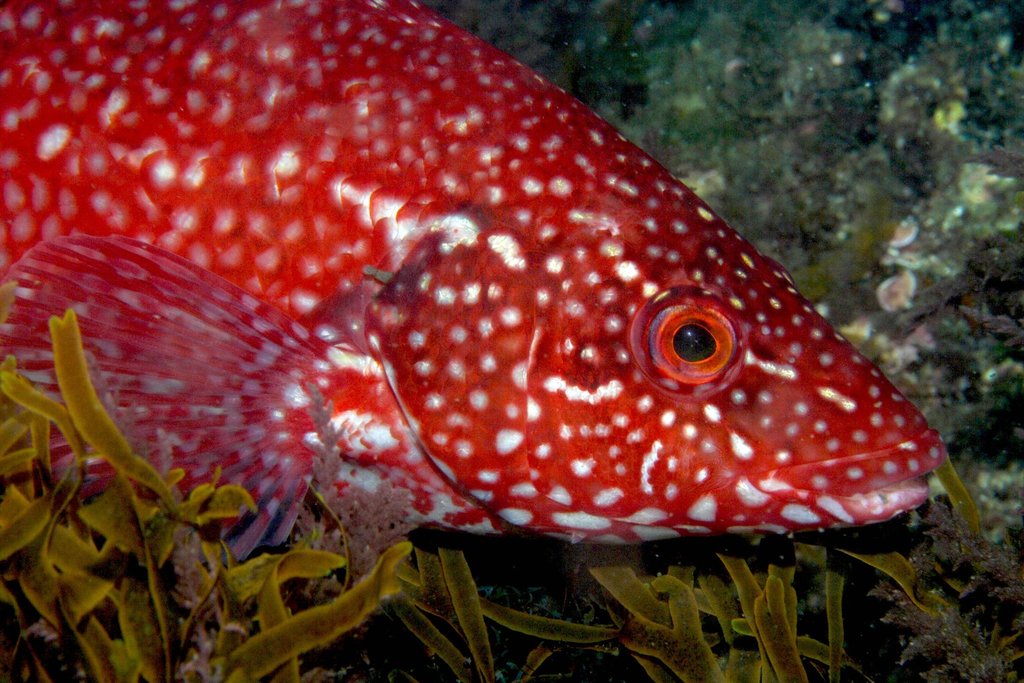
Ballan wrasse
- Family
- Labridae
- Depth
- 1–50 m
- Season
- Apr, May, Jun, Jul, Aug
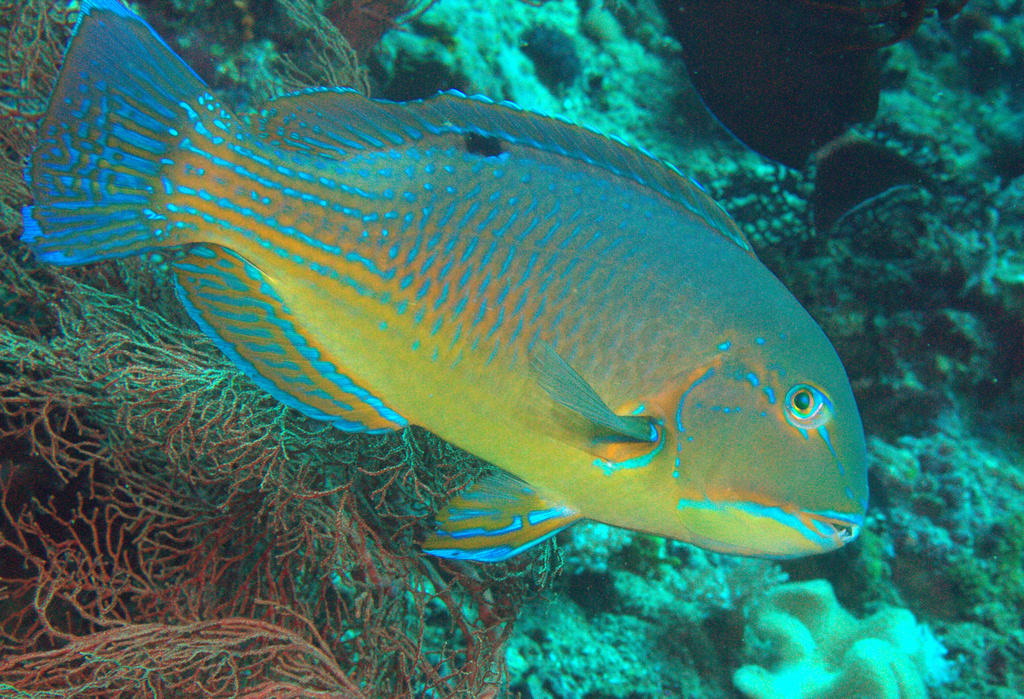
Blackspot tuskfish
- Family
- Labridae
- Depth
- 10–60 m
- Season
- Jan, Feb, Mar, Apr, May, Jun, Jul, Aug, Sep, Oct, Nov, Dec

Blue tuskfish
- Family
- Labridae
Guides for this water
Technique, gear and safety guides that fit Cuckoo wrasse.