
Green wrasse
The green wrasse is the fish most often written off as just another wrasse: large, quietly coloured, not rare in catches, and listed as Vulnerable by IUCN. Males build dish-shaped nests and guard the eggs, which means a big fish taken in the breeding season costs more than one fish. Release is the recommendation here, and it is not the same thing as a legal ban.
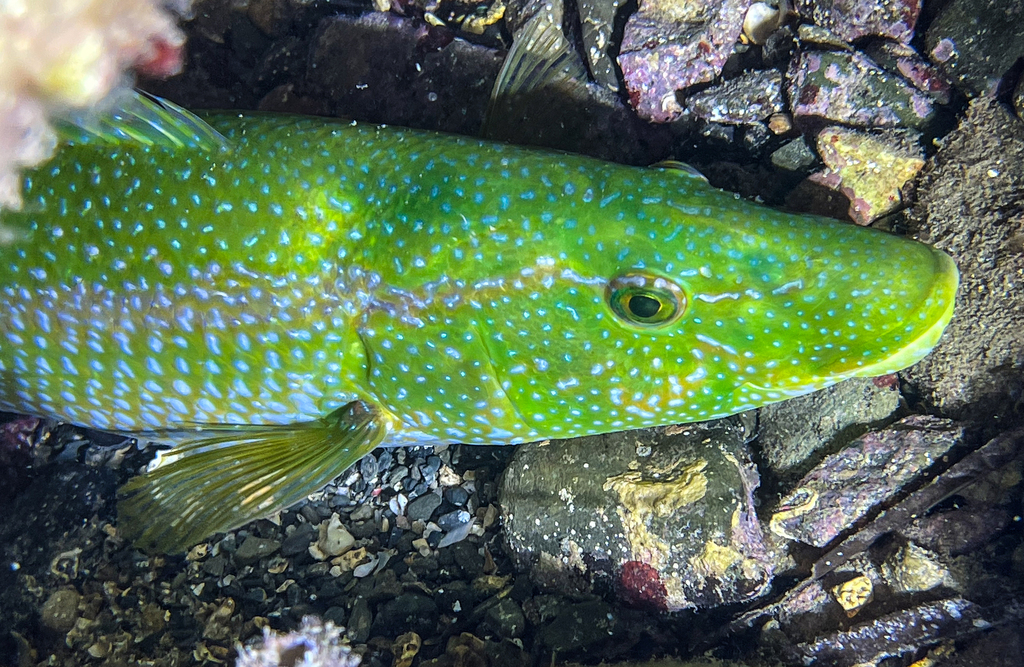
The green wrasse is the fish most often written off as just another wrasse: large, quietly coloured, not rare in catches, and listed as Vulnerable by IUCN. Males build dish-shaped nests and guard the eggs, which means a big fish taken in the breeding season costs more than one fish. Release is the recommendation here, and it is not the same thing as a legal ban.
A big, plain wrasse with thick lips and large scales
Size is the first clue. This is one of the largest wrasses in the Mediterranean, with a recorded maximum of 47 cm and a common length of 37.5 cm. The body is thick, the back slightly humped, the belly gently convex; the head is large, the eyes large, the lips thick, the mouth small, and the body is covered in large smooth scales. Colour is green to brown-green without dense spotting or strong bars, and the caudal fin has a rounded rear edge. Against L. merula, the green wrasse is greener and larger, while adult L. merula runs dark brown to near black with pale fin margins. Against local Symphodus species it is heavier, thicker-lipped and larger-scaled, where Symphodus tend to be smaller with dark flank blotches or stripes. Colour fails in deep water, so judge lips, scales and body depth, and photograph the flank if unsure.
The rock and eelgrass seam, with a depth caveat
FishBase records the range from Portugal to Morocco, including the Mediterranean and Black Sea. The fish lives in shallow coastal water near rock and eelgrass, which makes it a classic edge species between reef and meadow. One caveat belongs here: this FishBase entry gives no depth figure, and the 1 to 50 m used in this article is a regional working range, not a FishBase field. The productive ground is the reef margin and the outer edge of the eelgrass, especially the seam where stone meets weed. It does not hang in open water the way some wrasses do; it moves tight to structure and ducks into weed or crevice when disturbed.
Nesting males and a Vulnerable listing
FishBase records that the species is oviparous, pairs during breeding, and that males build dish-shaped nests and guard the eggs. No monthly spawning table or spawning temperature is given, so work with the qualitative pattern: breeding begins as water warms in spring, and males start guarding nests. Mediterranean catches improve in spring, hold through summer, remain possible in autumn, and drop to deeper or more stable structure in winter. Age and growth are not published here, but a large wrasse is expected to mature late and grow slowly, which sits behind the IUCN Vulnerable assessment (VU, assessed 2008, criterion A4ad). When a guarding male turns up in the breeding season, release matters more than a photograph.
Small baits worked slowly along the weed edge
The fish feeds tight to structure, so the bait goes to the rock-weed seam. From shore, a float rig with shrimp sinks slowly along the outer edge of the eelgrass, and the take often comes as the bait first touches the weed. From a boat, bottom-fish shrimp or crab meat at the base of the rock, with just enough lead for a light swell to move it. The third option is a soft plastic crawled along the meadow edge with long pauses; the fish is not a fast chaser, but it reacts to a bait that looks like it is escaping. All three need a slow retrieve. The mouth is small and the lips thick, the bite shows as a few taps, and striking early usually pulls the bait away.
Light gear, fine hooks, and a release plan
A 2.4 to 2.7 m medium spinning rod and a 3000 reel are enough, with 20 lb braid and a 20 to 25 lb fluorocarbon leader. The mouth is small, so keep the hook modest: a size 2 to 1/0 wide-gap single with a fine, tough wire that comes out fast. Eelgrass snags easily, so use lighter lead and a hook that sits fairly clean, and avoid hauling on a snag. A hooked fish dives into the weed on the first run, so leave drag margin and a long leader for abrasion. Unhook it in the water where possible; if you photograph it, support the belly rather than squeezing the gill cover, and let it swim off on its own.
Vulnerable status, release advice, and no invented ban
Flesh: no dedicated eating-quality assessment was found. Wrasse flesh is soft and needs fast handling, but the species is IUCN Vulnerable, so release is the recommendation here, especially for nest-guarding males in the breeding season. Rules by jurisdiction. EU: Labrus viridis is not listed in Annex IX Part A of Regulation (EU) 2019/1241, so there is no EU minimum conservation reference size. Article 2(2) applies only Articles 7, 10, 11 and 12 to recreational fishing, so Annex IX sizes do not automatically bind anglers unless a member state extends them. Article 17 of Regulation (EC) 1967/2006 bans sale of recreational catch. Spain (ES): shore and boat fishing both need an autonomous-community licence under RD 347/2011; the Mediterranean table in RD 560/1995 Annex II does not list the species, and communities may be stricter. France (FR): no sea-fishing permit, but RecFishing registration is required from age 16, and the Mediterranean section of the 26 October 2012 arrêté does not list it. Italy (IT): no paid licence, but an annual MASAF declaration is required, with electronic catch registration from 2026. Greece (GR): licence abolished by Law 4256/2014, 5 kg per person per day, spearfishing banned nationwide in May. Croatia (HR): licence from shore and boat, 5 kg per person per day, and the national table does not list it. Turkey (TR): foreign visitors may shore-fish without a document; boat fishing needs a tourism permit or avlanma fişi, and the 2024/21 size table was not retrieved, so no Turkish size is stated. One distinction has to be explicit: IUCN Vulnerable is not a legal retention ban. No national ban on keeping this species was found in the sources checked; release is advice, not a statutory duty. Seagrass itself is protected in some areas, so check local marine-protected-area rules. Confirm the current year's official notices before you go.
Where the numbers come from, and what is missing
Length, distribution, habitat description, breeding behaviour and IUCN status (VU, assessed 2008, criterion A4ad) come from FishBase. The 1 to 50 m depth range is a regional working figure because FishBase gives none, and the text says so. Regulation text comes from the EU regulation and national official sources retrieved in November 2026. Separation from L. merula and Symphodus rests on lips, scales and body shape, not measurements. Age, growth and monthly spawning are blank and listed as pending.
How to catch it
Shore casting
Fished with the listed approach, matched to the recorded depth and size.
Lure fishing
Fished with the listed approach, matched to the recorded depth and size.
Where these facts come from
Check these pages before you rely on a size, range or protection status.
- FishBase — Labrus viridis — FishBase · T2
- GBIF — Labrus viridis occurrence records — GBIF · T2
- IUCN Red List — Labrus viridis — IUCN · T1
- Photo record — iNaturalist — iNaturalist · T3
Fish in the same water
These fish live in the same place.
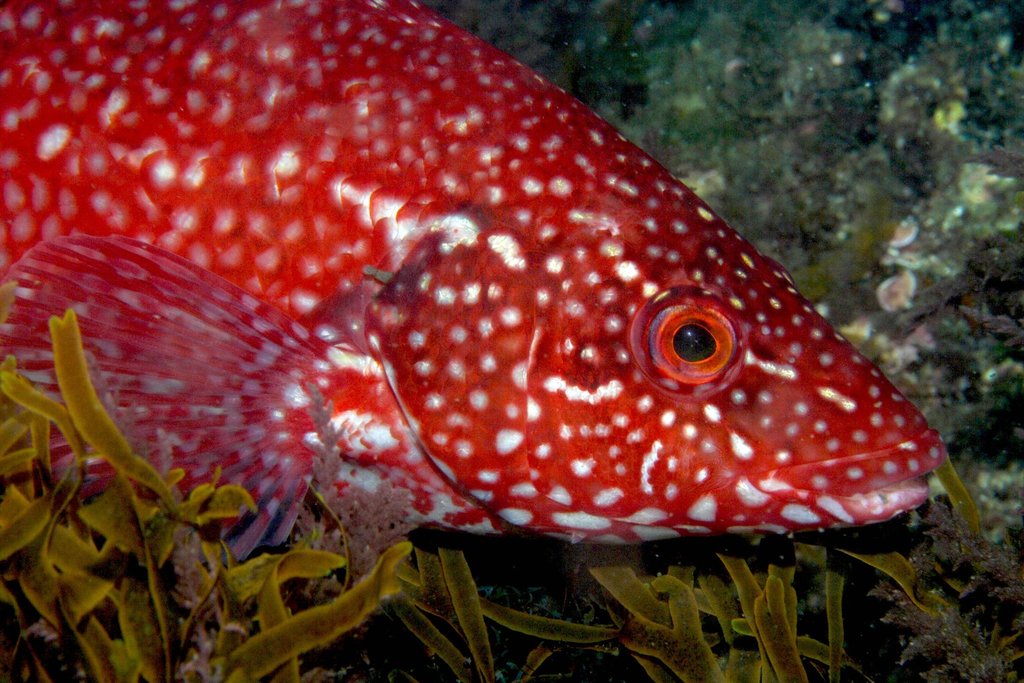
Ballan wrasse
- Family
- Labridae
- Depth
- 1–50 m
- Season
- Apr, May, Jun, Jul, Aug
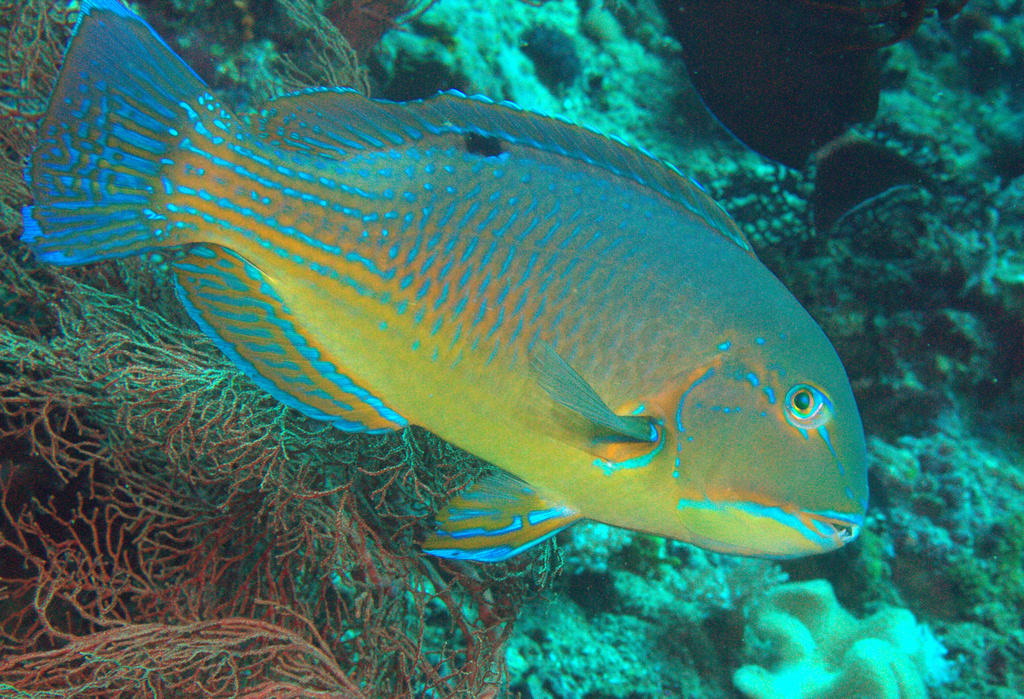
Blackspot tuskfish
- Family
- Labridae
- Depth
- 10–60 m
- Season
- Jan, Feb, Mar, Apr, May, Jun, Jul, Aug, Sep, Oct, Nov, Dec

Blue tuskfish
- Family
- Labridae
Guides for this water
Technique, gear and safety guides that fit Green wrasse.