
Hogfish
Hogfish is a Labridae wrasse of shallow Florida and Caribbean reef, recognised by an elongated pig-like snout and two long free dorsal spines. It roots for mollusks, crabs and urchins over sand and rubble beside structure, changes from female to male with size, and is taken mainly by spearfishing and light bottom fishing.
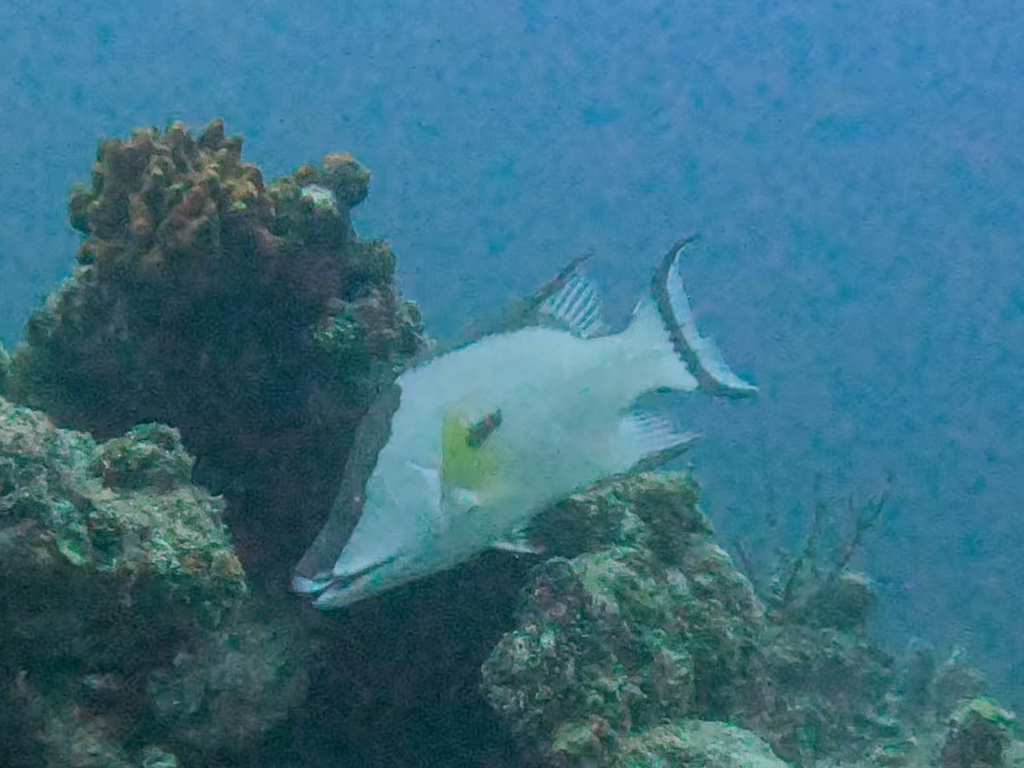
Hogfish is a Labridae wrasse of shallow Florida and Caribbean reef, recognised by an elongated pig-like snout and two long free dorsal spines. It roots for mollusks, crabs and urchins over sand and rubble beside structure, changes from female to male with size, and is taken mainly by spearfishing and light bottom fishing.
Identification
Hogfish are unmistakable once seen: a deep-bodied, laterally compressed wrasse with a long, sloping, pig-like snout and a single dorsal fin running almost the length of the back. In adults the first two dorsal spines are elongated and free of the fin membrane. Colour runs from grey-white through rose to deep reddish brown.
The snout settles identification. No other common Gulf reef fish pairs a pointed, protruding snout with thick wrasse lips and this body depth. FishBase gives 91 cm total length and 11 kg, with 35 cm a common adult; maturity is about 18 cm and the oldest fish recorded 23 years.
The species is a protogynous hermaphrodite: all fish start female and the largest later become male. The biggest fish on a reef are therefore the rarest, and heavy fishing removes breeding males first.
Distribution and Habitat
FishBase records it from Nova Scotia and Bermuda through the northern Gulf of Mexico to northern South America. In the Gulf the working range is the Florida shelf and the hard bottom west toward the Flower Garden Banks; it is not a bay or surf fish, and Texas anglers meet it offshore.
Depth is 3 to 30 m and most fish are shallower. Adults work open bottom and coral reef and are often found where gorgonians are thick. The productive spots are patch reef, low limestone relief, and the sand-and-seagrass edge where reef meets flat.
That edge matters because hogfish feed by rooting; they need sand or rubble next to structure they can retreat into. A clean wall with no sand at its base holds fewer fish than a scruffy ledge with a rubble apron.
Habits and Diet
Mollusks dominate the diet, with crabs and sea urchins close behind. A feeding fish tips nose-down and digs or jets into sand and rubble for snails, bivalves and urchins. Fish work in ones and twos rather than schools.
Activity is diurnal; fish shelter in crevices at night, which is why night dives produce few hogfish. They are curious rather than wary, a trait that makes a slow approach more effective than a fast one.
FishBase spawning records from Cuba and Puerto Rico fall between January and July and again in November and December, so there is no single short window; local timing probably follows temperature and moon.
Fishing Methods
Spearfishing is the classic method in Florida: hogfish are curious, slow to spook and easy to identify underwater. Freedivers working 5 to 15 m cover patch reef and ledge quickly, and an unhunted fish will often turn broadside to look at a diver.
Hook-and-line needs a small, tough bait on the bottom. Shrimp, squid strip, crab and clam all work, but the fish nibbles and the mouth is small, so a big bait on a big hook mostly feeds the reef. A 1/0 to 2/0 hook and a thumbnail-sized bait convert far more bites.
A third option is to fish the sand edge rather than the reef. Drop a small bait onto the rubble apron beside structure, let it settle, and watch the line rather than the rod tip; a hogfish take is a slow pull, not a thump.
Gear and Approach
For spearing, a 70 to 90 cm gun suits patch reef and shallow ledge, with a single flopper or small slip tip and a reel or short float line. A long bluewater gun is a handicap in tight limestone.
Rod and line: a 7 ft medium spinning outfit, 15 to 20 lb braid, 20 to 30 lb fluorocarbon leader, a small egg sinker and a 1/0 to 2/0 hook covers almost everything. Because fish are shallow, light lead and a slow, still presentation beat heavy gear.
Approach matters more than tackle. Swim or drift slowly, scan ledges for a tail or snout in a crevice, and stop before you are in range. From a boat, anchor uptide, fish straight down and keep the bait still; a dragged bait spooks more fish than it draws.
Seasonal Window
Water temperature drives the pattern more than the calendar. Hogfish are catchable all year in Florida, but the reliable window is spring through autumn, when fish are up on shallow hard bottom. A cold front pushes them off the flat, and the days after a front are slow.
Spawning spans a long season rather than a sharp peak, so there is no week to plan around. Plan around stable weather instead: a run of calm, warm days after a settled spell beats one hot day in the middle of a blow.
Tide matters on shallow reef. Moving water, especially the last of the incoming and first of the outgoing, puts fish on the feed; slack water is the time to move and look.
Edibility and Handling
The flesh is highly esteemed and FishBase records it as marketed fresh and frozen. It is firm, white and sweet, and many Florida anglers rate it above grouper. Thick fillets hold together on the grill.
Handling decides quality. Bleed the fish immediately and put it in an ice slurry, not a cooler of loose ice; a hogfish left warm on deck turns soft quickly. Trim the dark lateral-line meat and keep fillets dry until cooking.
FishBase lists ciguatera reports for the species, so large fish from known ciguatera areas are a poor table choice. The risk is not uniform across the range, but it is real.
Regulations and Conservation
Rules split at 25°09′N. North of that line the minimum is 14 inches fork length with a bag of 5 per person per day; south of it, 16 inches fork length and 1 fish per person per day.
Florida state water follows the same split, and the Atlantic side is managed at 16 inches and 1 fish. Mississippi sets 14 inches fork length and 5 fish per day. Louisiana lists no separate state rule, so federal limits apply in federal water; Alabama folds hogfish into its 20-reef-fish aggregate; Texas lists nothing, and federal rules apply beyond 9 nautical miles.
The IUCN Red List classifies hogfish as Vulnerable, assessed 4 February 2009. Because the species changes sex with size, harvest removes males before females. Rules change yearly; confirm which side of 25°09′N you are on, and check current FWC and NOAA notices before you go.
How to catch it
Spearfishing
5–15 m
Boat bottom fishing
Drift fishing
Where these facts come from
Check these pages before you rely on a size, range or protection status.
- FishBase — Lachnolaimus maximus — FishBase · T2
- GBIF — Lachnolaimus maximus occurrence records — GBIF · T2
- IUCN Red List — Lachnolaimus maximus — IUCN · T1
- Photo record — iNaturalist — iNaturalist · T3
Fish in the same water
These fish live in the same place.
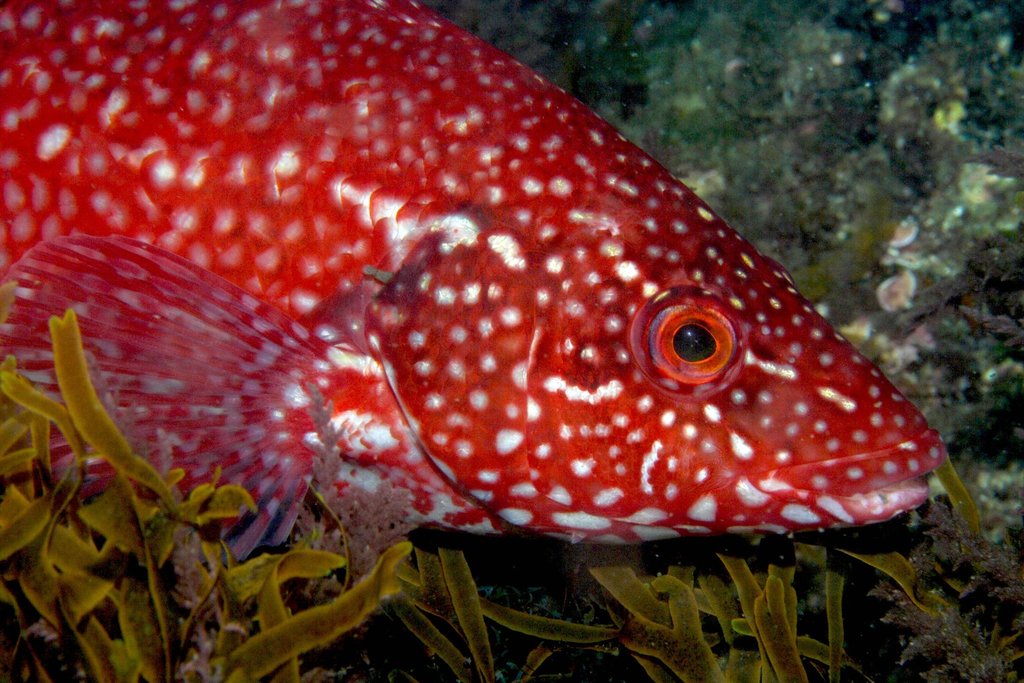
Ballan wrasse
- Family
- Labridae
- Depth
- 1–50 m
- Season
- Apr, May, Jun, Jul, Aug
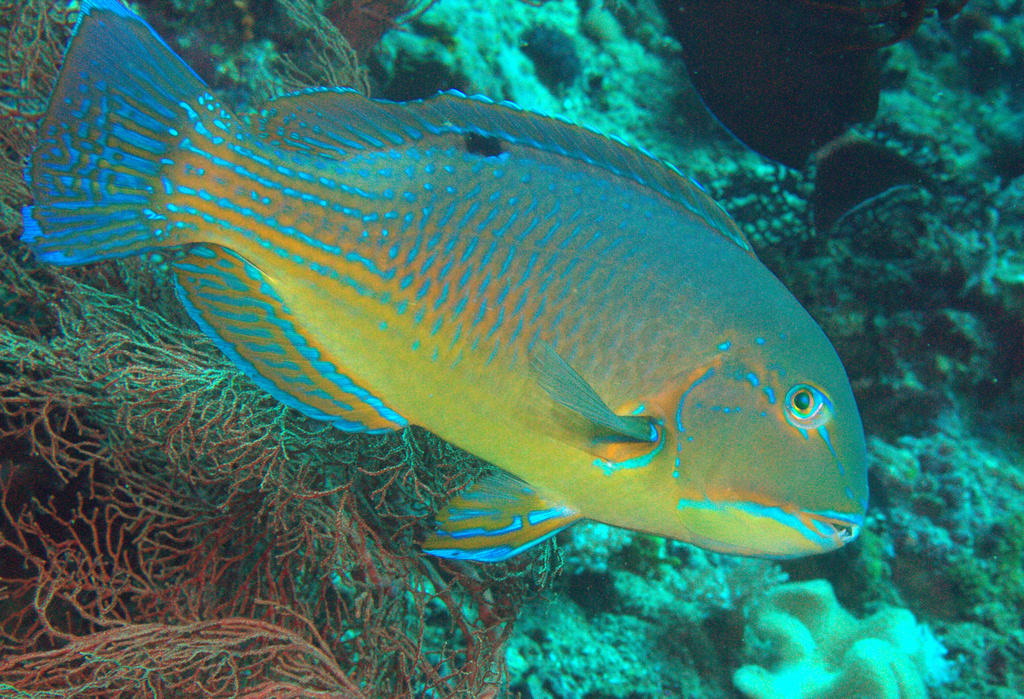
Blackspot tuskfish
- Family
- Labridae
- Depth
- 10–60 m
- Season
- Jan, Feb, Mar, Apr, May, Jun, Jul, Aug, Sep, Oct, Nov, Dec

Blue tuskfish
- Family
- Labridae
Guides for this water
Technique, gear and safety guides that fit Hogfish.