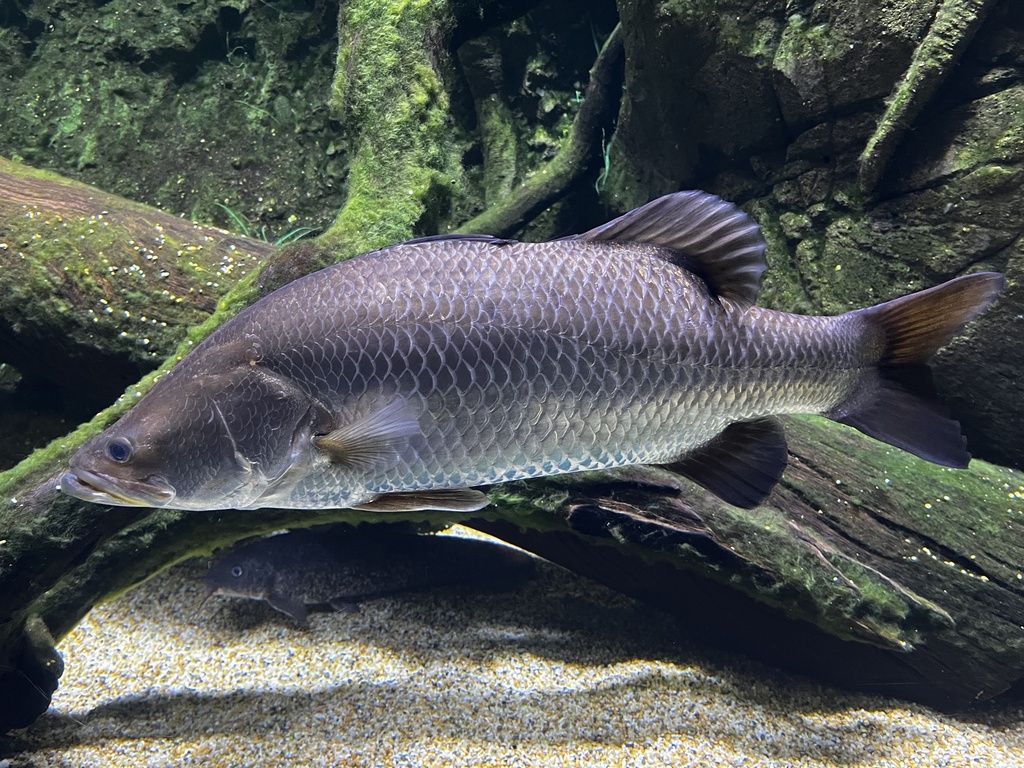
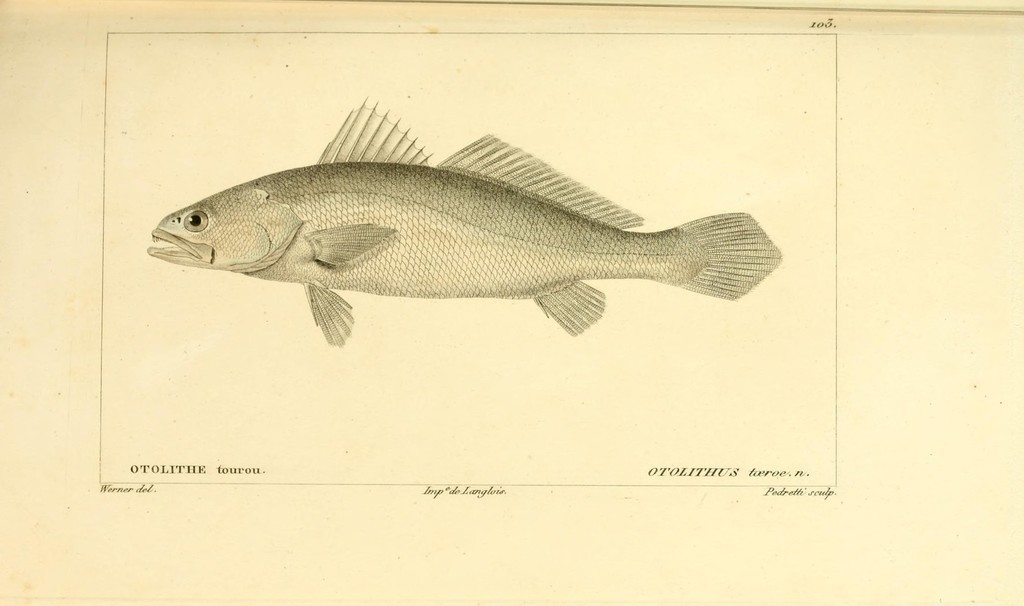
Barramundi (Lates calcarifer) is a fish of the family Latidae. FishBase gives its range as: Indo-West Pacific: eastern edge of the Persian Gulf to China, Taiwan and southern Japan, southward to southern Papua New Guinea and northern Australia. It is recorded from 10 to 40 m, in tropical water at 15–28 °C. The recorded maxima are 200 cm TL, 60 kg, 35 years. Diet includes crustaceans and fishes. IUCN status: Least Concern (LC). Chinese name: .
Three waters in one line
The summary lists this species under all three milieu terms — marine, freshwater and brackish — calls it demersal, adds catadromous, and gives 10–40 m for depth and 15–28 °C for temperature. The three water words are not hedging. They describe an animal that crosses the boundary, and the crossing is what an angler can plan around. A river, an estuary and a coastal bay are three different fisheries for one animal.
The river mouth is the hinge
The spawning table makes the hinge visible. The recorded localities are places where fresh water meets salt: the Burrum River mouth in southern Queensland, Chilka Lake on India's east coast, the Sunderban, the Northern Territory side of the Gulf of Carpentaria, and unspecified coastal entries for Thailand and south-east India. A river mouth is not a random mark; it is the point where the catadromous life cycle can be completed. That is why the table reads like a list of river mouths rather than a list of latitudes.
The country table runs much wider than those entries, from Pakistan and the Persian Gulf edge through South-East Asia to French Polynesia. The spawning records cluster on the Australian and Indian sides of that range. A wide range statement and a narrow spawning list are not in conflict; they describe different things. One says where the species has been recorded at all, the other says where someone has documented the act of spawning.
What the salinity does to position
No source splits the species into size classes along the gradient, so what follows is my reading of the milieu terms rather than a sourced claim: fish recorded in fresh water and fish recorded in coastal water occupy different positions on one route, and that route runs through the estuary. For a trip, the first question is therefore not which lure but which section of the system. The estuary is where both answers can be right on the same day.
The size range sits on the gradient
The ceiling is 200 cm TL and 60 kg; the usual fish is 150 cm; the oldest recorded animal is 35 years; and maturity starts at 44.5 cm TL, inside a recorded span of 29–60 cm. That span is unusually wide, and the record offers no explanation. Both a 29 cm fish and a 60 cm fish fall inside the documented maturity window, so any single breeding-size number would misstate the source. The span is the honest figure.
The spawning table is a set of river mouths
Eight local entries produce the twelve-month union: Burrum River mouth (December–January), Chilka Lake (January–March and May–September), the Northern Territory and Gulf of Carpentaria (December–March), Thailand (April–September, locality not stated), the Queensland east coast (December–March and October–December), south-east India (April–September), the Sunderban (April–September), and Western Australia (January–February and September–December). The months differ by place, and one entry names no place at all. The union is not a season; it is a map of when each river mouth is warm enough and wet enough.
Where the records actually sit
GBIF carries 45,733 preserved occurrences, 43,895 of them Australian; Bangladesh contributes 336, India 289, Cambodia 212 and Thailand 113. The dataset is effectively one country plus a handful of regional tails, not an even portrait of an animal that ranges from the Persian Gulf to northern Australia. iNaturalist adds 845 observations, a layer small enough that one active observer can move it. Salinity gradients are global; these records are not. A map dominated by a single country shows where the sampling capacity sits, not where the animal is equally abundant.
Gear for a fish that can be in a river or at 40 m
Shore casting and lure fishing are the recorded approaches. Both are shore-based, even though the depth range reaches 40 m; the record lists no boat method, so the deep end of that range is documented but not addressed by the recorded technique. The depth range belongs to the coastal and estuarine end; in the freshwater section the same fish is in water measured in metres of river, not metres of sea. Lure size should follow the common length of 150 cm rather than the 200 cm maximum, and the terminal tackle should be chosen for the section of the system you are standing in. A lure that works in a tidal mouth is not automatically the right lure two kilometres upstream.
Between fresh and salt, the rules change
The IUCN category is LC (Least Concern), assessed 15 February 2019, and the human-use entry records commercial fishing at the highest level, commercial aquaculture, gamefish status and public aquariums. The practical point is jurisdictional: freshwater, estuarine and coastal licences can be three separate instruments, and a closure in one stretch may not apply in another. Before you keep anything, check the rules for the water you are actually standing in, not the rules for the species as a whole.
How to catch it
Lure fishing
Lure fishing, with lure size matched to the recorded body size.
Shore casting
Cast from shore or a breakwater, within reach of the recorded inshore range.
Regulations before you keep it
These are the published regulations for this fish. Read the number first. The notice below it is the actual regulation.
Minimum size3
≥55 cm overall length · 27 cm minimum fillet
Australia — Northern Territory · AU-NT
The Northern Territory sets a 55 cm minimum overall length for barramundi, with a 27 cm minimum fillet length.
Barramundi | 5/3 $ ^{*} $ | 55cm minimum overall length NT-wide, minimum fillet length 27cm.
58–120 cm
Australia — Queensland · AU-QLD
Queensland sets a 58 cm minimum and 120 cm maximum size for barramundi.
Barramundi | Min: 58cm Max: 120cm | Limit: 5 per person, or 10 per boat (with 2 or more people on board)
550–800 mm (must be landed whole)
Australia — Western Australia · AU-WA
Western Australia sets a 550 mm minimum and 800 mm maximum size for barramundi, which must be landed as whole fish.
"Barramundi Lates calcarifer 550 mm (Max. size 800 mm must be landed as whole fish) 2 Possession limit = 2"
Bag limit2
5 fish possession limit · 10 per boat with 2 or more people
Australia — Queensland · AU-QLD
Queensland sets a possession limit of 5 Barramundi, with a boat limit of 10 when two or more people are on board.
A possession limit is the total number of fish you may keep at any time, including fish at home or in the freezer; it is not a daily take limit.
Barramundi | Min: 58cm Max: 120cm | Limit: 5 per person, or 10 per boat (with 2 or more people on board)
2 fish per person per day · possession limit 2
Australia — Western Australia · AU-WA
Western Australia allows 2 barramundi per fisher per day and a possession limit of 2.
"Barramundi Lates calcarifer 550 mm (Max. size 800 mm must be landed as whole fish) 2 Possession limit = 2"
Possession limit1
5 fish (3 in special management zones) within the 15-fish general possession limit
Australia — Northern Territory · AU-NT
The Northern Territory allows a personal possession limit of 5 barramundi, reduced to 3 in Kakadu, Mary and Daly River management zones.
Barramundi | 5/3 $ ^{*} $ | 55cm minimum overall length NT-wide, minimum fillet length 27cm.
Every record above names its source and the date it was retrieved. See the regulation register for the full list, or how to read these regulations.
Where these facts come from
Check these pages before you rely on a size, range or protection status.
-
FishBase — Lates calcarifer
— FishBase · T2
-
GBIF — Lates calcarifer occurrence records
— GBIF · T2
-
IUCN Red List — Lates calcarifer
— IUCN · T1
-
Photo record — iNaturalist
— iNaturalist · T3