
Cuckoo ray
Cuckoo ray is a rajid skate of the eastern Atlantic and Mediterranean, from the Kattegat and North Sea around Britain and Ireland down to Morocco and Senegal. It is recorded from 12 to 900 m. Males reach 81 cm TL and females 68 cm, with a common length of 40 cm and maturity at about 57.5 cm. It is present year-round, and boat bottom fishing and shore casting are the methods listed.
The cuckoo ray is a Rajidae skate of the eastern Atlantic, recorded from the Kattegat and North Sea around Great Britain and Ireland, through the Mediterranean, to Morocco and Senegal. FishBase gives a maximum length of 81 cm TL for males and unsexed fish, 68 cm TL for females, a common length of 40 cm TL, and a length at first maturity of 57.5 cm (range 45–71.8 cm). It is demersal and subtropical, recorded from 12 to 900 m and usually from 20 to 250 m, so most of the population sits beyond shore casting.
Identification
A skate body is a flattened disc of pectoral fin with a short snout and a slender tail. FishBase records a flattened cross-section and no anal spines, but the extracted morphology table publishes no usable fin formula, so identification should not depend on counting rays.
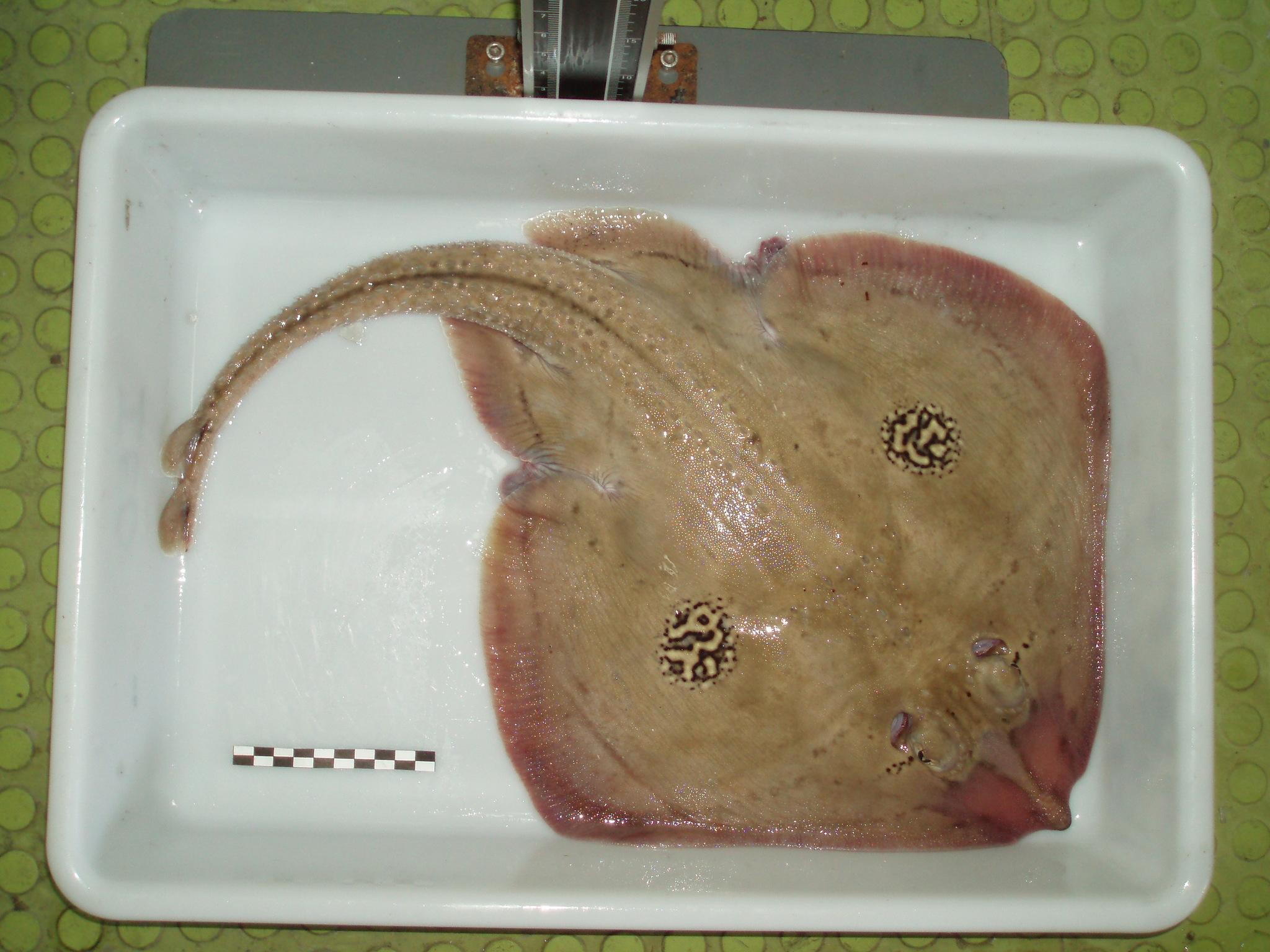
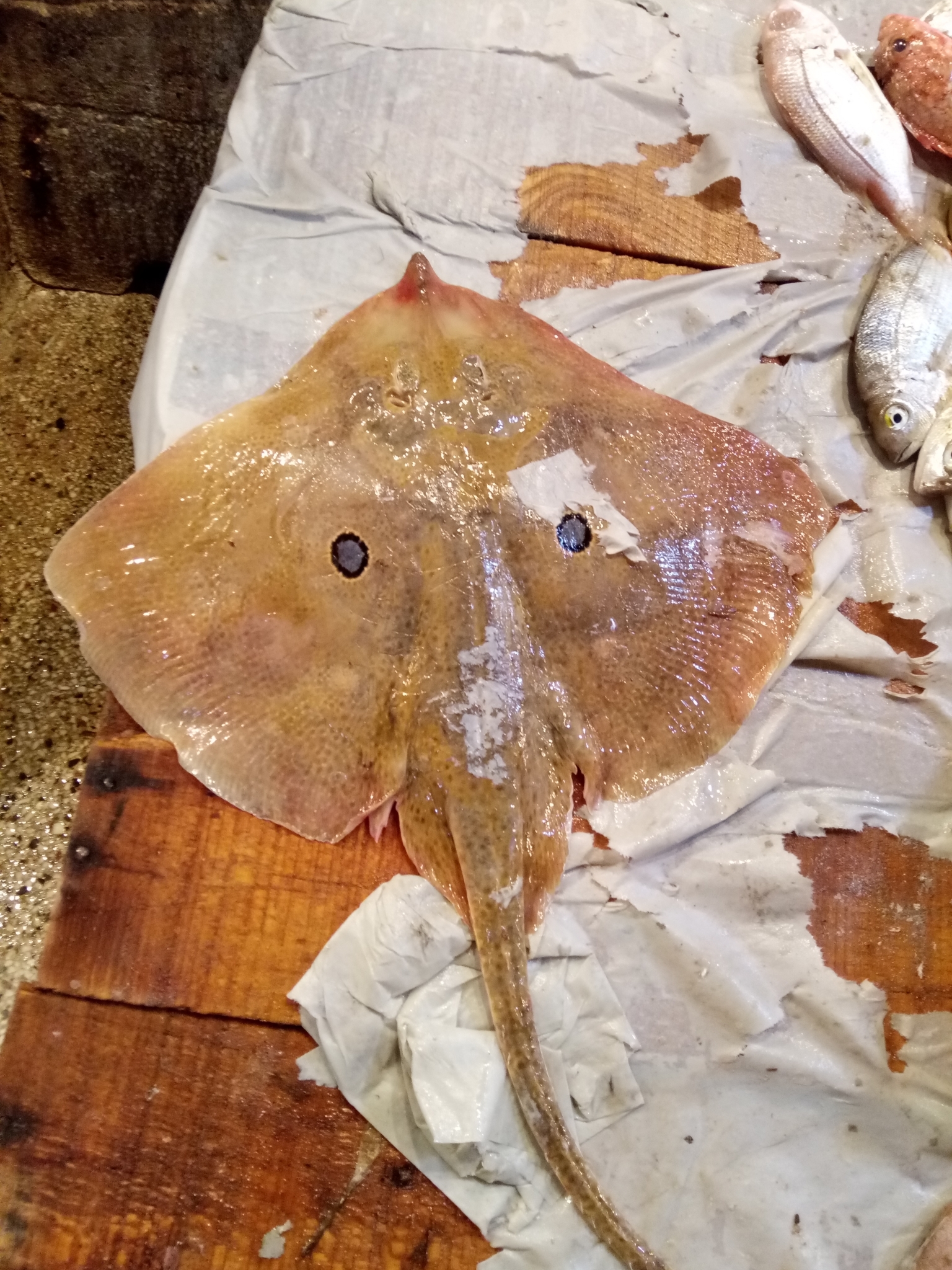
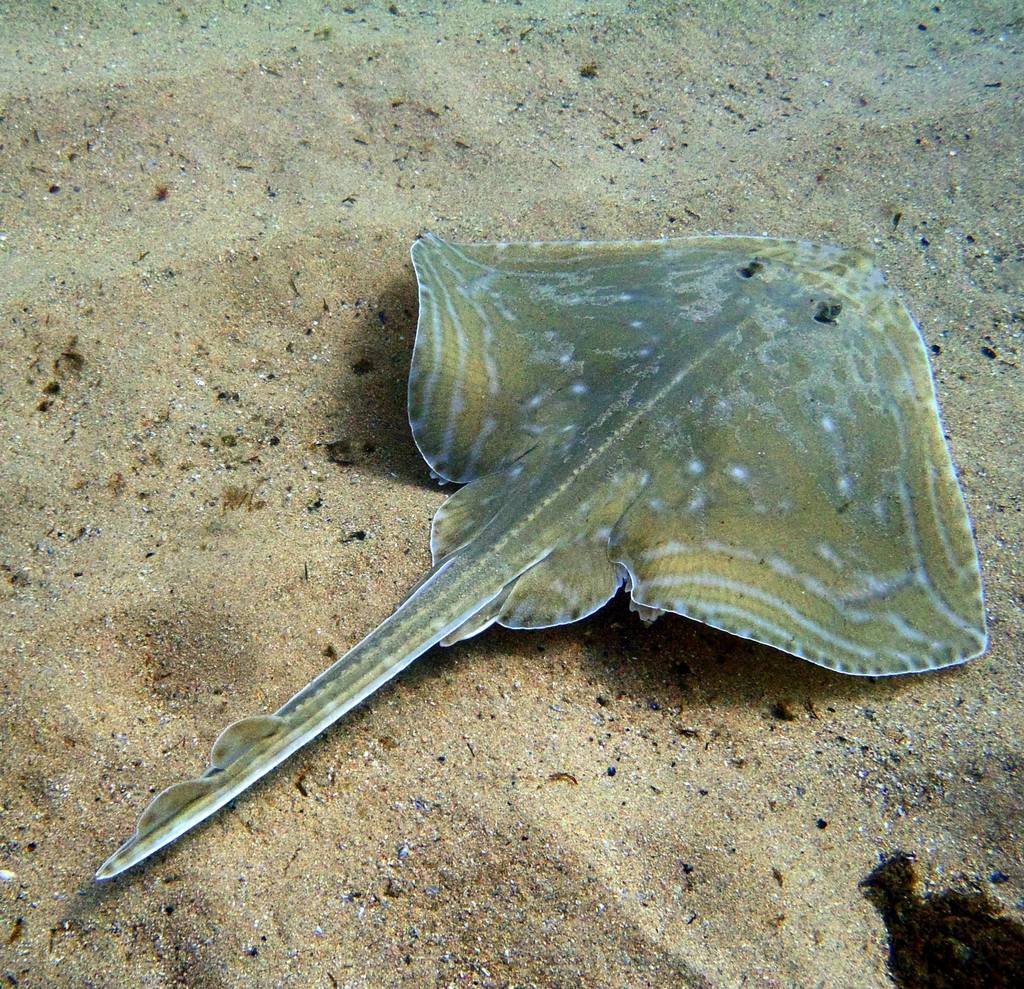
Pattern does the work. The upper surface is ochre to light greyish-brown with a large, roundish black eye-spot in the middle of each pectoral fin, and the underside is white. Those two spots are the reason for the name and the quickest field mark on the deck. The upper surface is spinulose, with thorns around the eyes, on the nape and shoulder, and in two rows along the tail; adults may have a bare patch in the centre of the pectoral fins.
Other skates on the same grounds are also spotted, so two large, round, well-separated spots on a plain ground are a guide rather than a guarantee. Check photographs and a local key, and release anything unclear.
Habitat and behaviour
FishBase's habitat keywords are sandy and muddy, with a usual depth band of 20–250 m, so adults sit on the shelf and upper slope and only the shallow edge overlaps with beach, pier and small-boat fishing.
The recorded diet is "all kinds of bottom animals", which fits a skate that works scent and disturbance rather than sight. The species is oviparous: eggs are oblong capsules 5.0–7.0 cm long and 3.1–3.9 cm wide with stiff pointed horns at the corners, laid on sandy or muddy flats, and FishBase gives around 70–150 eggs per individual per year.
A female caught in spring may be carrying capsules.
Seasonal window
The spawning table lists every month of the year, from a study off Peniche and Matosinhos in Portugal covering 2003–2010. A twelve-month record means egg-laying is not a narrow event, and it is not a bite forecast.
Water temperature and position on the shelf matter more than the calendar. In the north the fish sit deeper in winter and work onto shallower sand as the water warms. A moving tide over sand fishes better than slack water, because a skate finds bait largely by scent and by the trail the lead leaves. Clean water after a neap tide usually beats a big spring tide carrying weed.
Gear and approach
For boat work, a 20–30 lb class rod, a reel holding 300–400 m of 30 lb braid, and a running ledger or pulley rig with a 4/0–6/0 hook cover the range. Use 8–16 oz of lead depending on tide and depth, and a 60–100 lb mono snood. Mackerel fillet, squid, sandeel and fish heads all work.
A skate's take is heavy and slow. Do not strike at the first knock; wait until the rod stays loaded, then lift. A 68–81 cm female is heavy and the tail carries thorns, so use a net or sling rather than a hand under the wing. From the shore, a 12–13 ft rod, a 4–6 oz grip lead and a pulley rig with a long snood reach the same sand; fish the last two hours of the flood and the first of the ebb.
Release with the disc supported and the gills in the water, and never lift a big ray by the tail.
Edibility and regulations
FishBase records a minor commercial catch and public-aquarium use; the species is harmless to humans. The wings are the useful part, firm and mild, usually skinned and fried or used in soup. Bleed and chill the fish promptly.
The IUCN category is NT (Near Threatened), assessed on 20 February 2024, with no CITES or CMS listing. A near-threatened skate is a fish to release unless there is a clear intention to eat it.
Rules differ by jurisdiction. In EU waters the commercial-designations page shows a TAC but no minimum conservation reference size; commercial and recreational rules differ, and recreational catches follow national or local rules. The UK MCRS table does not list cuckoo ray, and any IFCA byelaw for the district would sit on top. France (DDTM/OFB), Spain (autonomous communities), Portugal (DGRM), Ireland (IFI), the Netherlands (NVWA) and Belgium (Vlaamse overheid) each set their own recreational rules. No species-specific minimum size, closed season or bag limit was verified, so check the current rule for the coast you fish.
Where to look
GBIF holds 58,693 occurrence records, most from the United Kingdom (25,343), France (13,673), Ireland (13,628) and Spain (4,801), then the Isle of Man (413), Norway (242), the Netherlands (172) and Portugal (90). The habitat keywords are sandy and muddy.
These are distribution signals, not spot coordinates. Look for offshore sandbanks and muddy sand in 20–100 m, the deeper shelf edge, and shallow sand reachable from a pier or beach. Check access and the landing rule.
How to catch it
Boat bottom fishing
Fished with the listed approach, matched to the recorded depth and size.
Shore casting
Fished with the listed approach, matched to the recorded depth and size.
Where these facts come from
Check these pages before you rely on a size, range or protection status.
- FishBase — Leucoraja naevus — FishBase · T2
- GBIF — Leucoraja naevus occurrence records — GBIF · T2
- IUCN Red List — Leucoraja naevus — IUCN · T1
- Photo record — iNaturalist — iNaturalist · T3
Fish in the same water
These fish live in the same place.

Guides for this water
Technique, gear and safety guides that fit Cuckoo ray.