
Brown ray
Two bright blue eyespots at the base of the pectoral fins settle the identification faster than any measurement. The brown ray is small, plainly coloured and easy to lump with other skates in a mixed catch; knowing the eyespots is what makes a confident release possible.
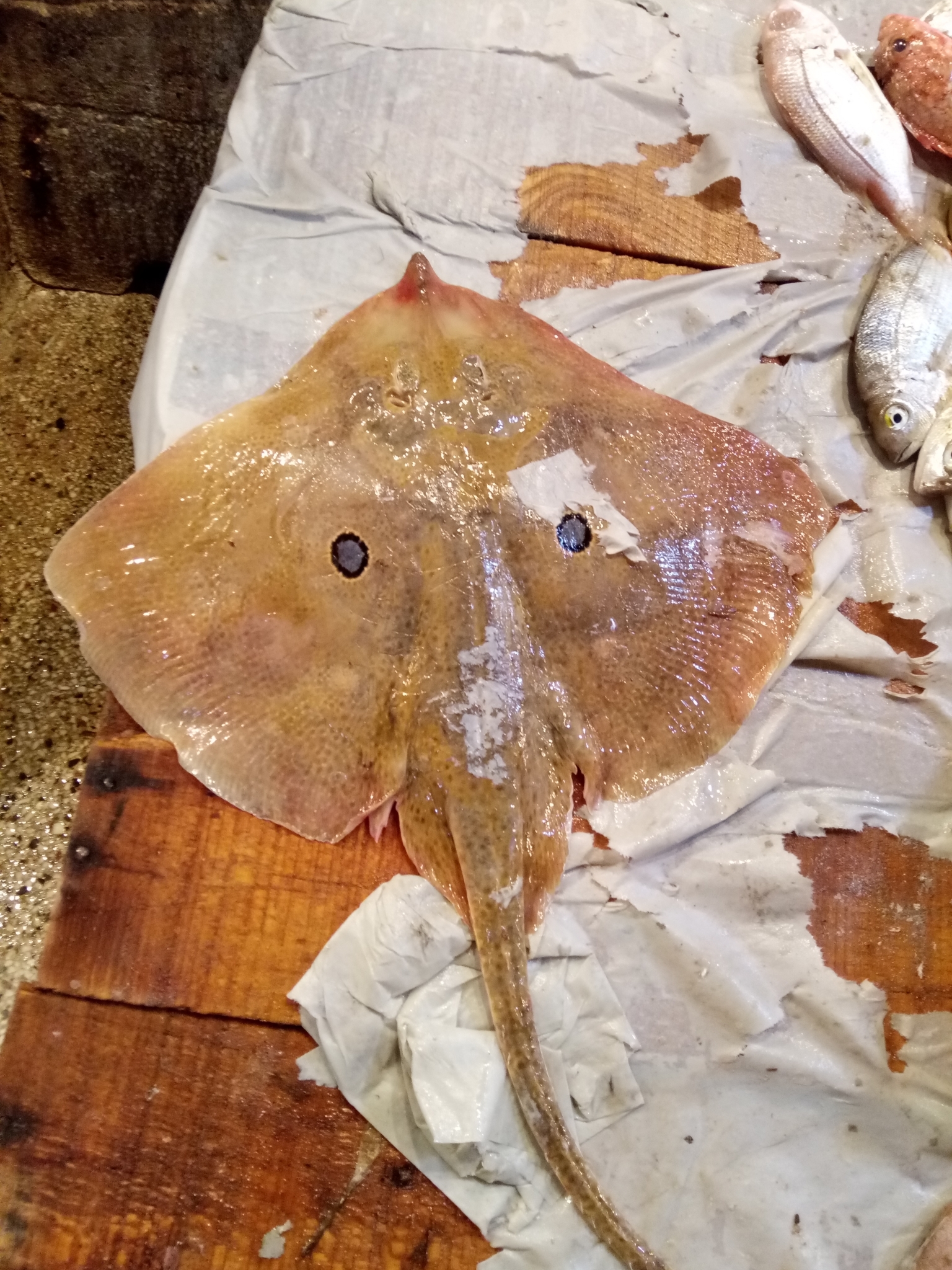
Two bright blue eyespots at the base of the pectoral fins settle the identification faster than any measurement. The brown ray is small, plainly coloured and easy to lump with other skates in a mixed catch; knowing the eyespots is what makes a confident release possible.
Two blue eyespots at the base of the fins
The disc is rhombic with a short, bluntly pointed snout and slightly rounded edges. The back runs ochre to reddish-brown with scattered dark spots, the belly is white, and each pectoral base carries a bright blue eyespot, usually with an orange-brown ring around the blue centre. That mark is the most reliable feature on the fish. Young skates are prickly above, adults nearly smooth, and some individuals show a small dark spot at the snout tip. Compared with Raja clavata, the brown ray is smaller and the eyespots are far more obvious; compared with a stingray, it has no long exposed spine, a thicker tail and two small dorsal fins at the end.
Soft ground on the shelf and upper slope
FishBase records the species from the Bay of Biscay through Morocco and Madeira, including the whole Mediterranean. It lives on soft ground on the shelf and the uppermost slope, recorded from 17 to 462 m but usually between 50 and 150 m, and it favours sand over mud. Small fish dominate inshore and adults sit deeper, so shore anglers and shallow boat trips mostly meet immature animals. The ground worth working is the sand-mud transition and any break in slope, where a bait is more likely to be found than on flat sand. The deepest records mean little to a recreational angler.
An egg-laying skate with a spring peak
FishBase describes the species as oviparous, with egg capsules 4.2 to 4.6 cm long and 2.7 to 2.9 cm wide and an annual output of about 40 to 72 eggs per female; a Chinese Wikipedia summary of the literature places a spawning peak in spring. No month-by-month catch table exists. The brown ray is a warm-temperate soft-bottom skate: spring and summer move it shallower, autumn and winter push it deeper, and inshore catches usually improve once water temperature settles upward. No source here gives a preferred temperature, and the effect of the spawning peak on catches is undocumented, so the seasonal section stays with depth and general behaviour.
Slow bottom work over soft ground
Boat fishing with a light lead and a single hook is the main approach: a squid strip or fish chunk on the sand, with the boat moving slowly so the bait covers ground rather than sitting in one spot. From shore, a long cast from a deep pier or the outside of a breakwater, letting the bait sink and then winding slowly, works because the retrieve lifts a trail of sand. The diet covers benthic animals and fish offal, so a strong-smelling bait is not refused. Keep hooks modest at 3/0 to 5/0 and leave the point clear. A hooked ray circles on the bottom, so lift steadily instead of striking repeatedly. Egg capsules wash up on beaches and are known as mermaid's purses; finding one does not mean a school is nearby.
Light boat gear and a wet, supported release
The usual outfit is a 7 ft medium boat rod or a 9 ft shore rod, a 4000 to 6000 spinning reel, 20 to 30 lb braid and a 40 lb fluorocarbon leader that copes with soft bottom and the rough skin on the tail. Use a 3/0 to 5/0 wide-gap single hook and choose the lead by current, flat on soft ground. Do not lock the drag: a skate loads its disc against the water and a hard pull pulls the hook. Long pliers keep hands clear, and the fish should stay in the water. If you weigh it, support the disc with a wet cloth and never lift it by the tail.
Good flesh, no special size, and one rule that does not travel
The flesh is white and fine-grained; bleed and ice it, skin it, and grill or poach it, taking care at the thin edge of the disc, which overcooks first. Livers are eaten in some places. On the rules: at EU level, Regulation (EU) 2019/1241 Annex IX sets no minimum size for skates, and Article 2(2) means those MCRS do not automatically bind recreational anglers; Regulation (EC) 1967/2006 Article 17 bans selling recreational catch. Spain requires a regional licence from shore and boat under RD 347/2011, and RD 560/1995 Annex II has no skate entry. France needs no permit but requires RecFishing registration from 16; the 2012 arrêté lists no skates in its Mediterranean section, and the Atlantic “Rajiformes 45 cm” entry does not apply here. Italy requires the annual MASAF communication, Greece has no licence and a 5 kg daily limit, Croatia requires a licence with a 5 kg limit plus one heavier fish. Turkey's 2024/21 table was not retrieved. The species is Least Concern, but immature fish are still worth releasing. Check current notices before you go.
Where the numbers agree and where they do not
The 63 cm maximum total length, 35 cm common length, 17 to 462 m depth range and the Least Concern assessment of 2019 come from FishBase. Chinese Wikipedia gives a maximum of 50 cm and a depth range of 17 to 426 m, which conflicts with the FishBase fields; this entry follows FishBase and logs the difference. The egg-capsule measurements and annual egg count are from the literature FishBase cites, while the spring peak comes from a Wikipedia summary. The seasonal section has no monthly catch data behind it.
How to catch it
Boat bottom fishing
Fished with the listed approach, matched to the recorded depth and size.
Night fishing
Fished with the listed approach, matched to the recorded depth and size.
Where these facts come from
Check these pages before you rely on a size, range or protection status.
- FishBase — Raja miraletus — FishBase · T2
- GBIF — Raja miraletus occurrence records — GBIF · T2
- IUCN Red List — Raja miraletus — IUCN · T1
- Photo record — iNaturalist — iNaturalist · T3
Fish in the same water
These fish live in the same place.

Blonde ray
- Family
- Rajidae
- Depth
- 10–380 m
- Season
- Feb, Mar, Apr, May, Jun, Jul, Aug
Cuckoo ray
- Family
- Rajidae
- Depth
- 12–900 m
- Season
- Jan, Feb, Mar, Apr, May, Jun, Jul, Aug, Sep, Oct, Nov, Dec
Small-eyed ray
- Family
- Rajidae
- Depth
- ≤ 100 m
Guides for this water
Technique, gear and safety guides that fit Brown ray.