
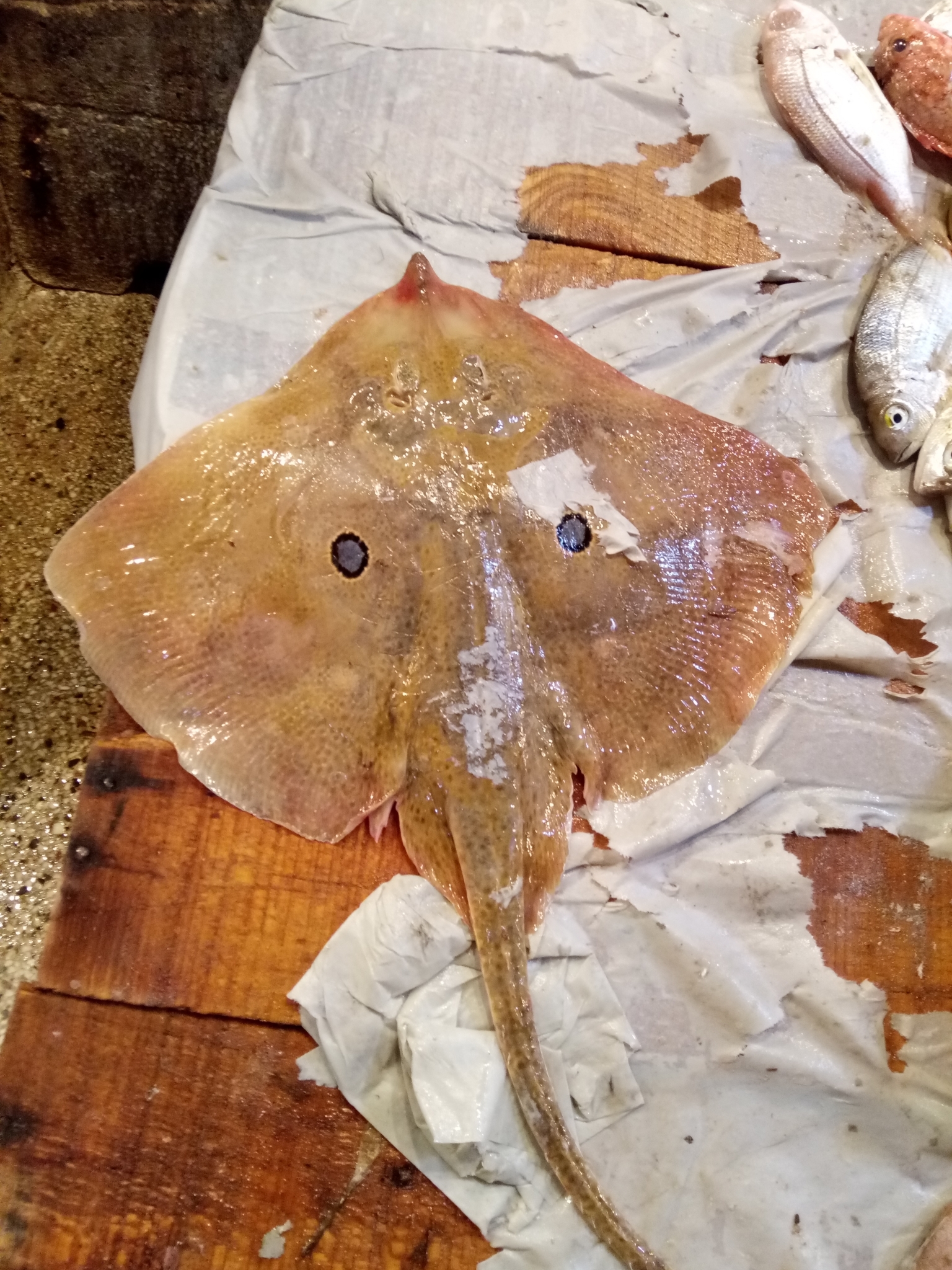
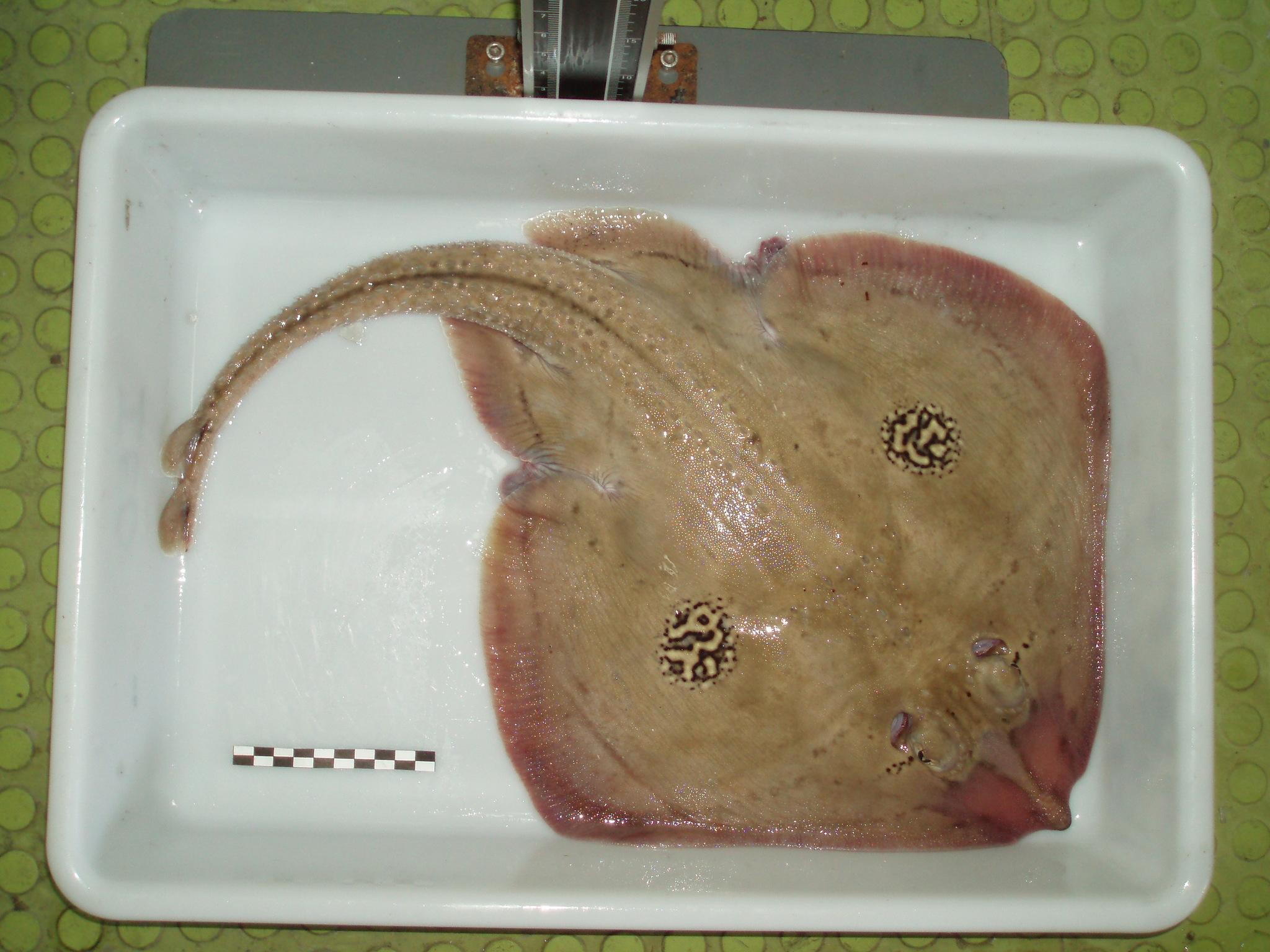
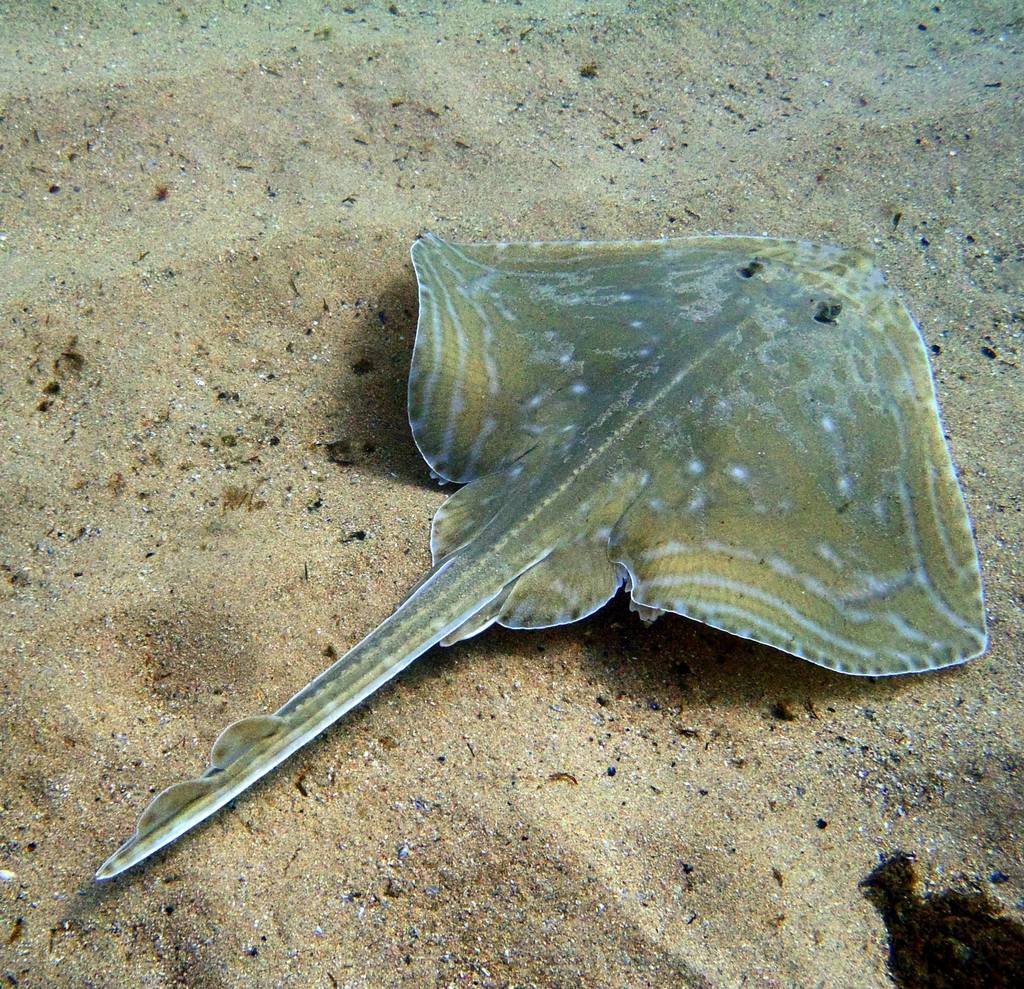
Blonde ray
Blonde ray is a large rajid skate of the eastern Atlantic, from the Shetland Islands down to Morocco, Western Sahara and Madeira. It works shelf and slope ground between 10 and 380 m, with the shallow end of that range inside reach of small-boat sand marks. Fish reach 120 cm TL and 14.3 kg, and the season runs February to August.

Blonde ray (Raja brachyura) is a fish of the family Rajidae. FishBase gives its range as: Eastern Atlantic: Shetland Islands to Morocco, Rio de Oro (Western Sahara), and Madeira. It is recorded from 10 to 380 m, in temperate water. The recorded maxima are 120 cm TL, 14.3 kg. IUCN status: Near Threatened (NT). Chinese name: .
A skate that starts at ten metres
The shallow end of this record is the part most pages ignore. FishBase gives 10 to 380 m for Raja brachyura and calls the species demersal, which puts the upper edge inside the range of a small boat working a sandy mark. The rest of the page has to be read with that in mind: this is a continental-shelf and slope ray, not a deep-water specialist. GBIF's country facet for the accepted key counts 16,490 occurrences: Great Britain 8,196, France 3,033, Ireland 1,907, the Netherlands 1,309, Jersey 879 and Spain 408. iNaturalist holds 486 observations under the name Blonde Skate. Both totals come from observer programmes in the north-east Atlantic; they say nothing about the rest of the range, which reaches Western Sahara.
Range on four different maps
FishBase draws the range from the Shetland Islands to Morocco, Rio de Oro and Madeira, and the territory table contains 23 entries. GBIF's distribution endpoint replaces that sentence with 13 declarations of a different kind: IUCN's global row reads PRESENT; the WoRMS block then lists water bodies — the Azores EEZ, European Marine Waters, the Belgian EEZ, Wimereux twice and the British Isles; native checklist entries for Belgium and the Flemish Region come from Waarnemingen.be; a Doñana Biosphere Reserve row is marked NATIVE; a Danish national checklist carries no status; a PRESENT row keyed only ISO:NO names no source; and the Azores Archipelago also carries NATIVE. WoRMS itself supplies a fourth map, and it disagrees with the first three: AphiaID 367297 is the accepted Raja brachyura of Lafont, 1871, while AphiaID 105882 is unaccepted and resolves to Bathyraja brachyurops of Günther, 1880. The second is a south-west Atlantic ray, so a name search that stops at the first hit can move the fish across an ocean.
The 370-metre gradient
Nothing in the record subdivides the depth. FishBase prints 10 to 380 m with no "usually" range, so the full 370-metre span stands as one band. That matters more for a ray than for a fish that swims in midwater: a demersal animal has to be met on the bottom, and without a core zone the only way to narrow the search is to use substrate. The habitat keywords list rocky, sandy and muddy, which is all three of the bottom types an angler can present a bait over. Temperate is the climate class, and the coordinate box runs 60°N to 22°N, 18°W to 24°E. The practical consequence is a slope read from the 10 m sand upwards, with the ray able to sit on any of the three substrates at any depth inside the band.
Records and the tape that measured them
The size block prints 120 cm TL for males and unsexed animals, 125.0 cm TL for females, 14.3 kg maximum published weight and a length at first maturity of 90.2 cm with a lower bound of 60 cm. No common length and no maximum age are published. The two lengths are not a conflict: they are the same total-length tape applied to two sexes, and the female figure is the larger one. The 14.3 kg weight is attached to the species rather than to a stated specimen, so 14.3 kg cannot be used to validate the 125 cm conversion. The maturity figure of 90.2 cm against a 120 cm ceiling is the number with management weight: a minimum set near the ceiling would leave few breeding females in the water.
Gaps in the biological file
The missing-field list contains common length and maximum age. Without a common length, 120 cm remains a record and there is no working size to compare it against. Without an age, the Near Threatened assessment of 15 April 2023 cannot be connected to generation length from this page. GBIF's declarations are geographic only: no depth statement, no population statement. The iNaturalist total of 486 is a presence signal from observers, and 486 records spread across a 23-territory range is thin enough that the map should not be read as density.
Gear and approach
The load is set by 120 cm and 14.3 kg. A rod and line rated above that weight, a hooklength that holds the bait off the wing, and a routine for bringing the ray aboard without lifting it by the head are the three requirements the record supports. The 90.2 cm maturity length gives the release measurement: below it, the fish is not yet in the breeding class the record describes. Nothing in the sources specifies hook size or leader strength, so those choices stay with the angler and the ground.
Rules, market and the last look
Near Threatened, assessed 15 April 2023, minor commercial, gamefish yes. Landing rules sit with the member state whose waters are fished. The six sources used here give no minimum landing size, no bag cap and no closed period. What the page does give is 90.2 cm at first maturity. The market label is minor commercial, which places the ray in mixed landings rather than in a directed fishery. The last check is the name: AphiaID 367297 is the blonde ray, AphiaID 105882 is Bathyraja brachyurops, and the second name belongs to a different ocean and a different depth profile.
Where these facts come from
Check these pages before you rely on a size, range or protection status.
- FishBase — Raja brachyura — FishBase · T2
- GBIF — Raja brachyura occurrence records — GBIF · T2
- IUCN Red List — Raja brachyura — IUCN · T1
- Photo record — iNaturalist — iNaturalist · T3
Fish in the same water
These fish live in the same place.
Guides for this water
Technique, gear and safety guides that fit Blonde ray.