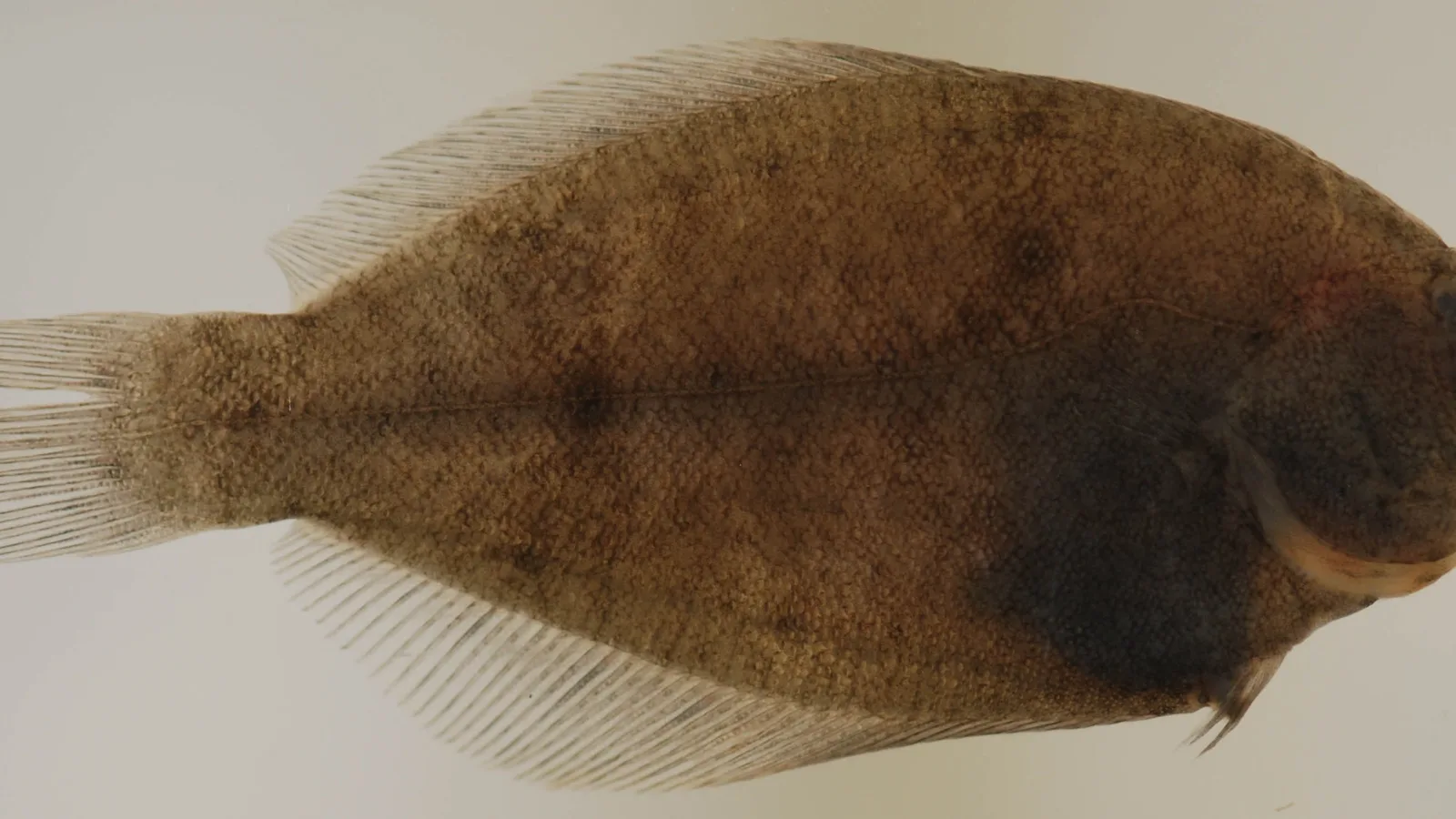
Winter flounder is a record with holes in it. There is a maximum length of 64 cm total length, a maximum weight of 3.6 kg, a maximum age of 14 years and a maturity length of 26.8 cm. There is no common length, no temperature range, no fin-ray count, and on the occurrence side only a distribution summary rather than an observation total. Those absences are not a reason to skip the species; they are the reason the method below looks the way it does. When a field is missing, the fishing has to be built from the fields that remain.
A record with holes in it
The environment line reads marine, brackish, demersal, oceanodromous, depth 5–143 m, temperate, 55°N–31°N and 82°W–52°W. That is a complete description of where the fish lives and almost nothing about what it looks like or how warm the water must be.
For an angler the useful response is to treat the missing fields as questions rather than gaps. No common length means the size you will meet has to be learned from the 26.8 cm maturity figure and from the 3.6 kg maximum. No temperature range means the season has to be read from the spawning table and from local water temperature. No occurrence total means the geographic signal has to come from iNaturalist and from the range statement.
26.8 cm maturity instead of a common length
A maturity length of 26.8 cm is small. It tells you that a 25 cm winter flounder is likely immature and that a 35 cm fish is a mature adult, which is the opposite of the pattern in cod or halibut, where maturity arrives at a length that most anglers rarely see.
The 64 cm maximum is then an outlier rather than a target. A 45 cm winter flounder is a good fish; a 55 cm one is exceptional. The 3.6 kg maximum belongs to the same rare class, and any tackle chosen for it is chosen for a fish you will not meet.
Practically, this makes winter flounder a light-tackle species. A 2.1–2.4 m rod rated 5–20 g, 0.10–0.13 mm braid and a 15 lb leader is enough, and the sensitivity of that outfit matters more than its strength, because the bite is a soft tap rather than a run.
5–143 m on mud
The depth range is 5 to 143 m, and the only habitat keyword in the record is muddy. That combination is the single most useful thing in the file: winter flounder are a soft-bottom fish, and a mark with rock, weed or coarse gravel is the wrong mark regardless of depth.
The 143 m outer limit is rarely fished. Most winter flounder are taken between 5 and 40 m, in bays, harbours and the inner shelf, on mud and muddy sand. The fish sits on the bottom and relies on camouflage, which is why a smooth mud surface with a little current is more productive than a rough one.
The brackish flag in the environment line matters too. This is one of the flatfish that tolerates low salinity, and estuaries are a normal part of its range rather than an edge case. A river mouth with muddy banks and a slow ebb is a winter flounder mark in a way that it is not a cod mark.
Winter in the estuary: December to March
The spawning table gives December to March in Chesapeake Bay, April to June in Delaware Bay, March to June in a Newfoundland pond, and January to May in New England. The centre of gravity is winter and early spring, in estuaries and nearshore water.
That timing is the practical key to the species. Winter flounder are one of the few flatfish that anglers target in cold water, and the season runs when most other inshore fishing has stopped. The fish move into estuaries and shallow bays to spawn, and the fishing follows them.
It also means the season is short and local. A mark that produces in February in New Jersey may be empty in April, and a mark that is dead in December in one estuary may be full in January in the next one along the coast. The spawning table's four entries are a map of that variation, not a single season.
A flatfish that feeds by touch
The diet keyword in the record is echinoderms — sand dollars, small sea stars, brittle stars. That is an unusual diet for a flatfish and it tells you something about how the fish feeds: it picks slow-moving or buried prey off and out of soft bottom, rather than chasing fish through the water column.
For bait selection, the implication is that scent and slow movement matter more than flash. A piece of clam, a sandworm, a small crab or a shrimp cocktail on a small hook, sitting still on the bottom, is the natural presentation. A fast-moving lure is the wrong tool.
It also explains why winter flounder are so often caught while fishing for something else. A bait resting on mud for another species will take flounder, and the angler who notices the soft tap rather than waiting for a run catches them.
Bait and the slow drift
The standard rig is a simple one: a small hook, a short leader, and enough weight to hold bottom in the current. A two-hook flounder rig with a bead and a small spinner blade is a local variation that adds a little flash without moving the bait off the bottom.
From a boat, the method is a slow drift or a controlled drift with the sinker bouncing along the bottom. The strike is a soft weight, not a thump; waiting for a hard take results in gut-hooked fish and missed fish in equal measure. Lift the rod tip steadily when the weight changes, and keep the line tight enough to feel the bottom.
From shore, the same rig cast into a channel edge and left to settle works, provided the tide is moving enough to carry scent. Slack water is the least productive part of the tide on mud.
VU 2021 and a stock that has been shrinking
The catalogue records Vulnerable, assessed 12 February 2021, and lists the species as commercial, experimentally farmed and a gamefish. That is a serious category for a fish that was once one of the most abundant flatfish on the northeast US coast.
The management response has been a mix of minimum sizes, bag limits and seasonal closures, and in several states the recreational fishery is now tightly restricted. Because the species spawns in estuaries, the closures are often timed to the winter spawn, which is also the best fishing.
1,536 observations and eight GBIF rows
The GBIF record for this taxon holds a distribution summary of eight rows and no usable occurrence total, so it cannot support a country breakdown. iNaturalist's 1,536 observations do the geographic work instead, and they are concentrated exactly where the fish is: New England, Long Island, New Jersey and the Gulf of Maine.
Neither source finds a flat for you. Together they confirm a cold-temperate, estuarine flatfish with a northern centre, and they leave the local question where it belongs: which muddy bay near you still holds fish, and which weeks are open.
Where and when it feeds
Tide. Fish the warmer water of a flooding tide in shallow bays.
Weather. Cold, clear, settled weather. A sunny afternoon can warm the flats by a degree or two.
Bait and lures
ClamWormShrimpSmall soft plastic
Regulations before you keep it
These are the published regulations for this fish. Read the number first. The notice below it is the actual regulation.
Minimum size1
≥12 in · unlimited possession · all year
United States — federal (Atlantic) · US-FED-ATL
Federal Atlantic rules set a 12-inch winter flounder minimum with unlimited possession.
Winter Flounder (Blackback, Lemon Sole)
Open season: All year
Minimum size: 12 inches
Possession limit: Unlimited
Bag limit4
12 in · Gulf of Maine 8 fish all year · Southern New England 2 fish Mar 1 – Dec 31
United States — Massachusetts · US-MA
Massachusetts sets a 12-inch winter flounder minimum with an 8-fish Gulf of Maine bag and a 2-fish Southern New England bag.
Winter Flounder
Gulf of Maine Min: 12" Year Round 8 fish
Winter Flounder
Southern New England Min: 12" Mar 1 - Dec 31 2 fish
12 in · 8 fish per angler per day
United States — Maine · US-ME
Maine allows 8 winter flounder per angler per day at 12 inches.
WINTER FLOUNDER (Pleuronectes americanus)
Size: Minimum size 12 inches.
Bag limit: 8 fish per angler per day.
12 in · 2 fish per person per day · Apr 1 – May 30
United States — New York · US-NY
New York allows 2 winter flounder per person per day from Apr 1 to May 30 at 12 inches.
Winter Flounder 12" 2 April 1 - May 30
12 in · 2 fish per person per day · Mar 1 – Dec 31
United States — Rhode Island · US-RI
Rhode Island allows 2 winter flounder per person per day from Mar 1 to Dec 31 at 12 inches.
3.29.1 Recreational
A.Minimum size: Twelve inches (12”).
B.Season: March 1 through December 31.
C.Possession limit: Two (2) fish per person per day in Rhode Island waters.
Closed area1
Narragansett Bay north of the COLREGS line, Potter Pond, Point Judith Pond and Harbor of Refuge: harvest and possession prohibited
United States — Rhode Island · US-RI
Rhode Island closes several coastal ponds and upper Narragansett Bay to winter flounder harvest.
3.29.3 Taking of Winter flounder prohibited
A.The harvest or possession of winter flounder is prohibited in Narragansett Bay north of the Colregs line; Potter Pond; Point Judith Pond and the Harbor of Refuge.
Every record above names its source and the date it was retrieved. See the regulation register for the full list, or how to read these regulations.
Where these facts come from
Check these pages before you rely on a size, range or protection status.
-
FishBase — Pseudopleuronectes americanus
— FishBase · T2
-
GBIF — Pseudopleuronectes americanus occurrence records
— GBIF · T2
-
IUCN Red List — Pseudopleuronectes americanus
— IUCN · T1
-
Photo record — iNaturalist
— iNaturalist · T3