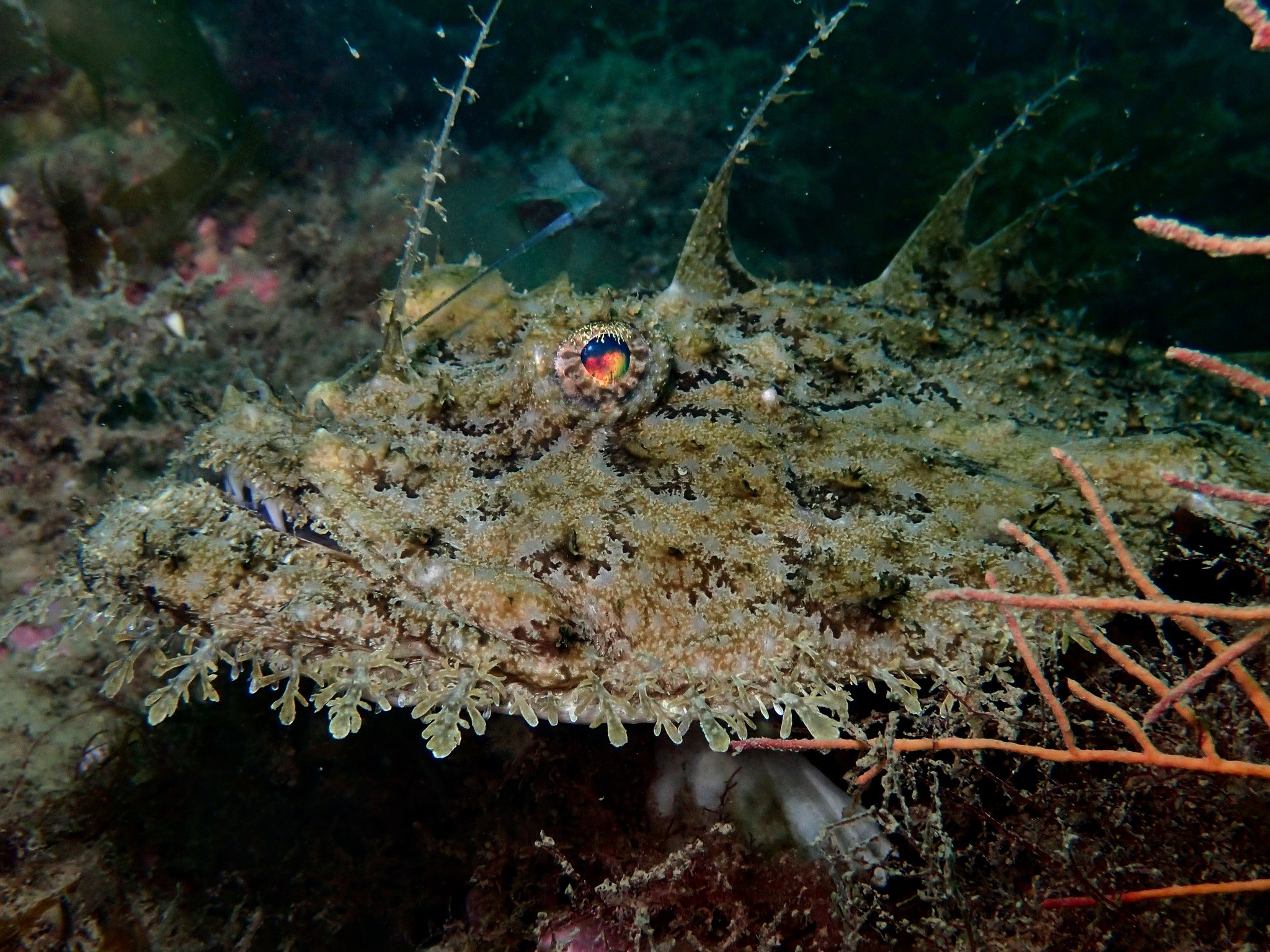
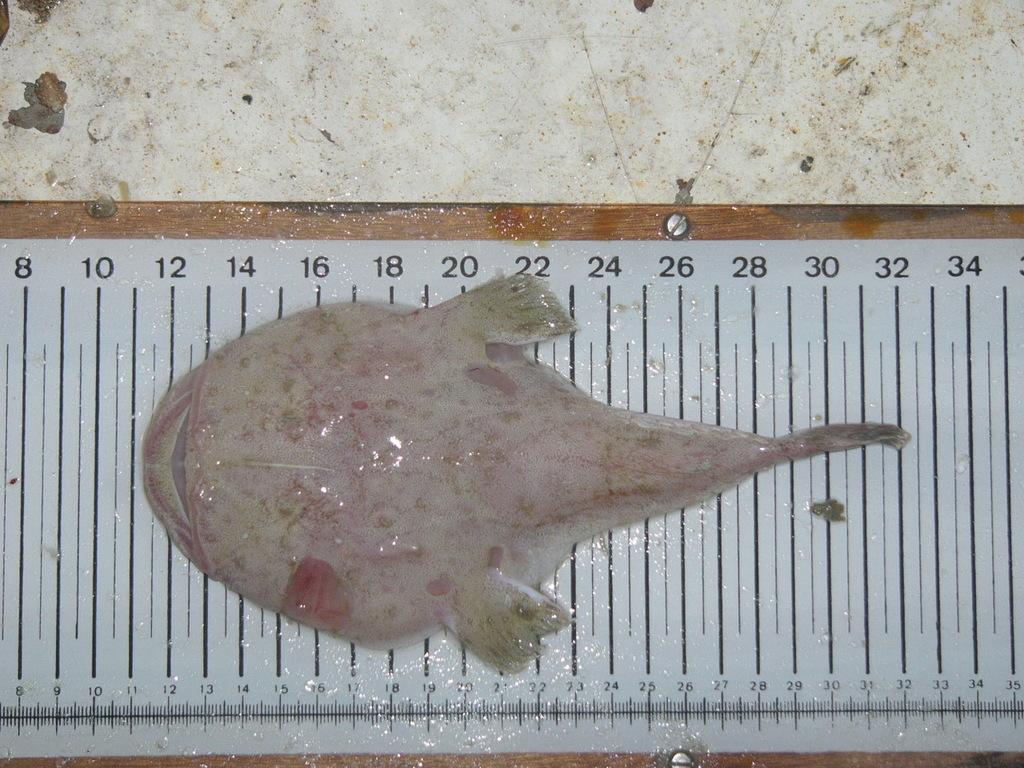
The record for this fish lists three kinds of bottom — rock, sand and mud — and that list is the most useful thing in it. A fish that appears over all three is not fussy about geology. It is fussy about one narrow requirement: a patch soft enough to sink into, with something solid nearby to brace against when the mouth opens. Read the bottom that way and the fishing follows.
Three substrates, one requirement
Rock on its own is no use to an angler. The animal cannot bury itself in stone, so a mark that is solid all the way down holds nothing. Sand and mud on their own are worse, because they are featureless and the fish could be anywhere on them. What the three words describe together is a boundary: sediment beside structure, the seam where a soft patch meets a hard edge.
That is why the same species turns up on gravel banks, in the silt between boulders and along the foot of a reef. The animal is not choosing a habitat in the way a biologist means the word; it is choosing a place where it can disappear and still have its lure standing in open water. Fish the seam, not the rock and not the flat.
A hundred centimetres is a working size
FishBase gives a common length of 100 centimetres and a maximum of 200, with a top weight of 57.7 kilograms and a reported age of 24 years. Those are standard lengths, measured to the end of the body rather than to the tip of the caudal fin, which matters when the number is quoted beside a rule written in total length. The two are not the same measurement and should not be compared directly.
The working consequence is simple. A fish at the common length is already a large animal by any measure, and one at the maximum is older than most of the people catching it. The size classes that carry the spawning stock are the upper ones, not the average.
Fifty-five centimetres
FishBase puts maturity at about 55 centimetres, and notes that some individuals mature earlier than that. A fish below that line is, for most of the population, a fish that has not spawned. Release it and the decision is settled; keep it and you are eating next year's spawners.
There is a second, separate question that European rules answer: whether a fish may be landed at all. The two are not the same instrument. A size rule tells you what to put back. A quota tells you how much the fleet may take. Both can be true at once, and an angler who confuses them will either release fish he could have kept or keep fish the fleet has no room for.
Twenty to a thousand metres
The depth range runs from 20 metres to 1000, with the population spread through the whole of it rather than concentrated at one end. For a bottom gear fisherman this is the single most awkward fact about the species: the same animal can be under a rod in twenty metres of water and under a trawler in a thousand, and the two fisheries meet the same stock.
Practically, the shallow end is where an angler can reach it. The deep end belongs to trawlers and to gear that no rod fisherman will ever see. That asymmetry is why the management advice for the stock is written for the fleet and not for the shore.
January to August
Spawning is recorded from January through August, one of the widest windows in the region. A season that long is less a date to avoid than a background condition: somewhere in the stock, spawning is always happening, and a closure aimed at "the spawning season" would cover most of the year.
What that means for a plan is different from what it means for a rule. If you want to leave breeding fish alone, there is no single month that does it. If you want to know why the stock is assessed the way it is, the long season explains a great deal about how the data are split.
One advice, two species
The international advice for this stock does not deal with one fish. It covers the two anglerfishes of the north-east Atlantic together, and for 2026 it sets a combined catch ceiling of 30,358 tonnes. The same document reports fishing pressure below the reference point and a spawning stock above the precautionary thresholds, which is the rare combination of a healthy stock and a regulated one.
The consequence is easy to miss. Because the two species are assessed and capped as a pair, a boat that lands only the one described here is not necessarily helping it; the ceiling is on the pair, and the other species draws on the same allowance. When a report says the stock is fine, check which stock it means.
What the knife takes
The fish is sold as tails and cheeks, and the liver is a product in its own right. The head is large enough that it is worth taking apart rather than discarding, and the cheeks are two firm pieces that survive cooking better than the rest of the head. The tail is dense enough to be roasted in one piece, which is not true of most white fish.
The naming is no help at the counter. English gives monkfish, French lotte, and the same word covers the American species on the other side of the ocean. A menu that says monkfish has told you the trade name and nothing about which animal is on the plate.
From the Barents to the Black Sea
GBIF's distribution records for this species run from Norway, Denmark and the United Kingdom down through Ireland, France and Portugal, and east into the Mediterranean as far as Greece, Israel and Ukraine. That is a range spanning the Barents Sea, the whole north-east Atlantic and the Black Sea, which is wider than most single-stock advice covers.
iNaturalist shows where divers and boat anglers actually meet the fish, which is the shallow, accessible edge of that range. It is a map of access, not of abundance. For the deep part of the range, the only reliable picture comes from the survey and the assessment, not from photographs.
Regulations before you keep it
These are the published regulations for this fish. Read the number first. The notice below it is the actual regulation.
Minimum size1
France's minimum capture size for monkfish (lotte) is 50 cm in the North Sea, Channel and Atlantic.
The arrêté sets the minimum sizes applicable to recreational sea fishing (pêche maritime de loisir).
| LOTTE | Lophius piscatorius | 50 cm |
Every record above names its source and the date it was retrieved. See the regulation register for the full list, or how to read these regulations.
Where these facts come from
Check these pages before you rely on a size, range or protection status.
-
FishBase — Lophius piscatorius
— FishBase · T2
-
GBIF — Lophius piscatorius occurrence records
— GBIF · T2
-
IUCN Red List — Lophius piscatorius
— IUCN · T1
-
Photo record — iNaturalist
— iNaturalist · T3