
Black-bellied angler
The fish carries its own lure on its head, and the angler still has to put a bait in front of its mouth. The black-bellied angler barely chases anything; the whole method follows from how it ambushes: on the bottom, slowly, with the bait parked where the fish can open up and take it.
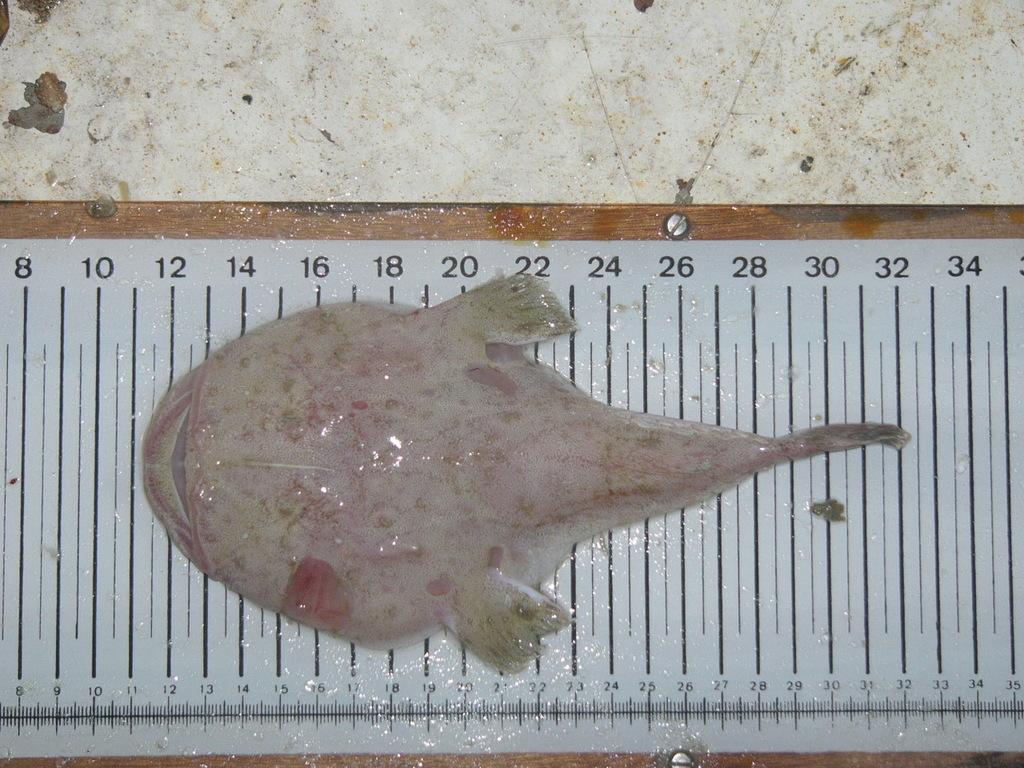
The fish carries its own lure on its head, and the angler still has to put a bait in front of its mouth. The black-bellied angler barely chases anything; the whole method follows from how it ambushes: on the bottom, slowly, with the bait parked where the fish can open up and take it.
A fishing rod grown on the head
The head is enormous and flattened, the mouth wide, the body tapering behind it and the skin loose. The first spine of the first dorsal fin is modified into a rod with a flap of tissue at the tip, and that flap is the lure. Colour is dark brown above with a paler belly. Lophius piscatorius is the close relative to rule out: budegassa means black-bellied, and the peritoneum of this species is black, while the other species is usually larger. The outlines are similar enough that the reliable separation needs the mouth cavity or the peritoneum, which is not always visible at the boat. When in doubt, treat the fish as Lophius and do not borrow the other species' size rule.
Deep mud and sand from shelf to slope
FishBase records the species from the British Isles to Senegal, including the Mediterranean, the Black Sea and the Baltic. It is a deep-water bottom fish over sand, mud and slope, recorded from 70 to 1013 m but usually between 100 and 500 m, with the deepest record from the eastern Ionian Sea. Shallow inshore water also produces fish, but the working ground is the slope. The edge of the slope, where a mud-sand platform breaks into steeper ground, concentrates small fish and matches a diet of nekton, mainly fish. The deepest marks mean little to a recreational boat.
A deep fish with a weak seasonal signal
FishBase gives a maximum age of 21 years and maturity at about 54 cm, with no spawning season or spawning ground. This is a deep species, and the seasonal difference shows up more in depth distribution and catch density than in a clean migration. In autumn and winter, mixed inshore water makes the upper slope easier to work; in spring and summer, surface warming spreads the fish out. No source here names a preferred temperature, so the section stays with depth and experience. Several days of light wind and steady current improve deep bottom fishing, because the bait then sits still where it was put.
Put the bait in front of an ambusher
Deep boat fishing with a heavy lead is the main method: send a whole fish or a large fillet to the slope, wait for the fish to take it properly, and then strike. A slow drift moves the bait along the slope and covers more ground than anchoring, and on steeper sections a bottom-hugging iron works by knocking up sediment. The diet is nekton, mainly fish, so the bait does not need to be small: a whole sardine, a mackerel chunk or a small squid all fit. The mouth is wide and the take is slow, so wait before lifting; striking early pulls the bait out. The first part of the fight feels like snagging bottom, which is the fish, not the rock.
Heavy gear for deep water and a big mouth
Use a 6 to 7 ft heavy boat rod with an 8000-size or larger spinning reel or an electric reel, 30 to 50 lb braid, a 60 to 80 lb fluorocarbon leader and a 6/0 to 8/0 wide-gap hook, with the lead sized to depth and current. In deep water, line diameter controls how quickly the lead reaches bottom. The fish swallows deep, so long pliers or a cut line are the practical answer. Fish hauled from a hundred metres or more often arrive with pressure damage; decide before you wind whether you intend to keep it, and if not, cut off at the surface rather than lifting it aboard.
Firm flesh, a Spanish 30 cm, and a black peritoneum
The flesh is firm; the tail and cheek are the useful cuts, skinned and then fried, grilled or used in soup, and the liver is valued in some places. On the rules: at EU level, Regulation (EU) 2019/1241 Annex IX sets no minimum size for anglerfish, and Article 2(2) means those MCRS do not automatically bind recreational anglers; Regulation (EC) 1967/2006 Article 17 bans selling recreational catch. Spain lists “Rape (Lophius spp.)” at 30 cm in RD 560/1995 Annex II, which covers this species, and a regional licence is required from shore and boat under RD 347/2011. France needs no permit but requires RecFishing registration from 16; the 2012 Mediterranean section lists no anglerfish, and the 50 cm Lophius piscatorius entry belongs to the Atlantic section. Italy requires the annual MASAF communication; Greece has no licence and a 5 kg daily limit; Croatia requires a licence with a 5 kg limit plus one heavier fish, and its national table has no anglerfish. Turkey's 2024/21 table was not retrieved. The species is Data Deficient, which is itself a reason for restraint. Check current notices before you go.
Where the identification and the data stop
The 100 cm maximum standard length, 50 cm common length, 21-year maximum age, 70 to 1013 m depth range and the Data Deficient assessment of 2014 come from FishBase. The black peritoneum is a regional identification feature, not part of the FishBase short description, so confirming it at the boat requires looking into the mouth or opening the belly. The Spanish 30 cm comes from RD 560/1995 Annex II; the French 50 cm belongs to Lophius piscatorius in the Atlantic and cannot be transferred. Spawning season, juvenile distribution and Mediterranean population trend are missing.
How to catch it
Boat bottom fishing
Fished with the listed approach, matched to the recorded depth and size.
Bottom fishing
Fished with the listed approach, matched to the recorded depth and size.
Where these facts come from
Check these pages before you rely on a size, range or protection status.
- FishBase — Lophius budegassa — FishBase · T2
- GBIF — Lophius budegassa occurrence records — GBIF · T2
- IUCN Red List — Lophius budegassa — IUCN · T1
- Photo record — iNaturalist — iNaturalist · T3
Fish in the same water
These fish live in the same place.

American angler
- Family
- Lophiidae
- Depth
- 0–800 m
- Season
- Mar, Apr, May, Jun
Angler
- Family
- Lophiidae
- Depth
- 20–1000 m
- Season
- Jan, Feb, Mar, Apr, May, Jun, Jul, Aug

Acoupa weakfish
- Family
- Sciaenidae
- Depth
- 1–20 m
- Season
- Jan, Feb, Mar, Apr, May, Jun, Jul, Aug, Sep, Oct, Nov, Dec
Guides for this water
Technique, gear and safety guides that fit Black-bellied angler.