
Yellow snapper
Yellow snapper is a lutjanid of the eastern Pacific, from southern California south to Peru, though rare north of Baja California. It lives from 3 to 60 m in subtropical water, reaches 71 cm TL and 13 kg, and feeds on fish. Its season runs April to November.

Yellow snapper (Lutjanus argentiventris) is a fish of the family Lutjanidae. FishBase gives its range as: Eastern Pacific: southern California to Peru, rare north of Baja California, Mexico; also at the Cocos and Galapagos islands. It is recorded from 3 to 60 m, in subtropical water. The recorded maxima are 71 cm TL, 13 kg. Diet includes fishes. IUCN status: Least Concern (LC). Chinese name: .
Brackish in the environment, reef in the keywords
FishBase's environment field is a coarse classification, and "brackish" there means the species occurs in water below full ocean salinity. The habitat keywords are a different kind of field: they describe the ground and the zone, and this species has only two, reef and coastal. There is no estuary, no lagoon, no mangrove in the list.
Read together, the two lines say: the fish can tolerate diluted water, but the record does not place it in the specific habitat that produces diluted water. A reader who needs a mark therefore has permission to look along the coast, and no licence to assume a river mouth is the answer.
A gradient is not a point
Salinity along a coast does not switch from fresh to marine at a line; it changes across distance, depth and tide. A reef edge, a coastal rock and a river plume are three positions on that continuum, and the species is recorded at the marine end and flagged for the diluted one. What the record does not give is the salinity at which the fish is most often found, and this article will not supply a number in parts per thousand.
The practical translation is that "brackish" should be read as a direction, not a destination. If fish are not on the reef, the next place to look is further along the gradient, not a specific estuary that a database has never named.
Three to sixty metres with no usual band
The depth range is 3 to 60 m, with no "usually" clause. Three metres is a cast from a rock or a short swim; sixty is a boat with a sounder. Unlike the groupers here, there is no deep floor to plan around and no band declared untypical.
For a subtropical fish on a coastal shelf, that is a wide but shallow box. It means the depth question is less useful here than the salinity question: a fish at 3 m and a fish at 60 m are both inside the record, and the thing that separates them is more likely to be the water mass than the metre reading.
iNaturalist holds 1,385 observations for the taxon. That is a measure of how many people with cameras fish this coast, not of how many fish are below them.
Seventy-one centimetres and thirteen kilos
The maximum is 71 cm total length at 13 kg. Neither the common length nor the age is given. So the ceiling is known, the middle is not, and the lifespan is not on the page at all.
For gear, the blank common length is the important blank. A rod chosen for 13 kg is a rod chosen for a fish that the page does not claim is typical. Treat every fish as unknown until weighed, and size the leader for the reef rather than for the maximum.
GBIF's distribution file holds six records: an ITIS East Pacific entry, a Nearctic and a Neotropical freshwater assessment, an IUCN Least Concern entry, an Ecuadorian checklist for the Arenillas reserve, and a Mexican national list. Identity is settled; the file does not rank the coast.
A maturity band only one centimetre wide
Maturity is 19.5 cm as an average inside a range of 19 to 20 cm. The range is a single centimetre, against 47 to 95.1 cm for one grouper in this batch, and a one-centimetre band is not a biological constant; it is the signature of a figure derived from a small sample or a single study, and it should be read as a claim about that study rather than about the species. A DataMares profile of the Mexican fishery puts first maturity at 31.5 cm total length, 12 cm above the FishBase figure, and neither page names the sample behind it.
The number is also small: 19.5 cm against a 71 cm maximum. A 20 cm snapper is a fish most anglers would release without thinking, and the record says it may already be mature, which makes the size question less informative than usual here.
April to November, from two places
The spawning table lists April to November, backed by two Mexican records: one from Manzanillo in April, May and September to November, one from a north-west research centre in April to September over 2000–01. Two records is thin support for an eight-month season, and the page presents them anyway because that is what exists.
For planning, the season is long enough to cover most of a warm-water trip, and the records are regional rather than species-wide. A closed season written for one Mexican state does not describe the whole range, which runs from 36°N to 13°S. Use the month as a coarse filter, then check the jurisdiction.
Experimental aquaculture is a label about the future
The use line reads commercial, gamefish and aquaculture marked experimental. "Experimental" is a status word about research, not about supply: it says the species was tried in culture, not that it is farmed at volume. A reader should not conclude that market fish are farmed, and should not conclude that wild fish are unaffected by culture research either.
The same line carries the gamefish flag, which is the one that matters for a rod. A fish that is both commercially netted and pursued with rod and line is a fish whose marks are known to two fleets, and the angler is usually the one who arrives second. The commercial side has numbers: CONAPESCA landings cited by DataMares rose from 5 t in 2001 to 318 t in 2018, with 2,669 t over the period and 94% of it from Baja California Sur, Jalisco and Nayarit.
Where to fish on the gradient
Start at the marine end, because that is where the record puts the ground: reef and coastal, three to sixty metres, no usual band. Fish the reef first, then move along the coast rather than into an estuary, because the estuary is the one habitat the keyword list does not contain.
The 71 cm maximum and the 19.5 cm maturity are the two ends of the size story, and the blank common length is the space between them. Keep the tape, keep the fish you release wet, and let the salinity tell you which part of the gradient you are standing on — because the page will not tell you where the fish sits, only that it can sit there.
Where these facts come from
Check these pages before you rely on a size, range or protection status.
- FishBase — Lutjanus argentiventris — FishBase · T2
- GBIF — Lutjanus argentiventris occurrence records — GBIF · T2
- IUCN Red List — Lutjanus argentiventris — IUCN · T1
- Photo record — iNaturalist — iNaturalist · T3
Fish in the same water
These fish live in the same place.
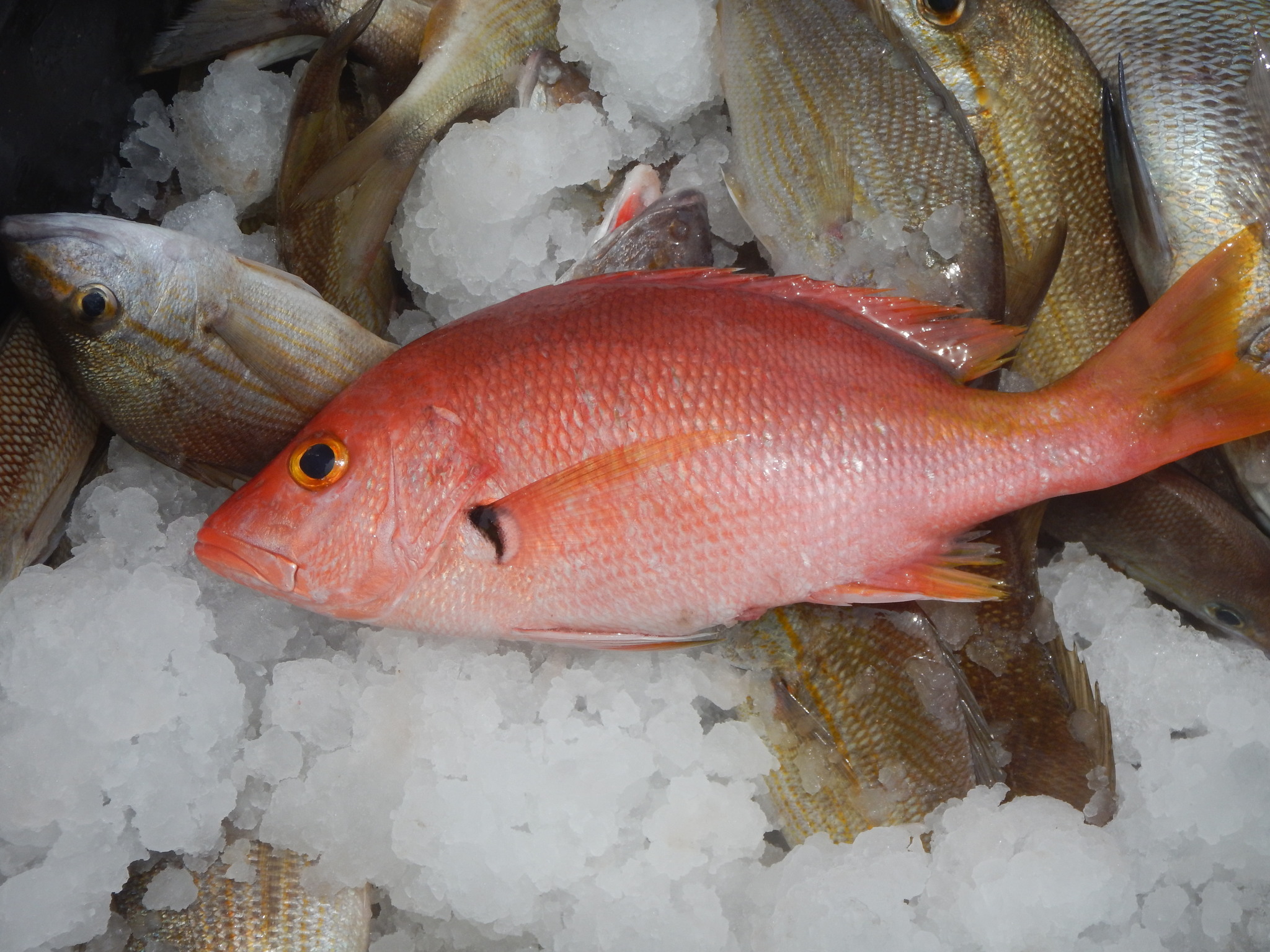
Blackfin snapper
- Family
- Lutjanidae
- Depth
- 20–200 m
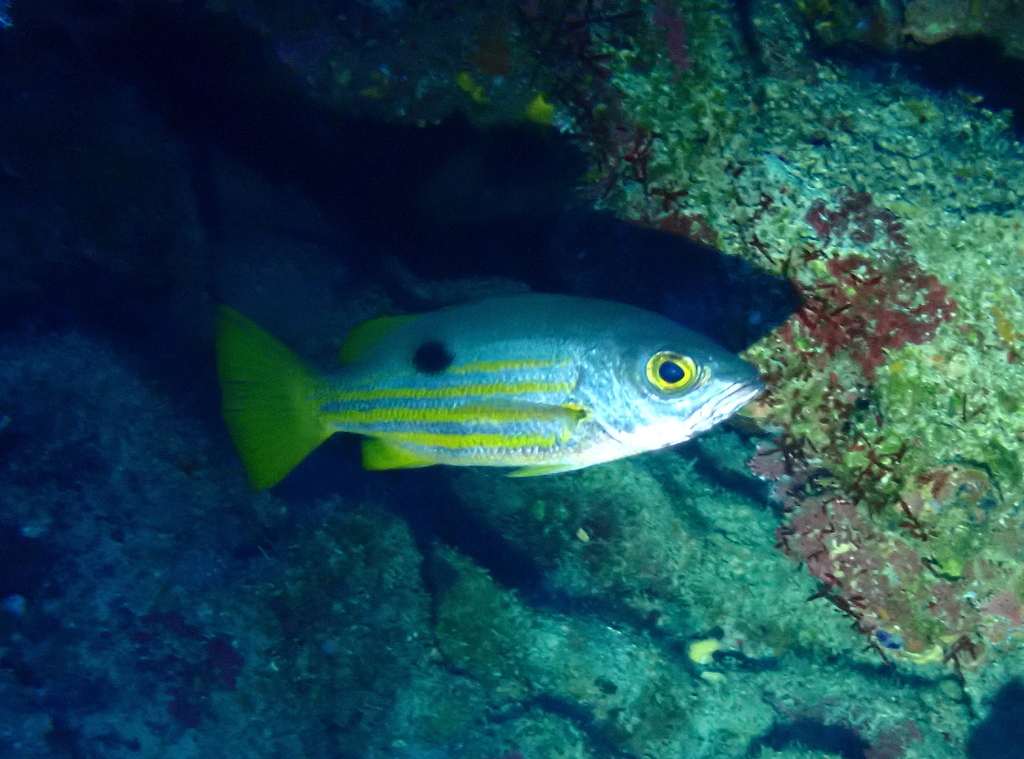
Blackspot snapper
- Family
- Lutjanidae
- Depth
- 5–20 m
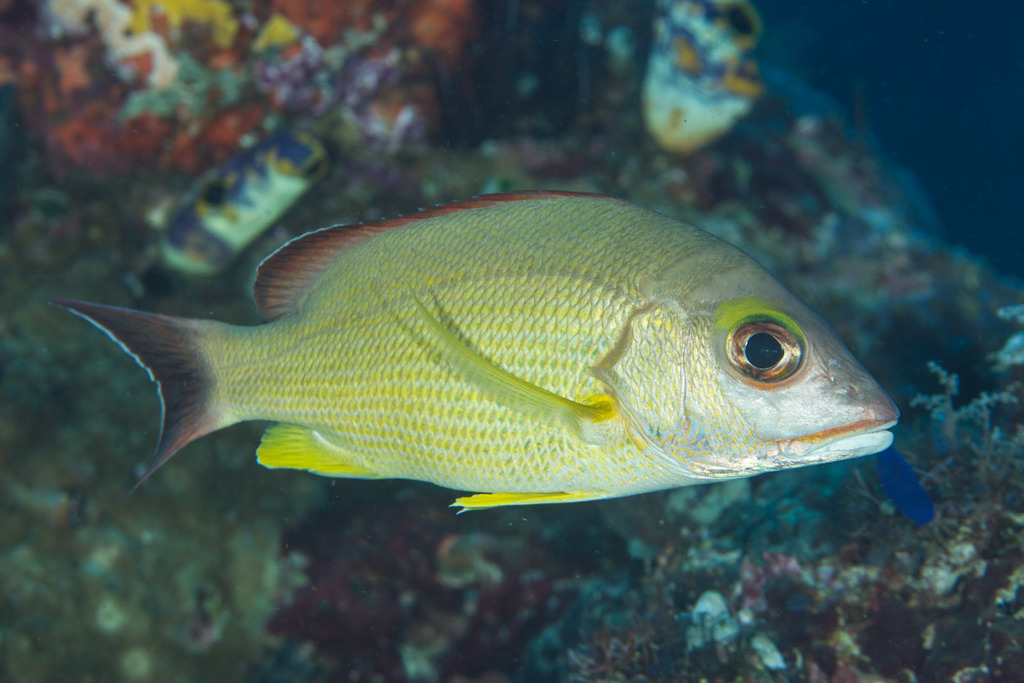
Blacktail snapper
- Family
- Lutjanidae
- Depth
- 1–80 m
- Season
- Jan, Feb, Mar, Apr, May, Jun, Jul, Aug, Sep, Oct, Nov, Dec
Guides for this water
Technique, gear and safety guides that fit Yellow snapper.