In one village this is dinner and in the next market it is the fish nobody will buy. Both statements describe Lutjanus bohar, and the reason is not fashion but ciguatera. FishBase records poisoning reports and adds a sharper line: large fish from oceanic areas in the western Pacific are often ciguatoxic, with Tuvalu named as an example. The same species is a commercial catch, a gamefish, and a fish that is utilised fresh and dried-salted. A market ban and a drying rack can exist on the same island.
The fish the market argues about
That contradiction is the practical content of this page. You are not deciding whether the fish is good; you are deciding whether this particular fish, from this particular slope, goes into the box.
Deep body, one groove, one black edge
The body is deeper than most snappers, 2.4 to 2.9 times in standard length, with a distinct groove or pit running from the nostrils to the front of the eye. The dorsal fin is X, 13-14, the anal fin III, 8, and the first gill arch carries 22 to 23 rakers. The vomerine tooth patch is a narrow crescent without a rearward middle extension.
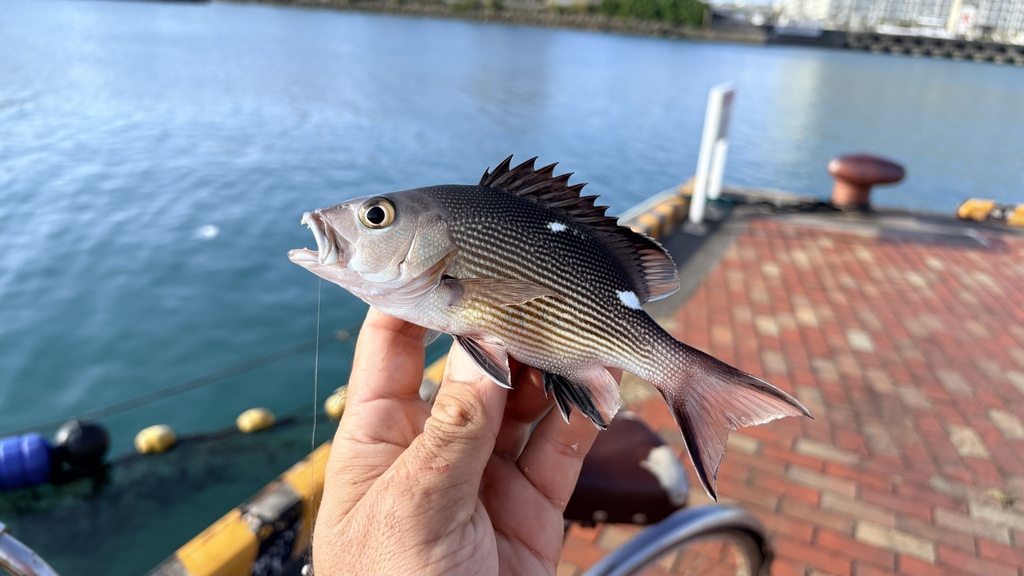
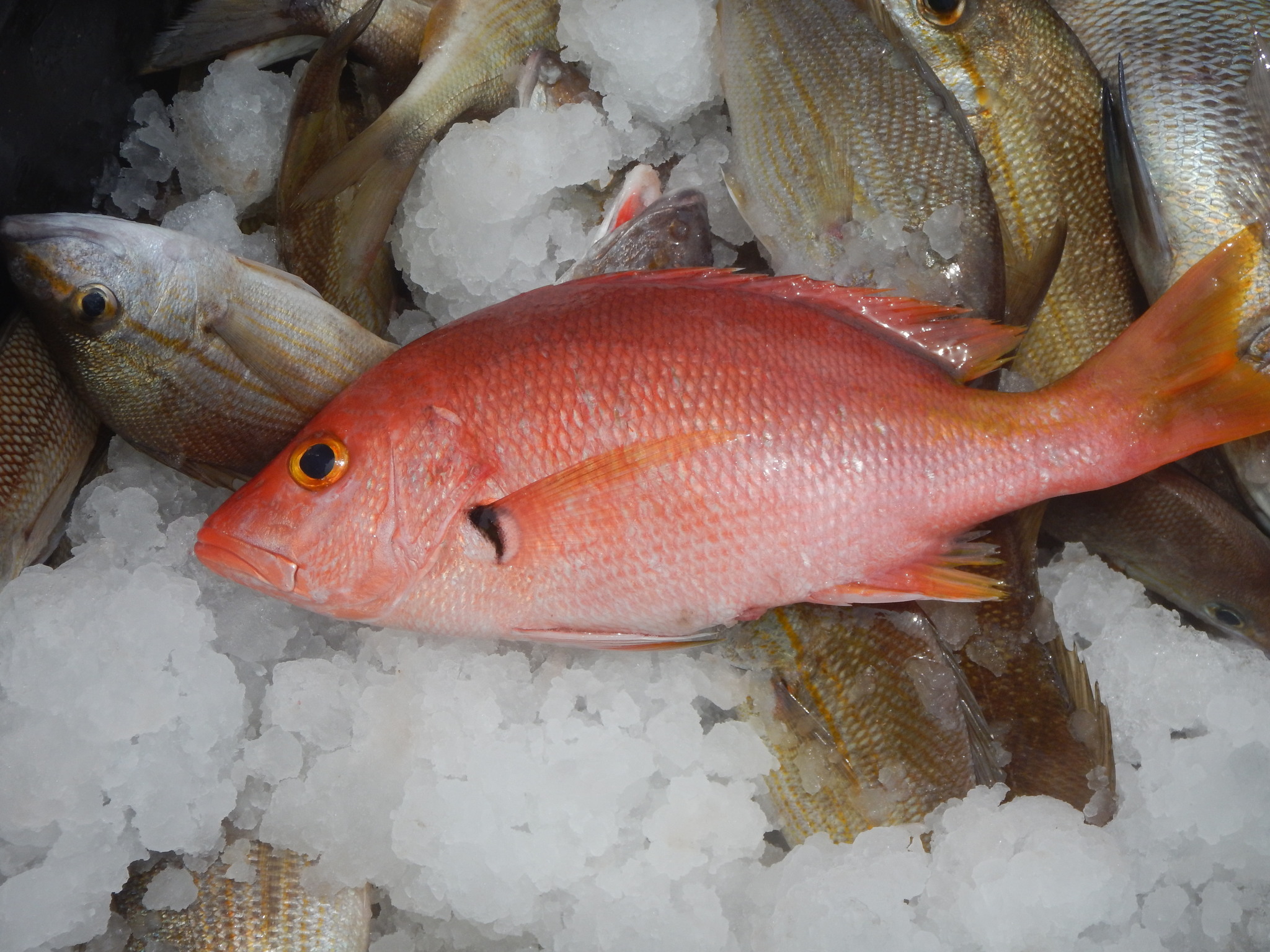
Colour is dark reddish brown with faint darker stripes. Young fish and some adults carry two silvery-white spots on the back, and the pectoral fin is pink with a prominently black upper edge. That black edge is the fastest field mark at distance; the two white spots are the reason for the English name and the reason small ones get mistaken for something else.
Islands, not coasts, and a slope at ten to seventy metres
The distribution text runs from East Africa to the Marquesas and Line islands, but the sentence that matters is the last one: the species is more common around oceanic islands than in continental areas. That is why atoll reports outnumber mainland reports, and why a trip built on a continental shelf can look like a failure when it is really a habitat mismatch.
Depth runs from the surface to 180 m, and most records fall between 10 and 70 m. Adults use coral reefs including sheltered lagoons and outer reefs, usually alone, and often right beside steep outer slopes. The word to fish by is slope. A flat reef top will produce small fish; the drop is where the 76 cm fish lives.
A handline and a bait that sits still
The record states the commercial method plainly: handlines and bottom longlines. That is also the correct recreational default. This is not a fish that chases; the diet list runs through fishes, shrimps, crabs, amphipods, stomatopods, gastropods and urochordates, which is the menu of a bottom feeder that takes what the slope delivers.
So: heavy lead, short leader, a whole small fish or a thick strip, down to the bottom, then lifted half a metre and held. Because the fish is usually solitary, one take does not mean a hot bite, and staying on a dead mark is the common mistake.
Ninety centimetres and fifty-five years
Maximum 90 cm total length, common length 76 cm standard length, maximum published weight 12.5 kg, first maturity 42.9 cm. The age figure is the one that should change behaviour: 55 years maximum, age at maturity around 9 years, K as low as 0.05, doubling time longer than 14 years. On the vulnerability scales it scores 68 of 100 for fishing and 85 for climate.
A 76 cm fish is not a young fish. On a slope where the big ones have been removed, the remaining stock is old fish that are not being replaced quickly, which is exactly the pattern a slow-growing, long-lived snapper produces.
What the toxin does to the trip
Ciguatera is the reason this page opened with a market argument. The toxin is produced by benthic dinoflagellates, moves up the food chain, and concentrates in the largest, oldest predators; the liver, the head and the gut should not be eaten. There is no reliable field test. Tingling lips or tongue, nausea, vomiting or stomach pain after the meal means a clinic.
Two things follow. First, the fish most worth releasing is also the fish most worth not eating, which lines up neatly. Second, a table that ate bohar last week without symptoms has produced no information about the fish in your hand, because toxicity varies between individuals on the same reef.
Eight coastlines, one direction
Commercial fishing, sport fishing and aquaculture all take it. IUCN classifies it as Least Concern, last assessed on 4 March 2015.
Maldivian law forbids taking reef sharks, seasons off grouper spawning aggregations, licenses reef-fish exports and bans the sale of tourist catch. Thai park closures remove the Similan and Surin reefs during the monsoon, and the management plan adds its own seasons and gear limits. The Rakhine coast and the Mergui archipelago are managed thinly and with poor data, so foreign boats and visiting rods depend on whatever permits are current. India has no national size floor; Kerala and Tamil Nadu set their own from CMFRI advice, and the Andaman and Nicobar islands layer on tribal and reserve rules. Sri Lanka's Bar Reef, Hikkaduwa and Pigeon Island cores are closed, with no national minimum size. Mozambique, Kenya and Tanzania each apply their own fisheries law, and their export and reef-protection provisions differ.
How to catch it
Boat bottom fishing
Fished with the listed approach, matched to the recorded depth and size.
Regulations before you keep it
These are the published regulations for this fish. Read the number first. The notice below it is the actual regulation.
Protected species1
No take
Australia — Queensland · AU-QLD
Queensland prohibits taking red bass.
Queensland classifies red bass as a no-take species; this is a fisheries rule, not a protected-species listing under the Nature Conservation Act.
Red bass | No take | No take
Every record above names its source and the date it was retrieved. See the regulation register for the full list, or how to read these regulations.
Where these facts come from
Check these pages before you rely on a size, range or protection status.
-
FishBase — Lutjanus bohar
— FishBase · T2
-
GBIF — Lutjanus bohar occurrence records
— GBIF · T2
-
IUCN Red List — Lutjanus bohar
— IUCN · T1
-
Photo record — iNaturalist
— iNaturalist · T3