For decades, authors have filed it under two other names. FishBase records that many recent workers called it Lutjanus malabaricus (non Schneider) or L. altifrontalis, and labels the Red Sea record as a misidentification. A shopper or a logbook carrying either name may hold this fish, and a fish sold as "crimson snapper" may be one of the others. That is the line this page follows: not what the fish looks like, but which recorded name it is hiding behind.
Two names on one shelf
The accepted name is Lutjanus erythropterus, described by Bloch in 1790, and GBIF accepts it at 99 percent confidence. The problem is not the acceptance of the name but the history underneath it: malabaricus and altifrontalis have both been used for this animal, and malabaricus is itself a valid species. So a record filed under malabaricus could be this species misidentified, or that species. Nothing in the record tells you which.
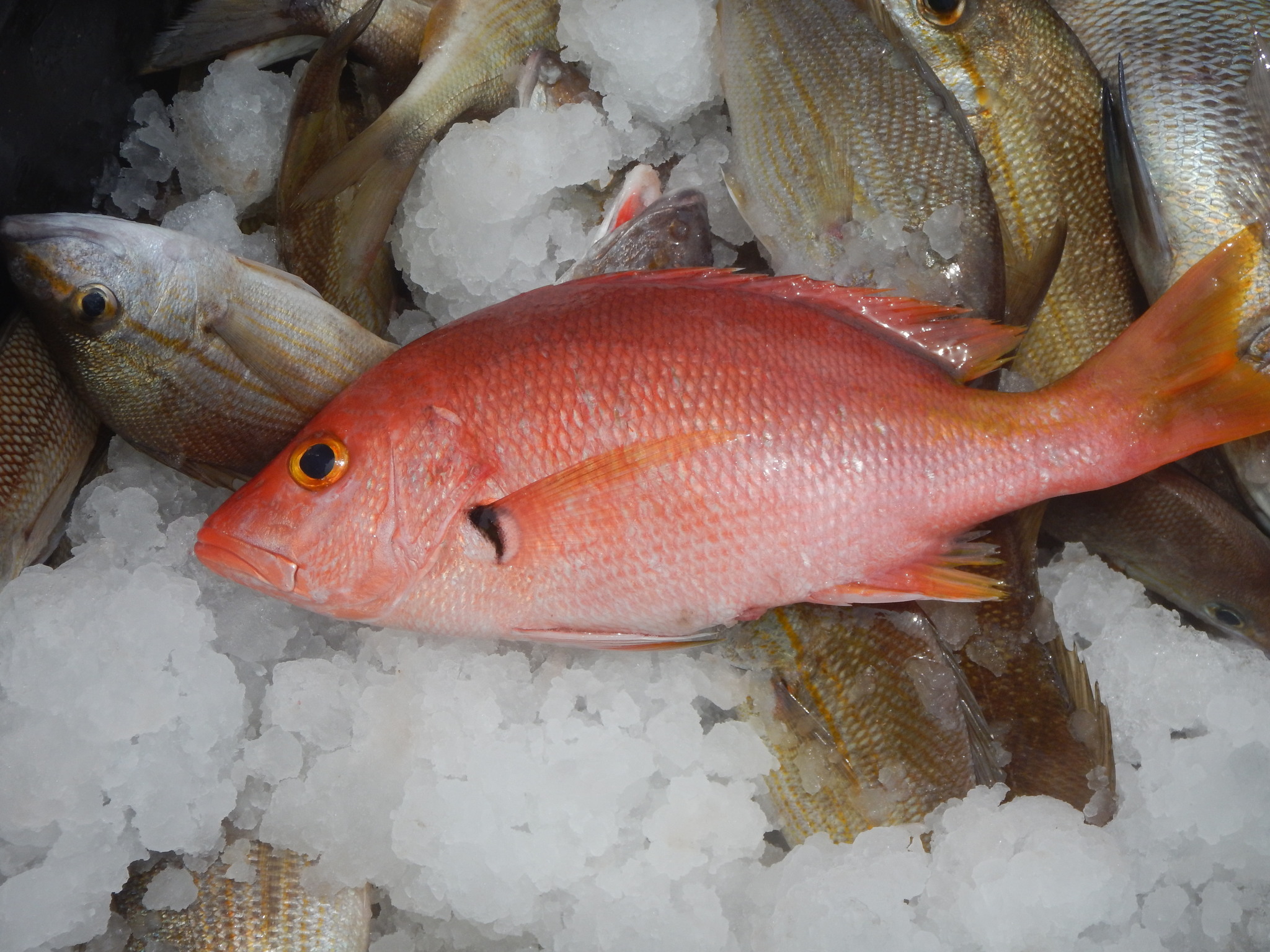
The English alias list makes the same point from the market side. It includes red snapper, red bream, red jew, scarlet snapper, pink snapper, firespot snapper, saddle-tailed perch and small-mouthed nannygai. Some of those names are used for other lutjanids in the same ports. A name on a fish box is a seller's label, not a determination.
What the Red Sea line means
The range statement ends bluntly: Red Sea reports are errors. The mapped range starts at the Persian Gulf and the Gulf of Oman and runs east to Fiji, north to southern Japan and Jeju Island, south to New South Wales. The Red Sea is not in that range, and the source says so rather than quietly omitting it.
Wikipedia's lead gives the range as the Pacific and Indian Oceans and keeps crimson seaperch, red bream and smallmouth sea perch among its names. The two-ocean framing is why a Persian Gulf record and a Fiji record belong to one account, even though most specimens are Australian.
GBIF still holds a scatter of western records: Eritrea two, Djibouti one, Bahrain one, Oman two, Yemen one. Oman and Yemen are on the stated country list, so they need no explanation. Eritrea and Djibouti are Red Sea coasts, and the source has already called Red Sea records misidentifications. This page will not decide whether those two specimens are mislabelled or belong to another species; it will only say that the two sources disagree on the same coast.
A 45 cm common fish with a 50.2 cm maturity line
Sizes: 81.6 cm fork length at the top, 45 cm total length as common, 8 years as the oldest, and Lm 50.2 cm with a floor of 50 cm and no stated ceiling. Two measures are mixed in one record: the maximum is fork length, the common length is total length. Fork length and total length are not the same number for a snapper.
The maturity line is also awkward. If 50.2 cm is the length at first maturity, the 45 cm common length sits below it, which would make the typical landed fish immature. Either the common-length figure comes from a different population, or the maturity estimate does. Neither source settles the question, and no average is taken here. For a kept fish, 50 cm is what the maturity entry supports; the 45 cm figure is a market-size statistic, not a breeding-size one.
Five to a hundred metres
The depth range is 5 to 100 m, and the habitat keywords are reef, sandy and muddy. Those three words describe a shelf, not a single spot: patch reef rising from sand, silt between the rises, and reef edge where the two meet. A snapper recorded across that range is not equally available at every metre of it, and the source gives no usual depth band.
The approved method is boat bottom fishing, which fits the habitat without pretending to precision. Anchor over sand next to a reef, drift across the silt, or work the drop-off where the hard bottom starts. A 5 m mark is reachable from a small boat; a 100 m mark needs a sounder and enough line. The record supplies the ends of the range, not a target depth.
Two spawning blocks in one survey
Spawning entries run January–April and September–December, all from one Great Barrier Reef survey. That leaves two blocks with a gap in May to August, in a single region. It is not a year-round season, nor a season for the Persian Gulf. A tropical snapper can spawn in different months at different latitudes, and one survey cannot show that.
The gap is the interesting part. If the record is right for that reef, then late spring and winter are the non-spawning months there, and a summer trip is not a spawning trip. If the record is incomplete, the gap means nothing. The record picks neither option, leaving a regional signal with a visible hole.
Rays, an oval body, and a red name
Counts on the checked page: 12–14 soft dorsal rays, 8–9 soft anal rays with three spines ahead of them, a fusiform build and an oval section. Spine counts and vertebrae are not given. For a lutjanid, the soft rays and the head profile are the practical check; "crimson" is about colour, and colour fades after death.
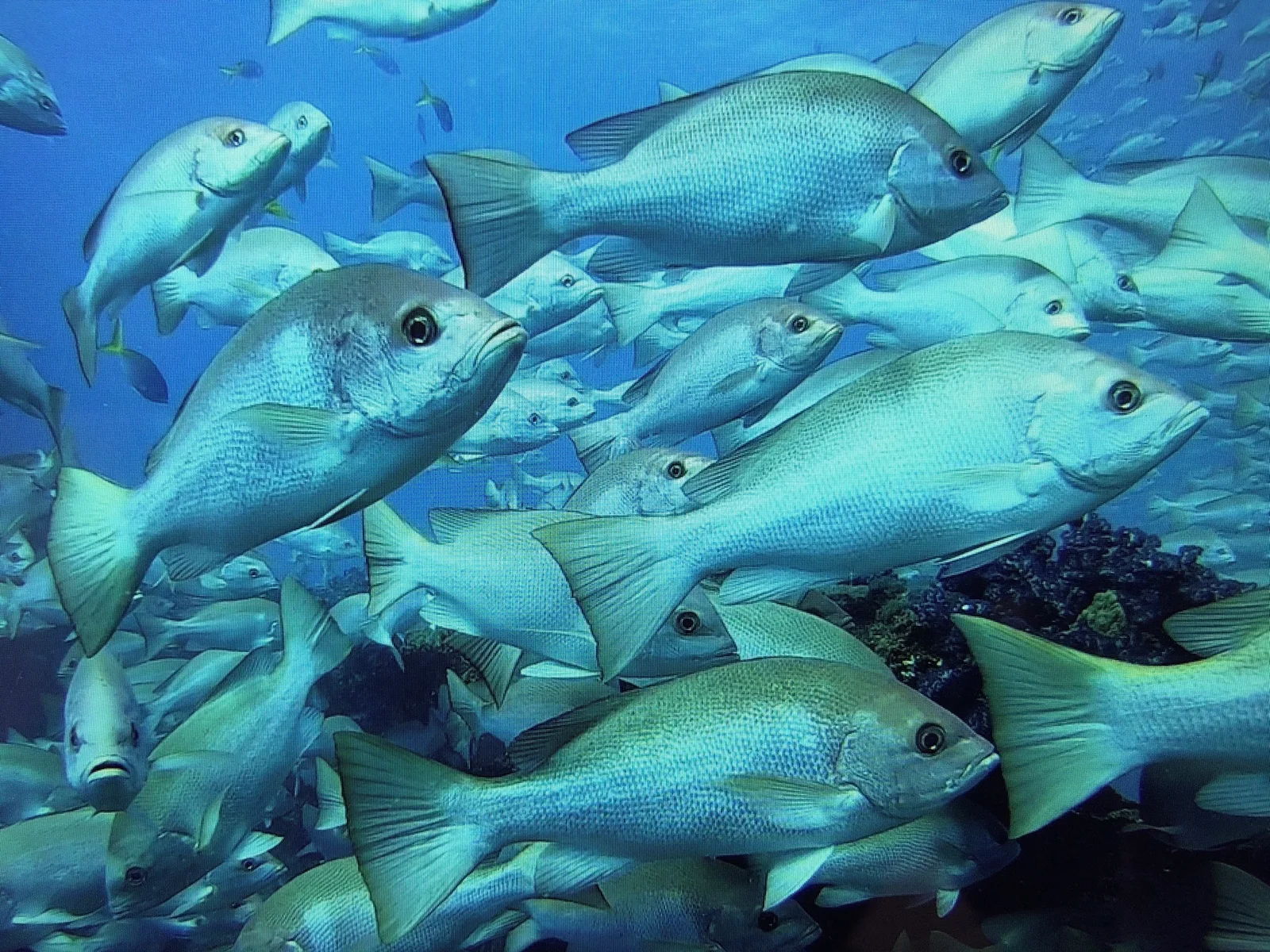
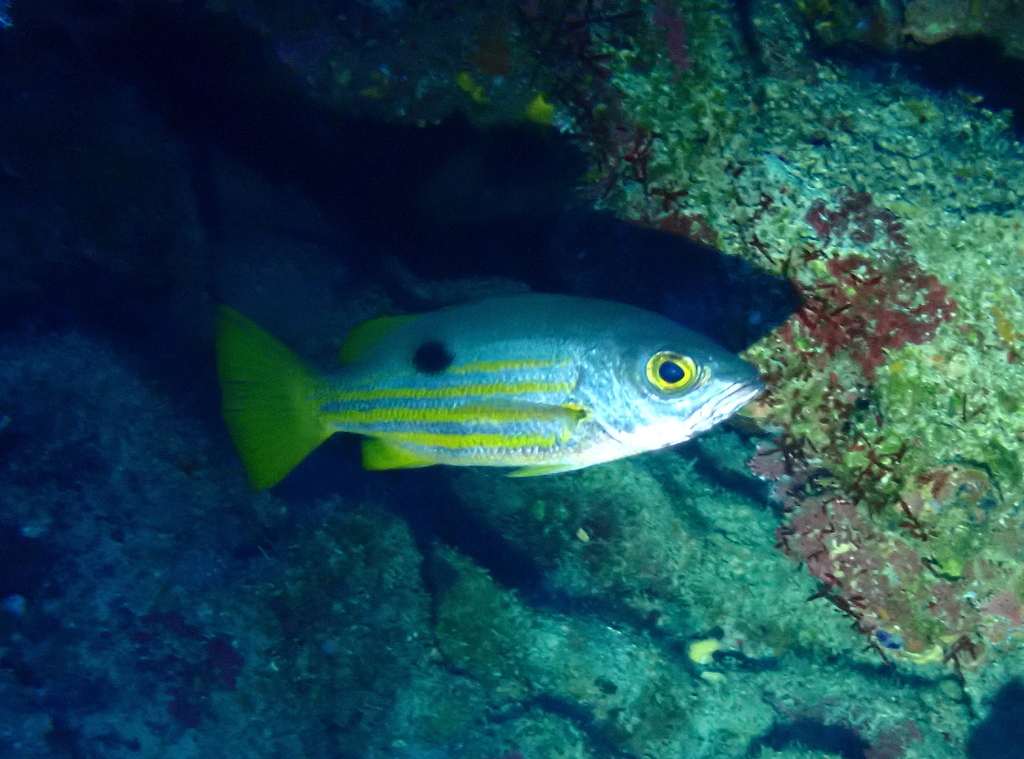
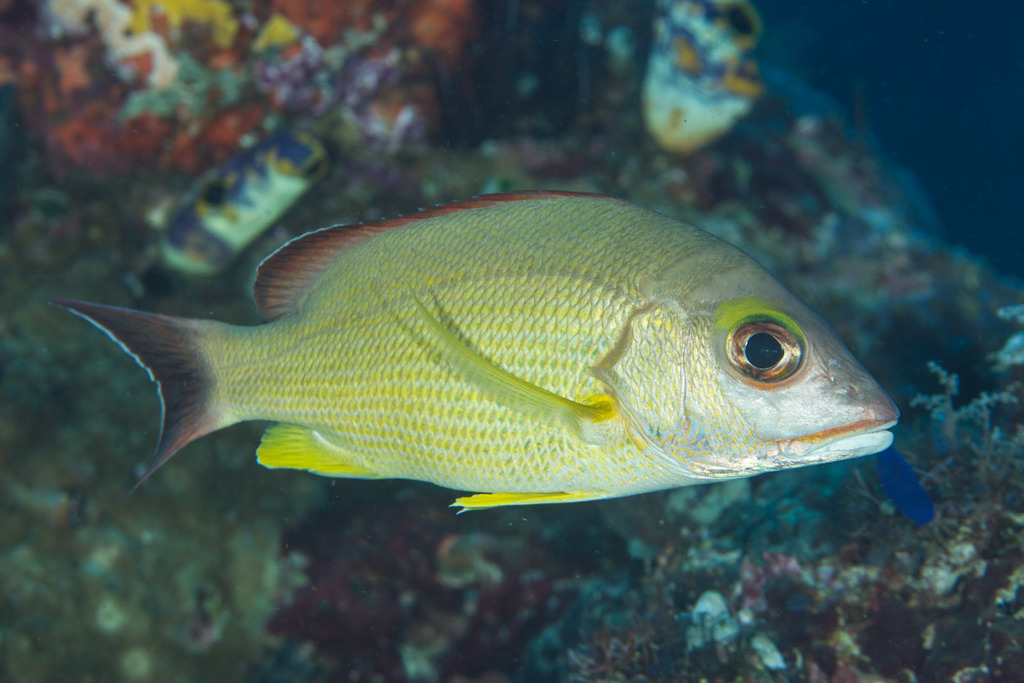
The photographs are the other check, but they are not a key. Several red snappers overlap in shape, and the record itself warns that this species has been confused with malabaricus. Release makes the rays incidental; keeping under a name-based rule makes the rule's name and the fish's name a matched pair.
Commercial, farmed, and Least Concern
FishBase names commercial capture and commercial farming, with no gamefish or aquarium entry. Red List status: Least Concern (28 June 2018). No rule text accompanies the page. An eight-year maximum age is short for a snapper, which changes the pressure picture: a stock that turns over quickly responds faster to a size limit than a long-lived grouper does.
The aquaculture entry matters for the name question. Farmed fish enter the market under the same trade names as wild ones, so a box labelled crimson snapper may not come from a reef at all. That does not affect the biology of the wild fish, but it does affect what a market record can prove about catch.
Where the counts sit
GBIF holds 2,737 records, and 2,306 of them are Australian. Indonesia has 89, China 45, and the Philippines, Thailand and Taiwan region 27 each. The stated range runs from the Persian Gulf to Fiji, far wider than that count distribution. The counts describe where specimens have been digitised, not where the fish lives.
iNaturalist has 102 observations, thin for a species this widespread. Read together, the two sources point to a well-documented Australian population and a thinly documented northern and western range. That argues for checking local names before trusting a regional catch report, the same argument the malabaricus line made at the start.
How to catch it
Boat bottom fishing
Anchored or drifting boat, bait or lure worked near the recorded bottom.
Regulations before you keep it
These are the published regulations for this fish. Read the number first. The notice below it is the actual regulation.
Minimum size1
≥40 cm
Australia — Queensland · AU-QLD
Queensland sets a 40 cm minimum size for crimson snapper.
The 9-fish combined possession limit covers crimson and saddletail snapper inside the 20 reef fin fish cap, with two five-day closures (8–12 October and 6–10 November 2026).
Crimson snapper (small-mouth nannygai) | Min: 40cm | Combined limit: 9 in total of crimson and saddletail snapper
Every record above names its source and the date it was retrieved. See the regulation register for the full list, or how to read these regulations.
Where these facts come from
Check these pages before you rely on a size, range or protection status.
-
FishBase — Lutjanus erythropterus
— FishBase · T2
-
GBIF — Lutjanus erythropterus occurrence records
— GBIF · T2
-
IUCN Red List — Lutjanus erythropterus
— IUCN · T1
-
Photo record — iNaturalist
— iNaturalist · T3