
Spotted rose snapper
A spotted rose snapper can be a farmed product, a restaurant fish and a wild reef fish in the same week. In Mexico it has sold for US$5–8 per kilogram, and a laboratory in Mazatlán has closed its full generation cycle in captivity. The wild record is stranger: a maximum length of 105 cm paired with a 1.3 kg maximum weight.
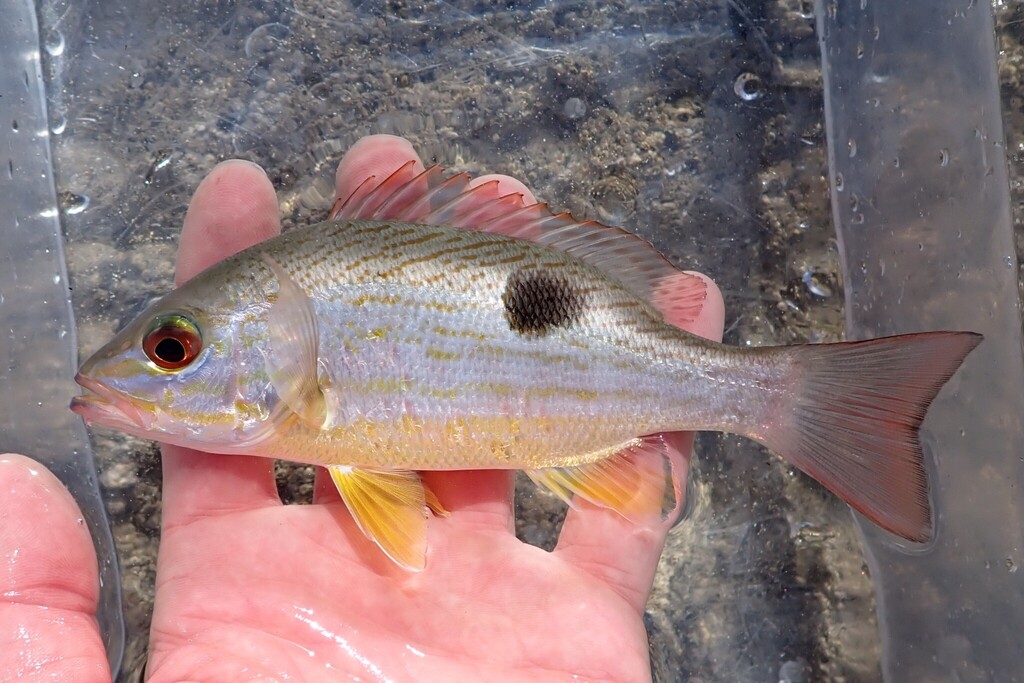
A spotted rose snapper can be a farmed product, a restaurant fish and a wild reef fish in the same week. In Mexico it has sold for US$5–8 per kilogram, and a laboratory in Mazatlán has closed its full generation cycle in captivity. The wild record is stranger: a maximum length of 105 cm paired with a 1.3 kg maximum weight. This article follows the price and the hatchery first, then the hard bottom where the fish lives.
The price before the fish
Culture trials for this species began in several Latin American countries along the Pacific during the last two decades of the twentieth century. The business model described in the aquaculture literature depended on collecting wild juveniles of various sizes, 50–200 g, rather than on hatchery production. That is a fishery hiding inside a farming story: the pond is stocked from the reef.
The same paper puts the market price at US$5–8 kg⁻¹ with strong demand in the Americas, which explains why grow-out trials continued while juvenile collection remained the weak link.
A market name that is not a species
“Snapper” is the market name the FDA Seafood List allows, with “Rose Snapper” as the common name for Lutjanus guttatus. It then lists Mutton Snapper, Flamenco and Pargo Chibato as cross-reference vernaculars, generally not acceptable on product labels in interstate commerce, with a misbranding warning attached.
Mutton snapper is a different fish in the western Atlantic. A buyer asking for mutton snapper in Mexico is not being sold a synonym; the names travel in different oceans. The label “Snapper” covers both.
One hundred five centimetres and 1.3 kilograms
FishBase puts the maximum at 105 cm total length and the published maximum weight at 1.3 kg. The common-length field is empty. Both figures come from the same size block and are not reconciled.
A 105 cm fish at 1.3 kg would be extraordinarily slender. Rather than average the pair or discard one, the useful reading is that the length and the weight come from different records, and which specimen produced which is not stated. For an angler, the weight figure is the one that matches the fish usually handled; the length figure describes an outlier whose body condition is unknown.
Maturity above its own range
Length at first maturity is listed as 26.4 cm; the range spans 17–18 cm. The stated maturity point sits above the range that accompanies it. Two measurements from two samples, with no note.
The practical consequence is narrow but real. If the range 17–18 cm is the one that applies to the stock being fished, then a 26.4 cm release threshold would protect fish that are already mature. If the 26.4 cm figure is the correct one, the range describes something else entirely. The page does not choose, and a trip rule should not pretend it did.
Ten to sixty metres
The depth field reads 10 to 60 m, tropical, between 33°N and 12°S. The biology text places adults over hard ground in shallow reef habitat, generally solitary or in small groups, occasionally in big schools. Juveniles inhabit estuaries and the mouths of rivers.
That is a two-part life history, not a single habitat. The adult fish is on hard structure in coastal water; the juvenile is in the brackish transition at the river mouth. A reef chart alone will find the first and miss the second.
The hatchery answer
The Mazatlán work obtained juveniles from wild adults, matured and spawned them in the laboratory, and produced an F1 generation that matured sexually at two years of age. Spawning was induced in two successive years, and F2 juveniles were reared to maturity and spawned in turn. The paper calls this closure of the generation cycle.
The significance is that the industry's dependence on wild juveniles is a choice, not a biological limit. Once F1 broodstock reproduce, the farm no longer needs to take 50–200 g fish from the reef. Whether the market switches is another question; the technical obstacle has been removed.
Where the wild record sits
FishBase puts Lutjanus guttatus in the eastern Pacific, from Mexico to Peru. GBIF holds seven distribution statements: East Pacific, Global, Nearctic and Neotropical, a Colombian mangrove-survey locality reading Bahia Solano, Ciudad Mutis, a second Colombian record that exists as the code CO:52835577, plus a Mexican checklist record marked with country code MX and lacking locality text. This is a thin set, and it says more about cataloguing than about abundance.
Nearctic and Neotropical realms sit beside a mangrove survey and a bare code: “distribution” can mean a realm, a sea, or a database key. The Bahia Solano entry names a mangrove site a boat can reach.
Fishing both identities
Begin with the statements that survive the conflict. Adults are on hard bottom between 10 and 60 m, often solitary, sometimes schooled. Fish the structure rather than the open sand between structures. At the river mouths, the juvenile habitat is the brackish edge, not the reef.
Then treat the market and the hatchery as separate information streams. The price tells you the fish is wanted; the closed cycle tells you farmed supply can exist without wild juveniles. Neither tells you where a mature fish will be at 40 m on a given tide.
Carry the two maturity numbers instead of one. If the fish is near 26 cm, the page's own range of 17–18 cm makes the release decision ambiguous. Record the length, note which threshold the local rule uses, and leave the contradiction visible rather than resolving it on the water.
Where these facts come from
Check these pages before you rely on a size, range or protection status.
- FishBase — Lutjanus guttatus — FishBase · T2
- GBIF — Lutjanus guttatus occurrence records — GBIF · T2
- IUCN Red List — Lutjanus guttatus — IUCN · T1
- Photo record — iNaturalist — iNaturalist · T3
Fish in the same water
These fish live in the same place.
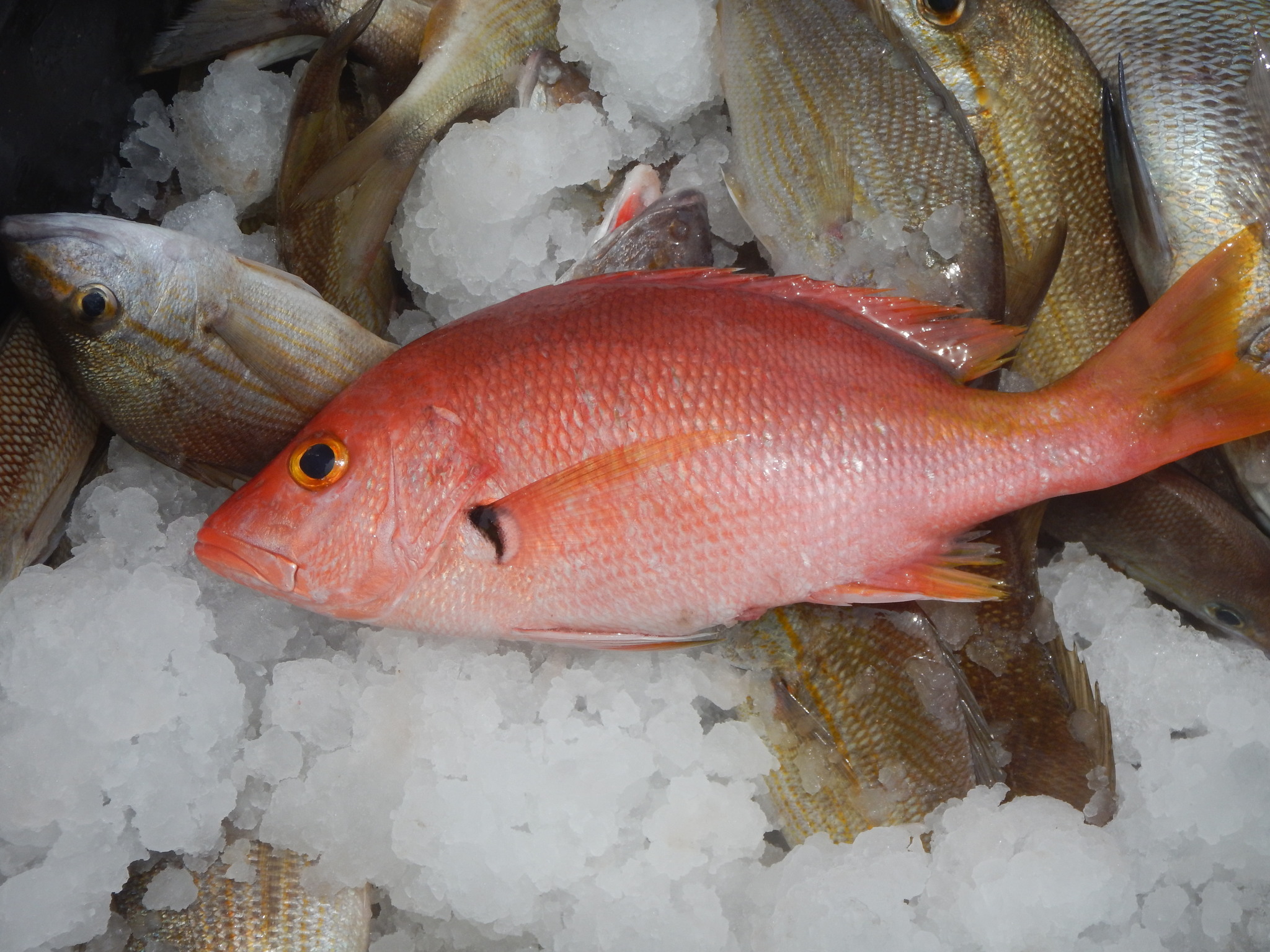
Blackfin snapper
- Family
- Lutjanidae
- Depth
- 20–200 m
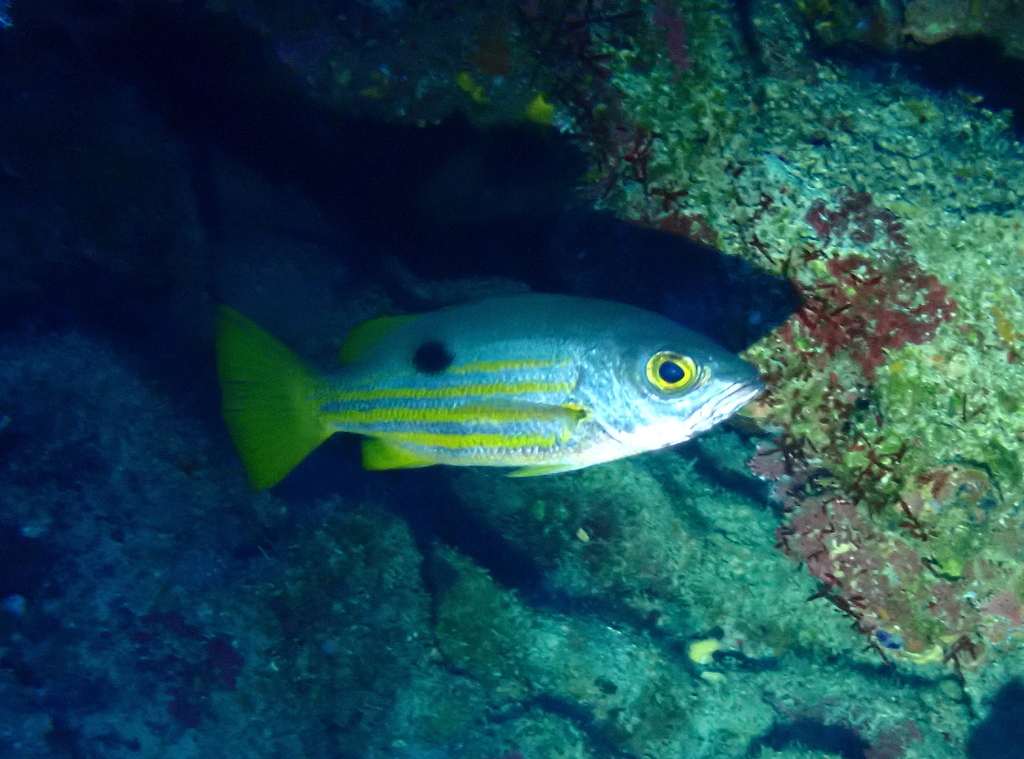
Blackspot snapper
- Family
- Lutjanidae
- Depth
- 5–20 m
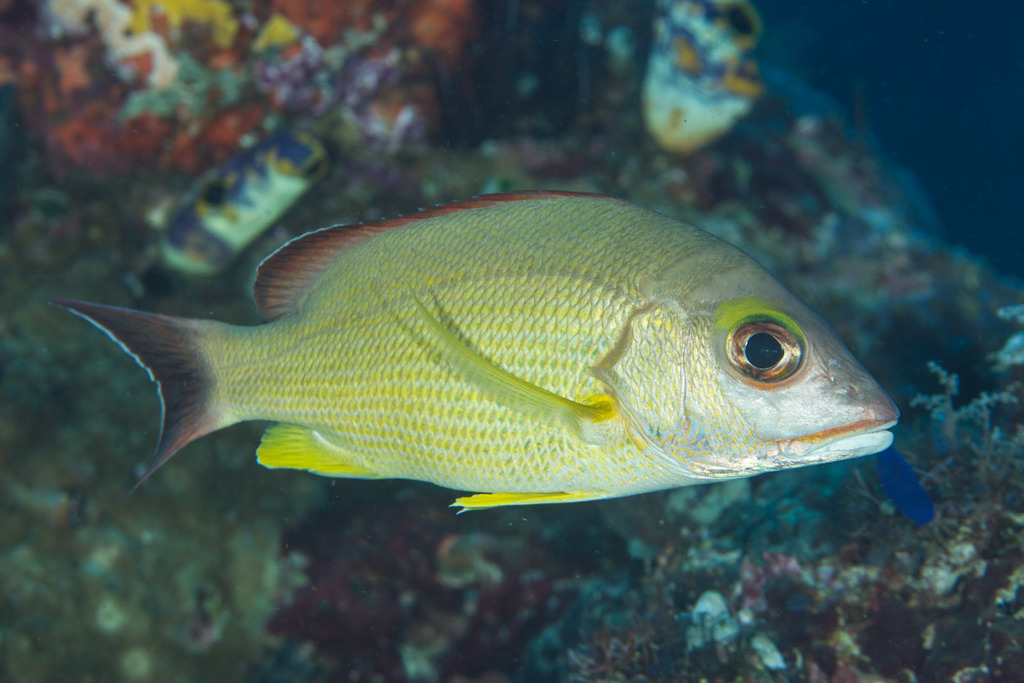
Blacktail snapper
- Family
- Lutjanidae
- Depth
- 1–80 m
- Season
- Jan, Feb, Mar, Apr, May, Jun, Jul, Aug, Sep, Oct, Nov, Dec
Guides for this water
Technique, gear and safety guides that fit Spotted rose snapper.