
One-spot snapper
One-spot snapper is an Indo-Pacific lutjanid, from East Africa to the Marquesas and Line Islands, north to the Ryukyu Islands and south to Australia. It is recorded as marine, brackish and reef-associated, from 1 to 60 m in tropical water between 31 degrees north and 27 degrees south. It reaches 60 cm TL with a common length of 50 cm. Bottom fishing and lures are the methods listed.
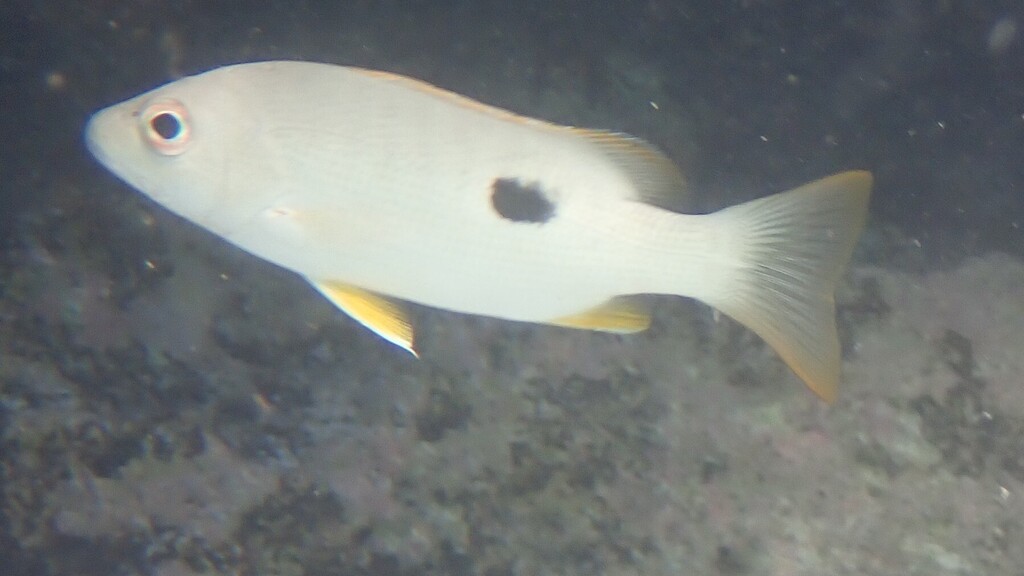
The one-spot snapper is an Indo-Pacific lutjanid, from East Africa to the Marquesas and Line islands, north to the Ryukyu Islands and south to Australia. It is recorded as marine, brackish and reef-associated, at 1–60 m, in tropical water from 31°N to 27°S and 31°E to 136°W. FishBase gives a maximum of 60 cm total length and a common length of 50 cm total length. IUCN lists it as Least Concern, assessed on 5 March 2015. FishBase's threat field records ciguatera poisoning reports.
One spot, and a shape that changes
The dorsal fin has 10 spines and 13–14 soft rays; the anal fin has 3 spines and 8–9 soft rays. The body is moderately deep to somewhat slender, its depth 2.6–3.0 times in standard length; the preopercular notch and knob are poorly developed; the vomerine tooth patch is crescentic without a medial posterior extension; the tongue is smooth and toothless; gill rakers on the first arch are 7 + 11–12, total 18–19 including rudiments; the caudal fin is truncate to slightly emarginate; scale rows on the back rise obliquely above the lateral line. Colour is whitish to pinkish with dusky scale margins; the upper back and dorsal head are grey or brown; a black spot sits on the back below the anterior soft dorsal rays, sometimes faint or absent; in juveniles the spot is round and shrinks and becomes horizontally elongate with growth; the fins are yellowish. The spot's position is more reliable than its shape, because large fish reshape it.
Caves, coral heads and wrecks
FishBase's range is the Indo-Pacific: East Africa to the Marquesas and Line islands, north to the Ryukyu Islands and south to Australia. The country table includes the Andaman and Nicobar Islands, American Samoa, Australia, Bangladesh, Brunei, Cambodia, China, the Caroline Islands, the Chagos Islands, the Comoros, the Cook Islands, Djibouti, Egypt, Eritrea, Fiji, French Polynesia, Guam, Hong Kong SAR, India, Indonesia, Japan, Jordan, Kenya, Kiribati, South Korea, Macau, Madagascar, Malaysia, the Maldives, the Marquesas, the Marshall Islands, Mauritius, Mayotte, Micronesia, Mozambique, Myanmar, Nauru, New Caledonia, Niue, the Northern Mariana Islands, the Ogasawara Islands, Oman, Palau, Papua New Guinea, the Philippines, Pitcairn, Réunion, the Ryukyu Islands, Samoa, Saudi Arabia, Seychelles, Singapore, the Society Islands, Socotra, the Solomon Islands, Somalia, South Africa, Sri Lanka, Sudan, Taiwan region, Tanzania, Thailand, Timor-Leste, Tonga, Tuvalu, the UAE, Vanuatu, Vietnam, Wallis and Futuna and Yemen. Adults live on coral reefs, usually close to shelter in caves, large coral formations or wreckage; they are usually solitary and occasionally in small groups; at night they feed mainly on fishes and benthic crustaceans, primarily crabs. GBIF's 4,014 records are led by the United States Minor Outlying Islands (372), Micronesia (347), American Samoa (338), Japan (281), Australia (279), Indonesia (235), French Polynesia (194), the Marshall Islands (155), Egypt (120) and the Northern Mariana Islands (115); iNaturalist has a taxon for the species.
One spawning record
FishBase gives a single spawning record: February and November off East Africa. That is a regional record and cannot be moved directly to Taiwan region or the Philippines; it shows at least two spawning windows in the western Indian Ocean, not a species-wide season. No water temperature is recorded, only the tropical label and the 31°N–27°S band. Plan around local temperature and tide. Snappers are largely nocturnal, so dusk, night and the change of tide are worth more than midday, and daytime fish sit tight to caves and reef crevices.
Fishing tight to structure
Boat and shore fishing both encounter it, and the key is fishing close to cover. Bottom rigs use prawn, crab, fish chunk or whole small fish, with a hook large enough and a leader abrasion-resistant enough for the reef; it eats crabs, so crab flesh or a small whole crab often beats a plain fish chunk. Lures are soft plastics, jigheads and small metal jigs crawled along the bottom, placed at cave mouths, crevices and wreck edges rather than thrown into coral. It is usually solitary, so do not expect a run of fish; after one, move to the next similar piece of structure instead of waiting on the same spot. At night, use a light stick or small lamp and watch your footing on the reef.
Medium-heavy, leader first
For 60 cm maximum and 50 cm common length, use a medium boat rod or shore rod, a 4000–6000 spinning reel, 1.5–2 braid and a 30–40 lb fluorocarbon leader. Because it lives around caves and wrecks, abrasion resistance matters more than raw strength; after the hookset, pull the fish away from the hole immediately or the line will be cut on structure. No maturity length is recorded, so no release size can be defended; releasing fish near the 60 cm maximum and keeping a middle-sized one is conservative.
Ciguatera is part of the plan
Recorded uses are commercial fisheries and commercial aquaculture. The flesh suits steaming, braising and soup; bleed, gut and ice promptly. Ciguatera is the risk that must be in the plan: FishBase explicitly records poisoning reports and notes that it is common in Tuvalu. Large reef snappers, their organs and their heads carry the higher risk; follow local advice rather than judging by freshness. In Taiwan region, the Fisheries Agency and local governments manage inshore fishing through closed areas, closed seasons, gear restrictions and minimum sizes. Hong Kong SAR's Fisheries Protection Ordinance regulates methods, and marine parks and reserves prohibit angling and collecting. Southeast Asian states differ widely, with Malaysia, Indonesia, the Philippines and Thailand setting size and closed-season rules and usually prohibiting take in core protected-area zones. Check the current local notice.
What the record leaves open
The page uses FishBase taxonomy, morphology, distribution, environment, biology, reproduction, use, IUCN and threat entries, with the country table for range and GBIF/iNaturalist for occurrence. The spawning months are one East African record and are flagged as regional, not extrapolated. No temperature or maturity length is recorded and no estimates are added. and are local aliases; the formal name is .
How to catch it
Bottom fishing
Fished with the listed approach, matched to the recorded depth and size.
Lure fishing
Fished with the listed approach, matched to the recorded depth and size.
Where these facts come from
Check these pages before you rely on a size, range or protection status.
- FishBase — Lutjanus monostigma — FishBase · T2
- GBIF — Lutjanus monostigma occurrence records — GBIF · T2
- IUCN Red List — Lutjanus monostigma — IUCN · T1
- Photo record — iNaturalist — iNaturalist · T3
Fish in the same water
These fish live in the same place.
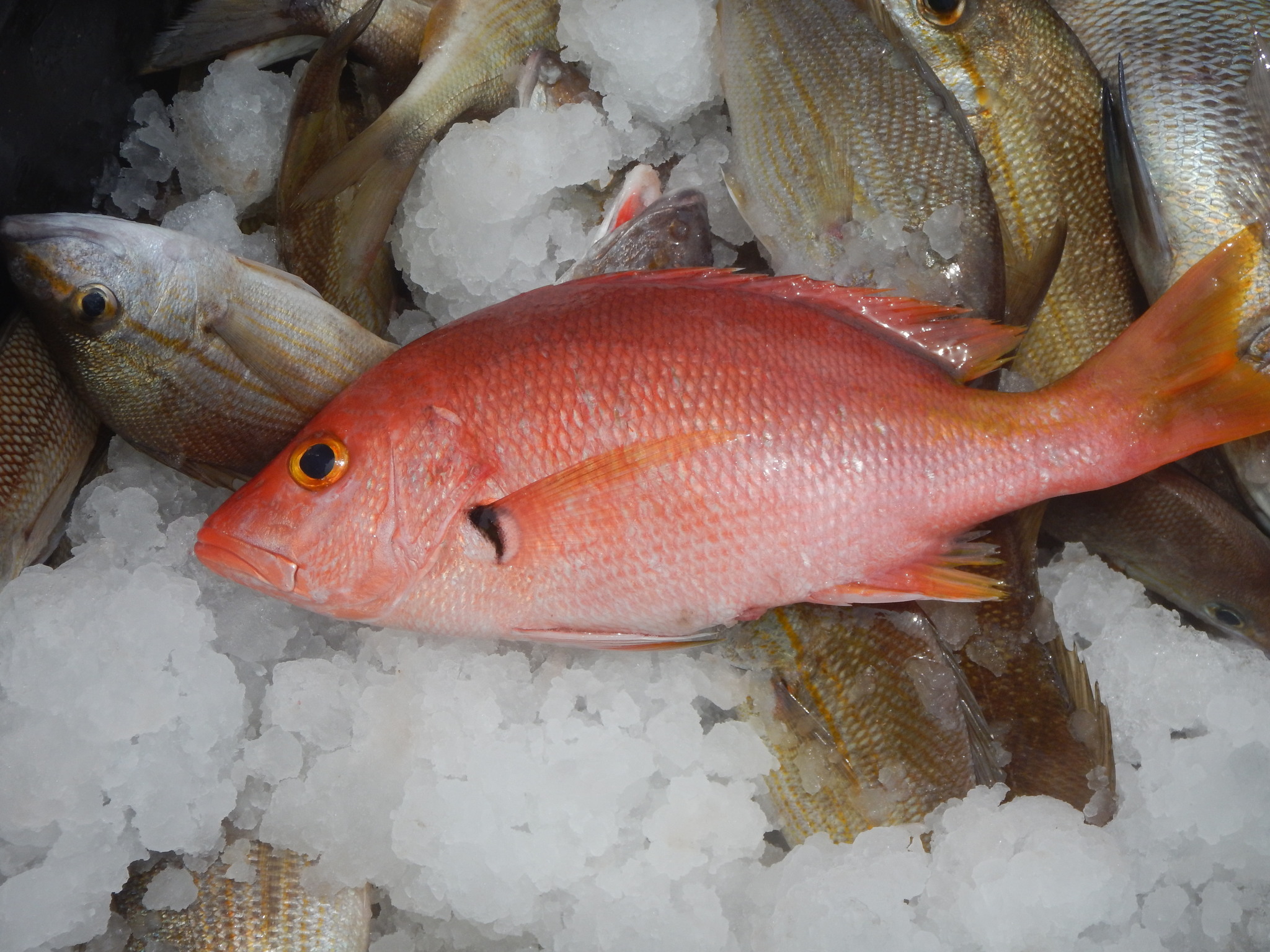
Blackfin snapper
- Family
- Lutjanidae
- Depth
- 20–200 m
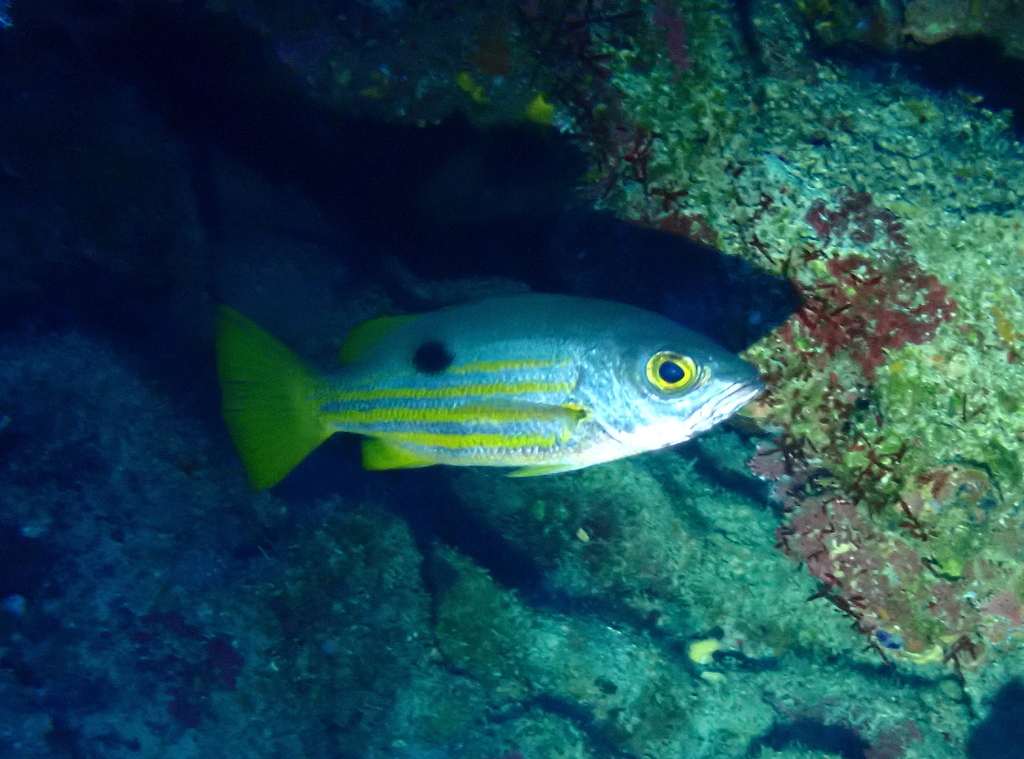
Blackspot snapper
- Family
- Lutjanidae
- Depth
- 5–20 m
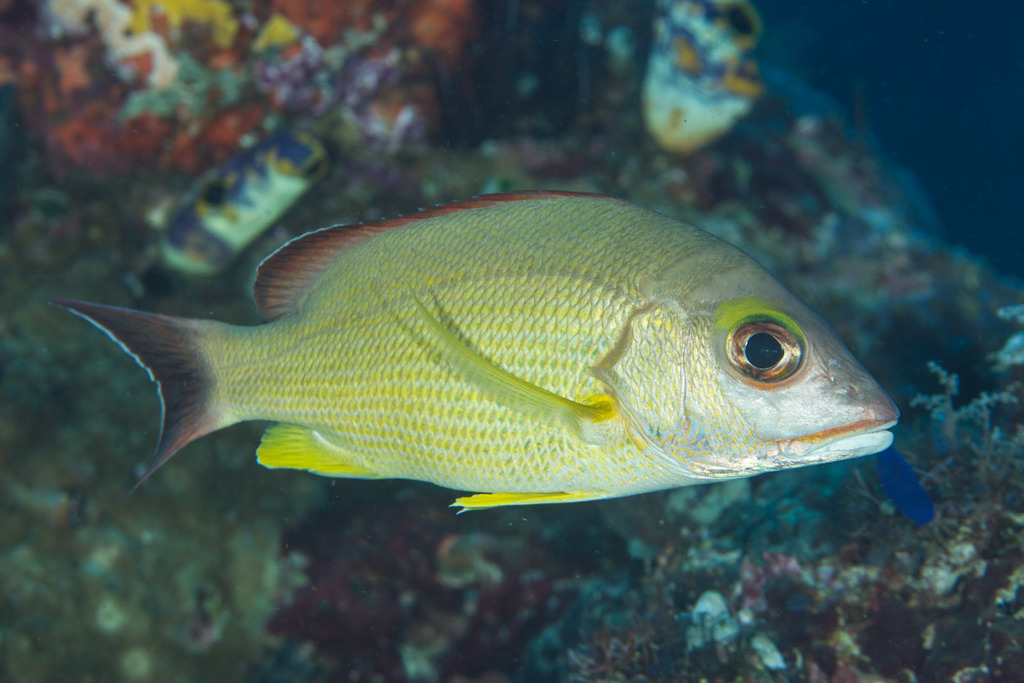
Blacktail snapper
- Family
- Lutjanidae
- Depth
- 1–80 m
- Season
- Jan, Feb, Mar, Apr, May, Jun, Jul, Aug, Sep, Oct, Nov, Dec
Guides for this water
Technique, gear and safety guides that fit One-spot snapper.