
Southern red snapper
Southern red snapper is a lutjanid of the western Atlantic, from Cuba south through the Caribbean to northeastern Brazil. It lives from 26 to 340 m in tropical water, reaches 100 cm TL and 10 kg, can live 18 years, and feeds on fish, molluscs and zooplankton. It is present year-round.

Southern red snapper (Lutjanus purpureus) is a fish of the family Lutjanidae. FishBase gives its range as: Western Atlantic: throughout most of the Caribbean Sea from Cuba southward to northeastern Brazil. Frequently confused with Lutjanus campechanus. It is recorded from 26 to 340 m, in tropical water. The recorded maxima are 100 cm TL, 10 kg, 18 years. Diet includes fishes, molluscs and zooplankton. IUCN status: Not Evaluated (NE). Chinese name: .
Two red snappers, one ocean
The distribution runs through most of the Caribbean from Cuba southward to northeastern Brazil. The same page puts Lutjanus campechanus in the same ocean, which is why the note exists at all. Two snappers with red bodies, similar proportions and overlapping markets will be confused by anyone who identifies fish at the counter rather than in the water.
That confusion is written into the source as a property of the account, not an angling anecdote. A catch reported as "red snapper" in the Caribbean may be this fish; one reported under the same name in the Gulf may be the other. Neither record settles which was caught from the name alone.
The name that never belonged
Bloch described Bodianus aya in 1790, and later authors used the name for this snapper; Rivas showed the original specimen was not a lutjanid and probably a sciaenid. The name was not wrong about a fish; it was wrong about which fish.
A historical name is therefore not evidence of identity: a synonym tells you where the word travelled, not what was in the net. The stable answer is the current binomial, and GBIF's distribution file holds only two records for it: an ITIS entry for the western Atlantic and a Mexican national checklist.
American red, Caribbean red, southern red
The English names on file are American red, Caribbean red snapper, southern red, southern red snapper, redfish and, simply, snapper. Every one of them is a trade word rather than a diagnostic one. "Caribbean" narrows the ocean; "southern" narrows the latitude; "American" narrows the market. None of them narrows the species.
This matters because the account's point is that the fish resembles another commercial species. A buyer asking for red snapper can be handed either, and a seller using "Caribbean red" is being more precise than most. The label is a route through the market, not a key to the animal.
One hundred centimetres, sixty-five in the box
The size line gives 100 cm total length, 10 kg and a common size of 65 cm, with 18 years as the maximum age. The common size is two-thirds of the maximum, which is a narrower gap than the big groupers show, and the 10 kg ceiling is modest for a snapper of that length. The age figure is the more interesting one: eighteen years is a long life for a fish that most anglers will meet at 65 cm.
A 65 cm common fish with an 18-year lifespan is not a young fish. The record gives no growth curve to say how far past its first years the typical fish is. The number to hold is 65, because that is what the fishery produces; 100 is the outlier.
Twenty-six to three hundred and forty
The depth range is 26 to 340 m, usually 70 to 120 m, and the habitat keyword is a single word: rocky. Two things follow. First, the usual band is deep enough that a boat and a sounder are prerequisites, not luxuries. Second, "rocky" without reef or estuary alongside it describes a hard bottom that is not necessarily a coral structure, which is a different kind of mark to find.
The environment line calls the species demersal. At 70 to 120 m that means baits on or just above the rock and a drift that keeps contact; the 26 m record exists, but the "usually" clause says it is not where the fish is found.
A maturity figure with no range
Maturity is given as 43 cm, a single number with no interval attached. Compared with the common length of 65 cm, that places the typical fish safely above the size of first maturity, which is the opposite of the pattern in several groupers. The absence of a range is not evidence that maturity is fixed at 43 cm; it means the page has one figure and this article will not manufacture a spread around it.
A single maturity value is a floor with unknown error. A 43 cm minimum would protect fish below it and say nothing about those above; a 65 cm common fish is likely mature, which is not a stock assessment. A 2022 study of the Amazon reef stock measured the share of the catch below the length at 50% maturity: 33.67% of the longline catch and 42.1% of the trap catch.
Twelve months, twelve records
The spawning table lists every month from January to December, backed by twelve regional records, several from Brazil and one from Trinidad in 1990–91. A year-round line supported by many separate observations is not the same claim as a single long study, and the page leaves both standing.
There is no month in which the species as a whole is not spawning somewhere, so a regulation has to be jurisdictional to mean anything. The record supports planning by country, not by calendar. Brazil supplies the country-level version: the joint MPA/MMA Portaria nº 66 of 27 July 2026 closes the pargo fishery from 15 December to 30 April and caps the annual catch at 2,750 t, open only to authorised vessels.
Not Evaluated is not good news
The Red List column reads Not Evaluated, with no assessment date. A commercially landed fish with no entry has not been through the process that produces a category, and the gap should not be read as reassurance. Brazil's environment ministry reclassified the species from Vulnerable to Endangered on 28 April 2026, citing a decline of more than 76% since the 1990s, fishing pressure about 175% above the sustainable level, and Pará's share of roughly 87% of Brazilian production. The two entries do not describe the same thing: one is a global assessment that has not been done, the other a national one that has.
The human-risk column adds ciguatera, which is a separate concern from stock status. Identify the fish, know which red snapper you have, and treat the missing category as missing information rather than as a clean bill of health.
Where these facts come from
Check these pages before you rely on a size, range or protection status.
- FishBase — Lutjanus purpureus — FishBase · T2
- GBIF — Lutjanus purpureus occurrence records — GBIF · T2
- IUCN Red List — Lutjanus purpureus — IUCN · T1
- Photo record — iNaturalist — iNaturalist · T3
Fish in the same water
These fish live in the same place.
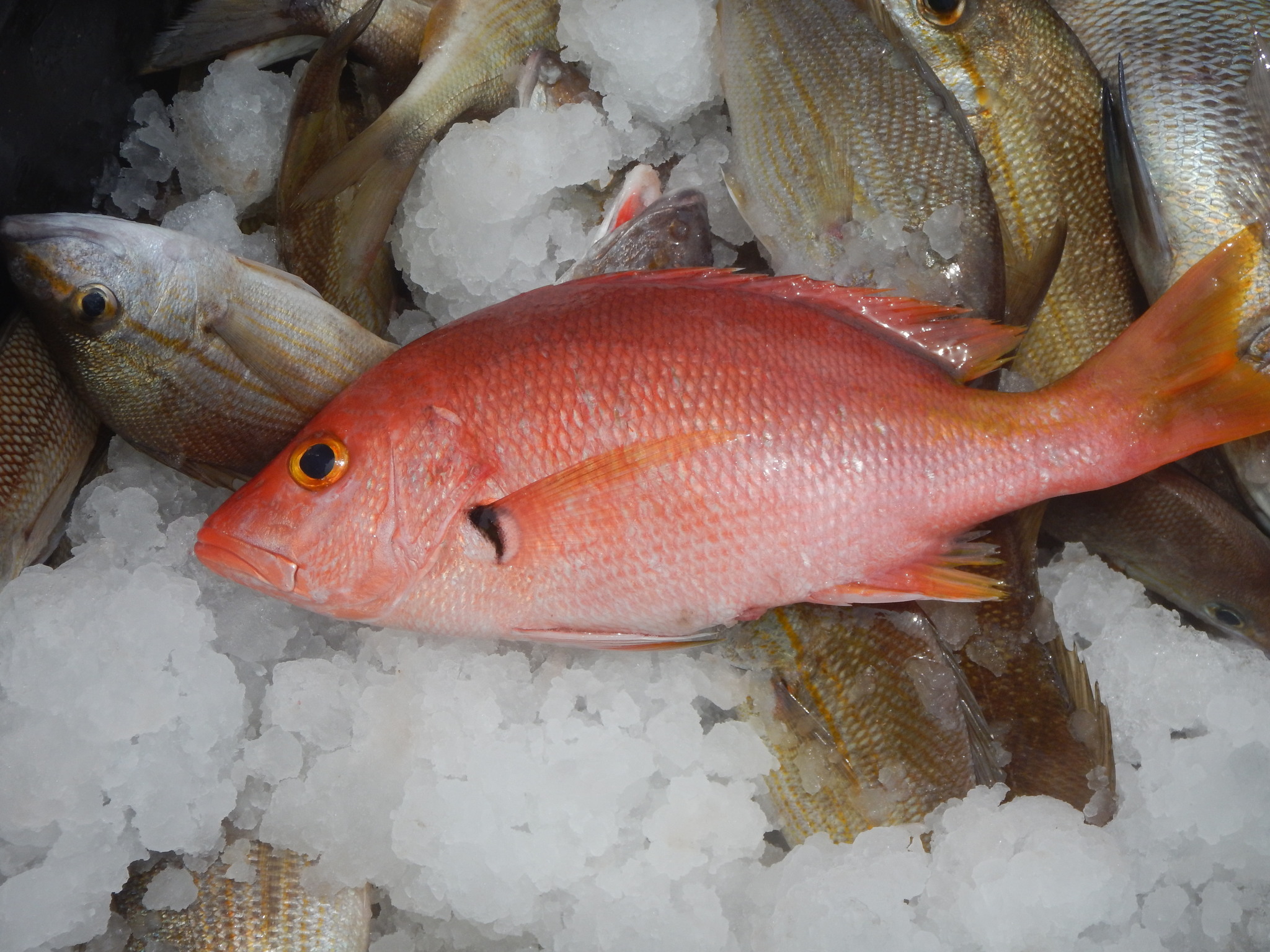
Blackfin snapper
- Family
- Lutjanidae
- Depth
- 20–200 m
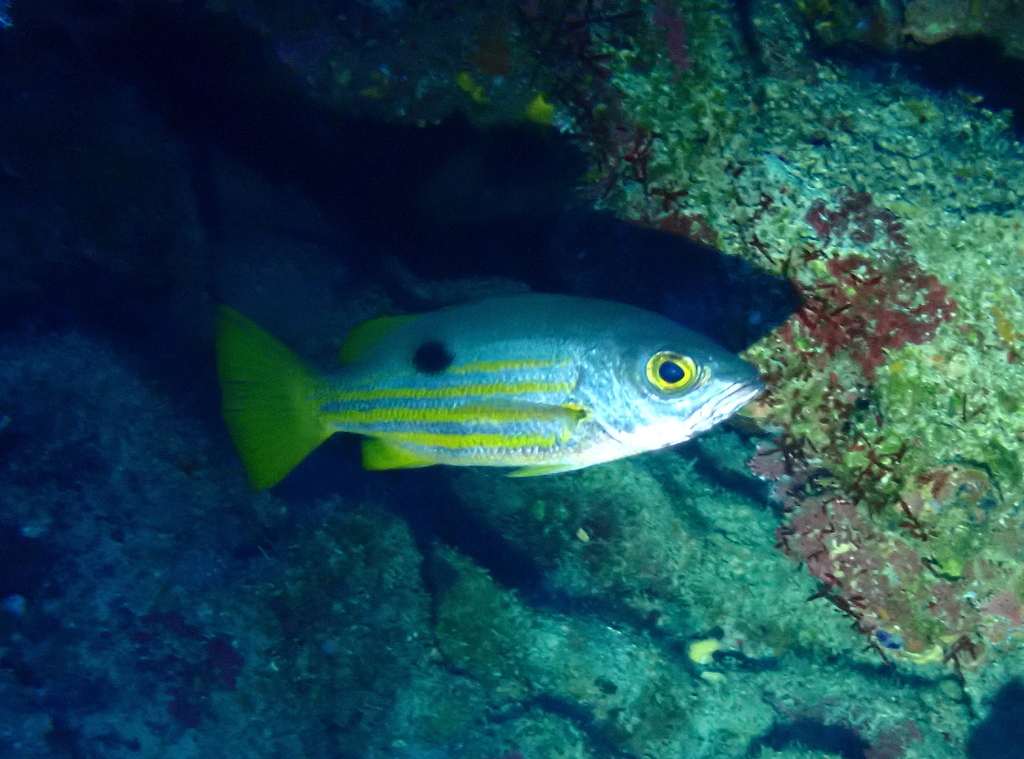
Blackspot snapper
- Family
- Lutjanidae
- Depth
- 5–20 m
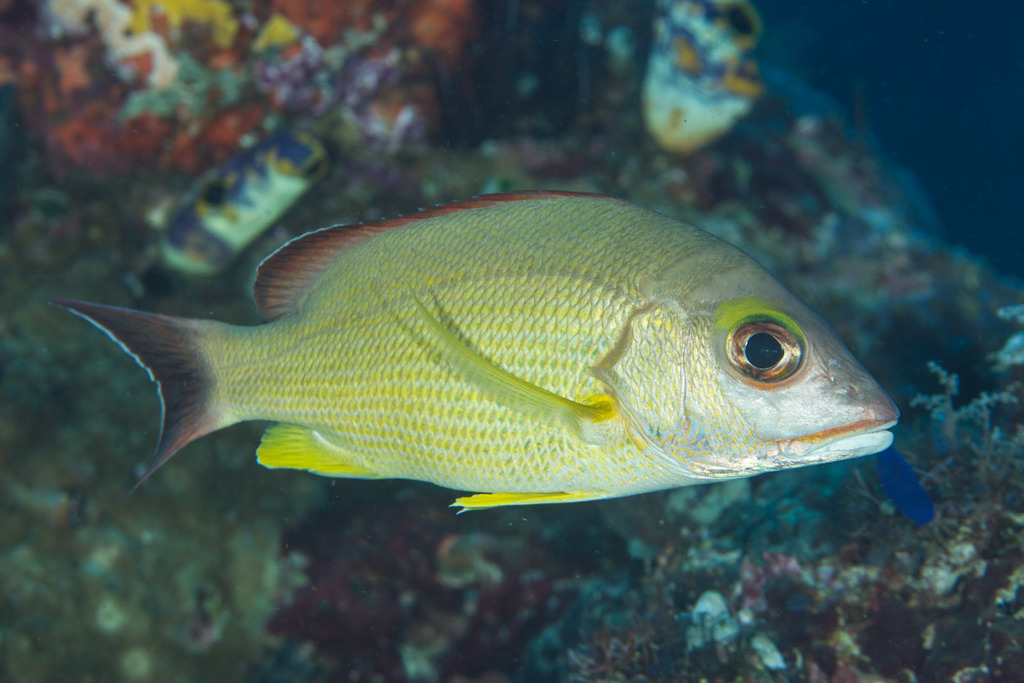
Blacktail snapper
- Family
- Lutjanidae
- Depth
- 1–80 m
- Season
- Jan, Feb, Mar, Apr, May, Jun, Jul, Aug, Sep, Oct, Nov, Dec
Guides for this water
Technique, gear and safety guides that fit Southern red snapper.