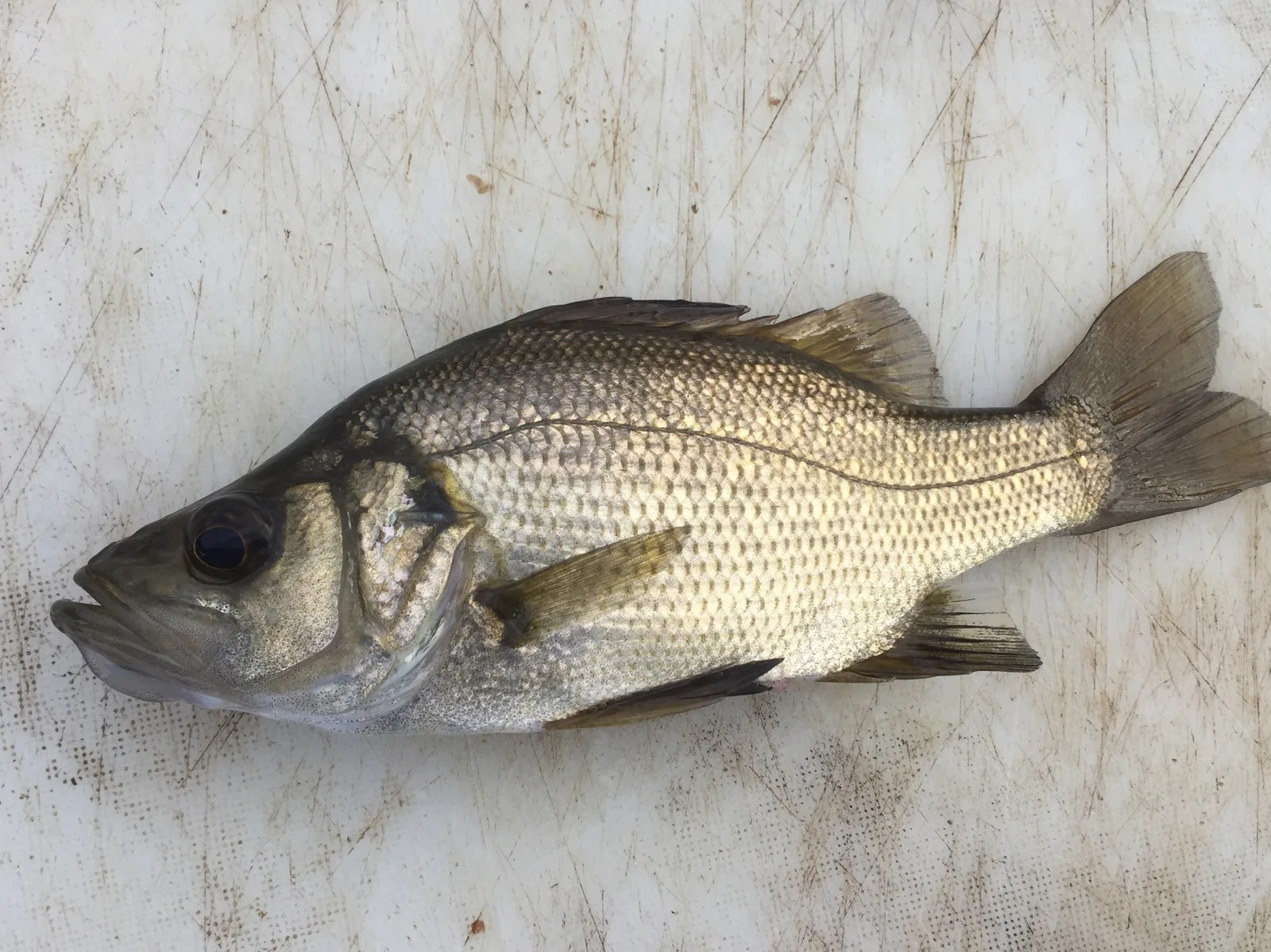
The Australian bass is a freshwater member of the family Percalatidae, endemic to coastal rivers from Queensland to Victoria and best known as one of eastern Australia's most popular game fish. It is catadromous, moving downstream to estuaries to spawn when flood flows arrive between May and August. No numeric depth is published for the species, so the record gives salinity and flow rather than metres. FishBase lists both commercial use and a gamefish flag, and the maximum total length is 60 cm with a reported age of 22 years. No IUCN assessment exists for it, and state rules rather than a national limit govern the catch.
Identification
The names are all bass and perch: Australian bass is the FishBase principal and the FAO form, with Australian perch, Eastern freshwater perch, Freshwater perch and plain Perch as the Australian variants. Chinese is , with as the traditional form. Wikipedia adds the history behind the name: the fish was simply called perch in most coastal rivers until the 1960s, when Australian bass gained popularity.
No fin-ray or vertebral count survives in the record: the dorsal and anal fins and the vertebral column are all blank, while only the body shape is given, as fusiform. For a species that anglers identify by mouth and outline, that is a thin record. The size line gives 60.0 cm TL maximum and 22 years maximum age, with no common length, no maximum weight and no maturity figure. A single 63 cm female estimated at more than 4.5 kg is mentioned in the biology, but the capture keeps it out of the size table because it is one specimen rather than a published maximum.
Habitat and distribution
The environment line is freshwater and brackish, demersal, catadromous, temperate, 10°S–40°S. No numeric depth is carried by FishBase, GBIF, iNaturalist or Wikipedia, so the page states none. Habitat keywords are rocky, estuary, coastal and brackish, and the diet is crustaceans, fishes and zooplankton. Wikipedia describes a primarily freshwater fish of coastal rivers and streams on the east coast.
FishBase's distribution text says the species is endemic to Australia from Queensland to Victoria, but the country table adds Fiji. GBIF returns six rows: two without a country code, two Fiji, one Australia and one New Zealand, with four of them marked introduced — including the Australian row. Those flags cannot be right for a species the text calls endemic, and the page does not use them as a range map. Because the current genus does not match an iNaturalist taxon, no observation data are available.
Season and fishing approach
The spawning-record page carries no rows. The timing comes instead from the FishBase biology summary: flood events between May and August trigger a downstream spawning migration, and estuarine conditions matter for spawning success. That is a narrative statement, not a set of dated records, and the page should label it as such. No temperature threshold and no spawning depth are given.
The use line is commercial with gamefish yes, and Wikipedia calls the species an extremely popular game fish. The capture still gives no method, bait or regulation. It also gives no depth range, so any advice about fishing depth would be invented; the salinity and flow cues in the biology summary are the only environmental signals recorded.
Edibility and regulations
IUCN has no assessment for the species: the category is Not Evaluated and no assessment date is given. No food-use field is carried. The human-use line is commercial plus gamefish yes, and Wikipedia's extract carries no conservation or regulatory material.
No size, season or bag limit is recorded. Because the fish is a popular game species across Queensland, New South Wales and Victoria, the applicable rules are state rules, and the page cannot name one. A reader should check the state rule where the fish is taken rather than infer a limit from the database flags.
Regulations before you keep it
These are the published regulations for this fish. Read the number first. The notice below it is the actual regulation.
Minimum size1
≥30 cm
Australia — Queensland · AU-QLD
Queensland sets a 30 cm minimum size for Australian bass.
Australian bass is a freshwater and impoundment species that only occasionally enters estuaries. In SIPS dams and weirs the possession limit is 5, not 2; confirm the water-specific rule before fishing.
Australian bass | Min: 30cm | Limit: 2
Bag limit1
2 fish possession limit
Australia — Queensland · AU-QLD
Queensland sets a possession limit of 2 Australian bass.
Australian bass is a freshwater and impoundment species that only occasionally enters estuaries. In SIPS dams and weirs the possession limit is 5, not 2; confirm the water-specific rule before fishing.
Australian bass | Min: 30cm | Limit: 2
Every record above names its source and the date it was retrieved. See the regulation register for the full list, or how to read these regulations.
Where these facts come from
Check these pages before you rely on a size, range or protection status.
-
FishBase — Macquaria novemaculeata
— FishBase · T2
-
GBIF — Macquaria novemaculeata occurrence records
— GBIF · T2
-
IUCN Red List — Macquaria novemaculeata
— IUCN · T1