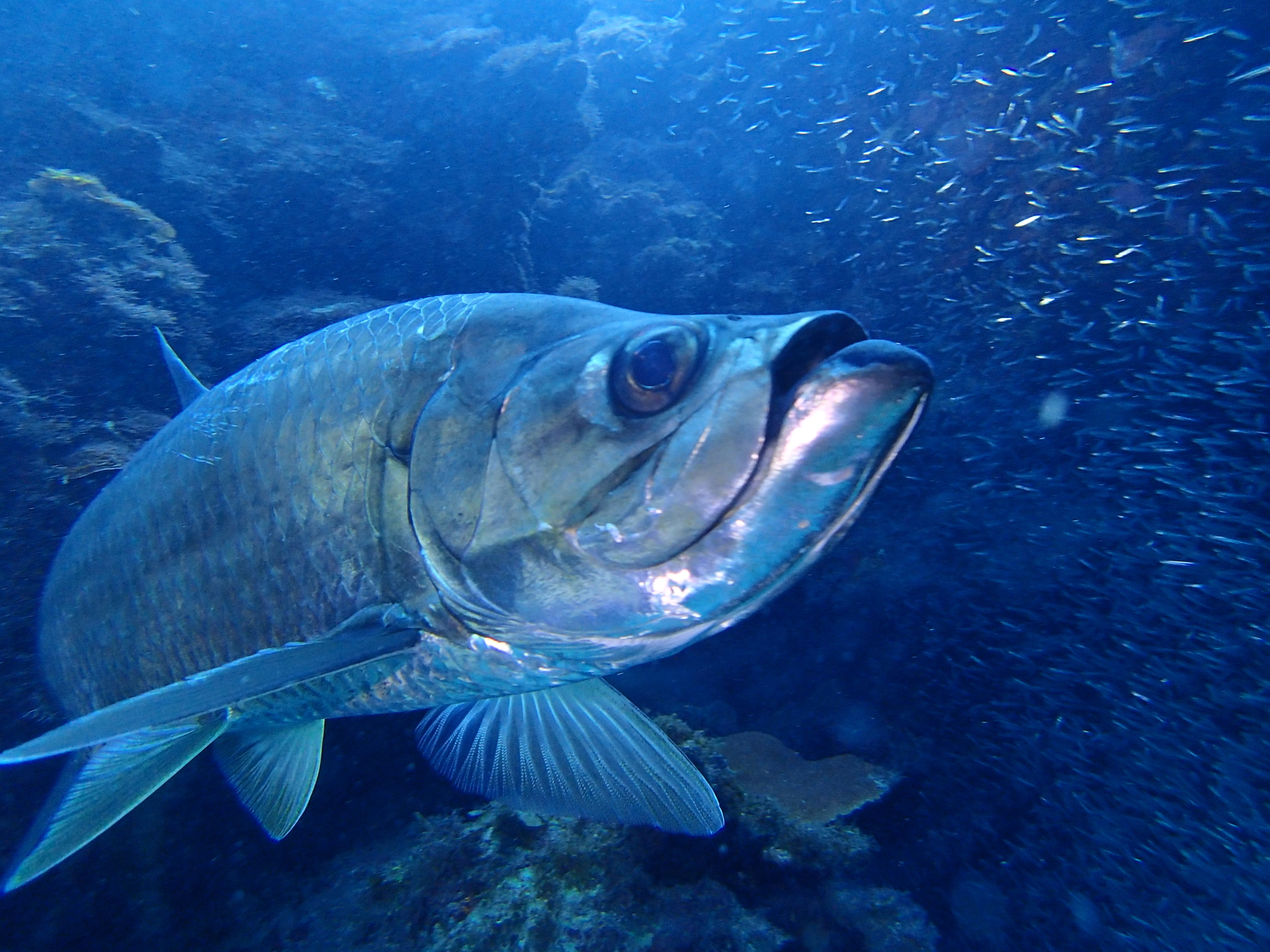
Tarpon is the fish that makes the difference between a record and a catch impossible to ignore. On the same page the maximum-length entry is 250 cm TL, the common length 130 cm, the maximum weight 161 kg and the maximum age 55 years. Those numbers describe the tail of the distribution, not the fish most people will ever see.
The gap between 130 and 250
Male or unsexed: 250 cm TL. Common: 130 cm TL. Heaviest published: 161 kg. Oldest reported: 55 years. TL measures from snout tip to tail tip.
The distance from 130 to 250 is what matters. A 130 cm tarpon is already a large, strong fish. A 250 cm tarpon is roughly twice that length and, at 161 kg, belongs to a different order of encounter. No average catch appears. What appears is a common length and a maximum, and the span between them describes the species, not a routine outing.
What a 161 kg fish means
The maximum weight is a record value, and the age record is 55 years. A fish that lives five decades and reaches 161 kg is not a fast-turnover resource. Because size accumulates slowly in an animal this long-lived, a big specimen is also an old one. The page carries no growth curve, which leaves the 55-year figure as the sole guide to how quickly the stock turns over.
The iNaturalist summary repeats the same maxima and adds a detail the FishBase page does not: the swim bladder can be filled with air and works like a primitive lung, which gives the fish an advantage when oxygen is low. That is a physiological fact, not a size fact, and it belongs beside the record figures rather than replacing them.
The maturity line that cannot be read
The maturity field says Lm 160 cm, and the range field reads 130 to 128.5 cm. The two ends of that range are in the wrong order: the lower figure is larger than the upper one. That is how the page presents it, and it cannot be repaired by guessing which number moved.
So the page gives a maturity length of 160 cm and a range that contradicts itself. Practically, the range cannot bracket the size at maturity. You can use 160 cm as the stated Lm, and you should keep the malformed range visible rather than silently dropping it.
0–15 m: a shallow fish in a big ocean
The habitat block characterises a reef-associated fish, depth 0–40 m, most records in the top 15 m, subtropical, 10°C to 40°C. Most records sit in the top 15 m; the 40 m envelope is not where the usual band lies.
That fits the way the fish is usually encountered. The Wikipedia extract places it in coastal waters, estuaries, lagoons and rivers, and the iNaturalist summary notes the air-filled swim bladder that lets it use surface air when oxygen is low. The page's habitat tags read estuary and coastal; its diet tag lists fishes.
Two Atlantic populations, one country table
The stated western range starts at Nova Scotia and Bermuda and reaches Brazil via the Gulf and Caribbean; the eastern one stretches from Mauritania to Angola. It adds exceptional records from Portugal, the Azores and the Atlantic coast of southern France, and one fish caught at Coiba Island in the Pacific after the species crossed the Panama Canal.
The country list mirrors it, down both Atlantic margins and across the Caribbean. The GBIF distribution table carries 102 rows, but they are not evenly spread: 75 are entries in a Brazilian fauna checklist, while only 13 carry Brazil as the country, 4 Colombia and 2 Mexico. A distribution table assembled from national checklists shows where checklists exist, not where the fish is densest.
Spawning windows shift with latitude
The spawning table marks January, February and April through August. Regional rows narrow it: April–May on Colombia's Caribbean coast; January–February off Ceará; June–August in the eastern Gulf off Florida; June–August again in the Gulf and Yucatan Channel off Mexico.
Across that range the species has no one spawning season. The twelve-month summary is a union of regional windows, and the regional windows are what count locally. The Wikipedia extract adds that, like other elopiforms, tarpon spawn at sea, which is a life-history statement rather than a calendar.
Vulnerable, gamefish, and ciguatera
The IUCN category is Vulnerable, assessed in June 2018. The human-use line lists commercial fisheries, commercial aquaculture, gamefish and public aquariums. Those uses sit together: the same species is a target, a farmed product and a tank animal.
The page also carries a threat note: reports of ciguatera poisoning. This is a food-safety warning on the species record, a different sort of statement from a fishing rule.
Fishing for the common fish
Plan around 130 cm, not 250. The common length is the figure that describes the fish the species is built around; the maximum is the outlier that made the record books. Size the gear, leader and drag for a strong 130 cm fish that can still jump and run, with enough reserve for something larger.
Record total length, weight, date and the habitat you were fishing. If you are keeping a fish, check the current local rules and the ciguatera advisory for that area first. And keep the record separate from the expectation: the 161 kg fish on the page is a fact about the species, not a promise about the trip.
Regulations before you keep it
These are the published regulations for this fish. Read the number first. The notice below it is the actual regulation.
Bag limit1
2 fish per angler per day · the two count as 5 fish against the 10-fish daily limit
Mexico · MX
Mexico allows two tarpon (sábalo) per angler per day; the two count as five fish of other species against the ten-fish daily limit.
Clause 4.7.1.
En el caso de sábalo, dorado o pez gallo, el límite máximo será de dos ejemplares de cualquiera de tales especies, los que también serán equivalentes a cinco organismos de otras especies.
Protected species2
Protected · catch-and-release only · possession prohibited
Belize · BZ
Belize protects tarpon alongside bonefish and permit: possession is illegal and the species is catch-and-release only for sport fishing.
Listed on the department's regulations page under the protected species section.
It is illegal for any person to be in possession of any Bonefish (Albula vulpes), Tarpon (Megalops atlanticus), or permit Fish (Trachinotus falcatus). These species are protected and are for CATCH-and-RELEASE only (sport fishing).
Unlawful to possess
United States — North Carolina · US-NC
North Carolina prohibits possession of tarpon.
Tarpon
UNLAWFUL TO POSSESS
Every record above names its source and the date it was retrieved. See the regulation register for the full list, or how to read these regulations.
Where these facts come from
Check these pages before you rely on a size, range or protection status.
-
FishBase — Megalops atlanticus
— FishBase · T2
-
GBIF — Megalops atlanticus occurrence records
— GBIF · T2
-
IUCN Red List — Megalops atlanticus
— IUCN · T1
-
Photo record — iNaturalist
— iNaturalist · T3