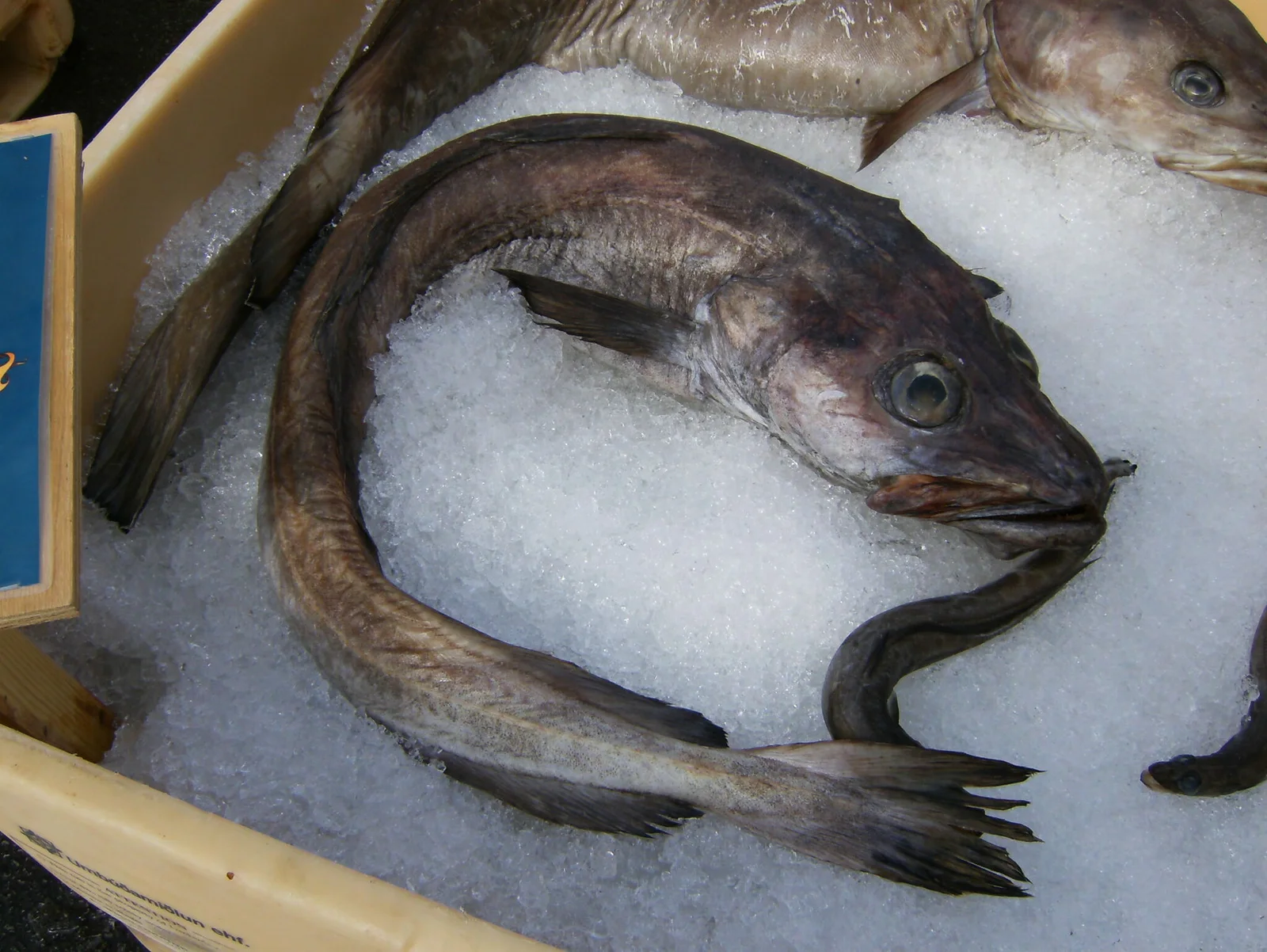
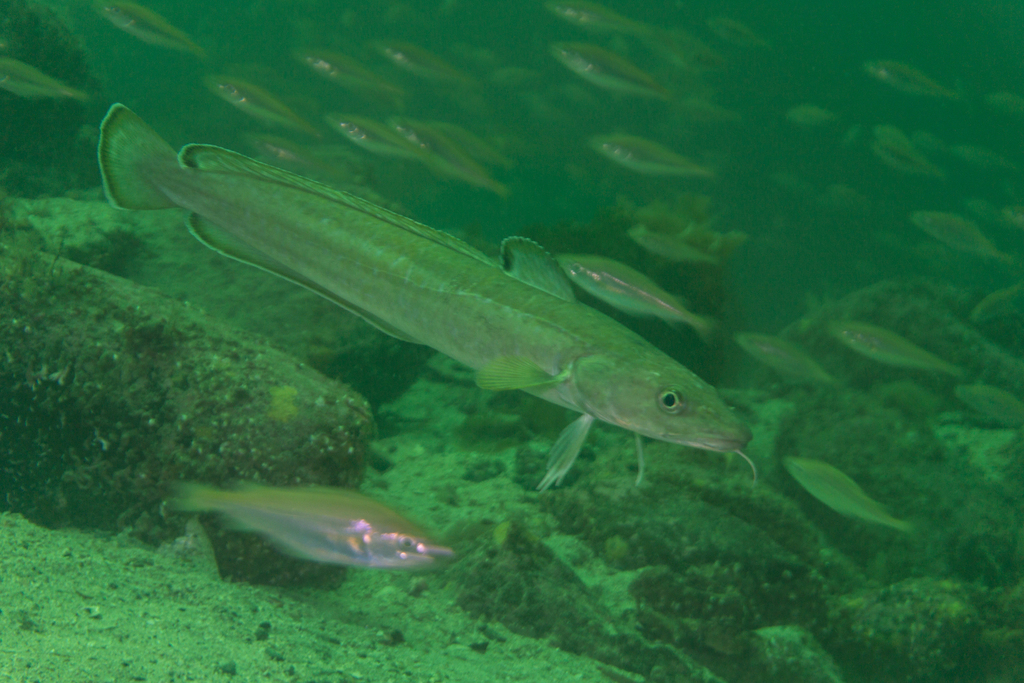
Blue ling is a large gadiform of the family Lotidae, built long and heavy enough to reach 155 cm and 30 kg. It ranges across the Northeast Atlantic from the Barents Sea and Iceland down to Morocco and into the western Mediterranean, with an isolated western record off Newfoundland. Most of its depth range is 350–500 metres, deeper than typical sport gear. FishBase records commercial fishing only and no gamefish use, so it is a commercial catch rather than an angling target. No IUCN assessment is listed.
One species, two ocean blocks
Blue ling is Molva dypterygia, a gadiform in the family Lotidae, order Gadiformes. Wikipedia describes it as a marine ray-finned fish of that family, present in the North Atlantic and the Mediterranean and commercially important. The distribution text splits the range into two blocks: a Northeast Atlantic one running from the southwestern Barents Sea and Spitsbergen through southeastern Greenland and southern Iceland, around the British Isles, south to Morocco and into the western Mediterranean; and a Northwest Atlantic entry at Newfoundland. An ocean sits between them and the capture treats them as the same species.
No English vernacular other than Blue ling is carried, and iNaturalist uses the same words. Chinese is , with as the traditional-character writing. The epithet dypterygia is not explained anywhere in the capture.
Counts that stop at the anal fin
Only the anal fin is quantified: zero spines and 70–81 soft rays. The dorsal fin counts are blank, and separately the non-fin fields for vertebrae, body shape and cross-section are also blank. A 70–81 ray count is high and fits a long-based anal fin, the sort ling and some deep-water gadids carry. With no dorsal count and no vertebral count, that single number is as far as the record can key the fish.
Saying so plainly matters, because it fixes what the page can do. Entries built from this capture describe size, depth and range with confidence and describe shape hardly at all. A reader holding a ling should not expect this page to separate the fish from a close relative in Molva; the capture never claims to.
Twenty-five country entries
The country table lists twenty-five entries: Albania, Algeria, Belgium, Bosnia and Herzegovina, Canada, Croatia, the Faroe Islands, France, Gibraltar, Greenland, Iceland, Ireland, Italy, Malta, Montenegro, Morocco, Norway, Portugal, Russia, Slovenia, Spain, Svalbard and Jan Mayen, Sweden, Tunisia, and the United Kingdom. The table carries no native or introduced flag, so this page does not classify them.
The list maps the Northeast Atlantic margin plus a single Canadian row, and that matches the text. Two entries deserve a note. Bosnia and Herzegovina is not an Atlantic state; its presence in a marine table depends on how the short Adriatic coast is counted. Canada appears once, for Newfoundland, the only Northwest Atlantic record. Both are artefacts of country aggregation, not separate populations.
The 350–500 metre band
The environment line reads marine, demersal, non-migratory, depth 150–1000 m, usually 350–500 m, temperate, 79°N–29°N and 65°W–44°E. Demersal and non-migratory together describe a fish that stays on or near the bottom inside a fixed band. The usual range is far narrower than the extremes, and it is the number that matters when looking for fish.
The bottom is reduced to one keyword: muddy. Diet is crustaceans and fishes. No temperature figure is carried, so the thermal envelope has to be inferred from latitude, which reaches from the Arctic to 29°N in the subtropics. A species present across that span on a single bottom type is not tied to one water mass.
Nothing in the record separates the two ocean blocks by depth or temperature. The Newfoundland entry is a country row and nothing more, so whether the western fish live at the same 350–500 m is unknown here.
Two spawning calendars, one species
Five spawning rows are carried. The Mediterranean runs January to March. The North Atlantic, Norway, southern Iceland and western Scotland all run April to May. The species therefore has an early window in the south and a later one in the north, and the two do not overlap.
The rows are few and coarse. Four of the five are labelled by sea area or by country, and none names a locality finer than a coast. Whether Mediterranean fish start in January because the water is warmer or because the population is a separate stock, the capture does not say. What it does establish is that a single "spring" label would misplace the southern rows by two months.
Eighty-six centimetres to first maturity
Maximum length is 155 cm TL, maximum weight 30.0 kg, maximum age 20 years. First maturity is 86.5 cm, with the range printed as "? – 88 cm". No common length is recorded.
The maturity figure needs care. A range whose lower bound is missing and whose upper bound sits just above the stated value is not really a range; it reads as one measured point and one loose ceiling. Either way, maturity at 86.5 cm against a 155 cm maximum means the species breeds at a little over half its length, which is late for a gadid. Twenty years and 30 kg fit that slow schedule. No growth curve is supplied, so the age at first maturity remains unknown.
Eleven records on a map that should hold more
GBIF returns eleven distribution rows for usage key 5214883: four without a country code, Norway 3, Sweden 2, Denmark 1, Ireland 1. iNaturalist holds eleven observations. For a fish fished commercially across 25 countries and territories, both figures are very small.
This is recording effort, not rarity. A species living at 350–500 m is seldom photographed and seldom submitted to a citizen-science platform; a trawl catch is not an observation. The rows that exist cluster in the North Sea and along the Norwegian coast, where survey coverage is dense. The page should cite the structured range and resist reading the map as the limit of the fish.
Fishing a species with no assessment
Blue ling is listed as commercial, with no gamefish tick and no aquaculture entry. IUCN has not assessed it (Not Evaluated); neither CITES nor CMS lists it. There is no assessment date to quote.
That absence frames the practical advice honestly. Depth is the usable variable: 350–500 m as usual, 150–1000 m at the extremes, over mud. A boat working that band for ling is doing what the record describes, and it will not find a regulation summary on this page, because none was captured. The entry can say where the fish lives and how large it grows; the rest belongs to national rules and to skippers who know the grounds.
Regulations before you keep it
These are the published regulations for this fish. Read the number first. The notice below it is the actual regulation.
Minimum size3
The minimum size for Blue ling in Spain is ≥70 cm.
| Maruca Azul (Molva dypterygia) | 70 |
The minimum size for Blue ling in France is ≥70 cm.
| LINGUE BLEUE | Molva dipterygia | 70 cm |
≥70 cm
United Kingdom · UK
The minimum size for Blue ling in UK waters is ≥70 cm.
| Blue ling | Molva dipterygia | 70 cm |
Every record above names its source and the date it was retrieved. See the regulation register for the full list, or how to read these regulations.
Where these facts come from
Check these pages before you rely on a size, range or protection status.
-
FishBase — Molva dypterygia
— FishBase · T2
-
GBIF — Molva dypterygia occurrence records
— GBIF · T2
-
IUCN Red List — Molva dypterygia
— IUCN · T1
-
Photo record — iNaturalist
— iNaturalist · T3