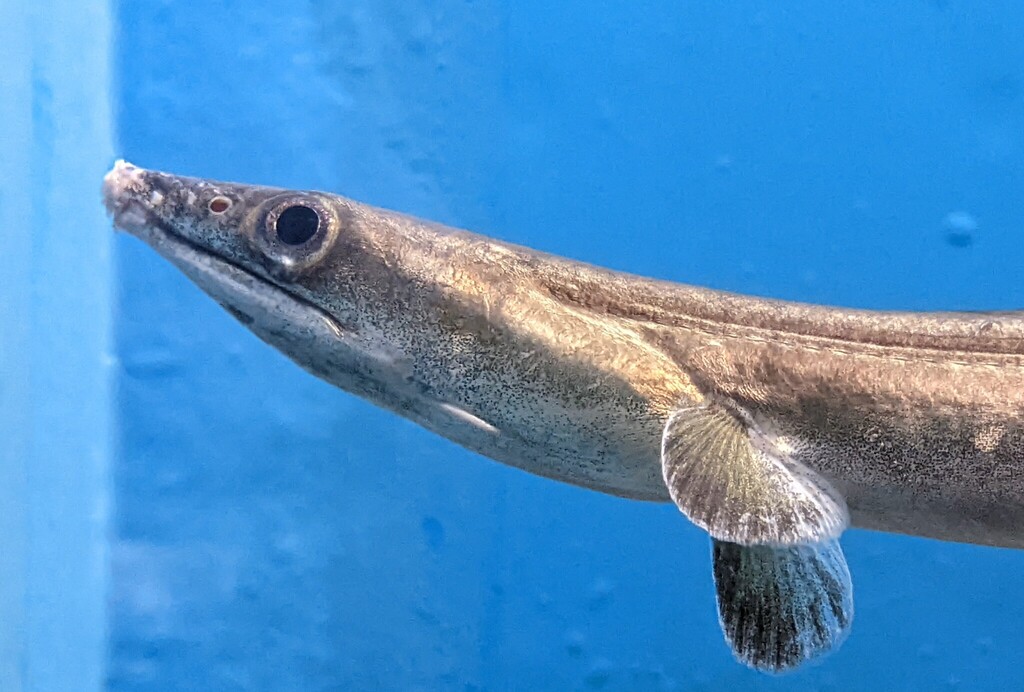
Japanese pike eel (Muraenesox cinereus) is a fish of the family Muraenesocidae. FishBase gives its range as: Indo-West Pacific: Red Sea, Persian Gulf, west coast of India, and Sri Lanka to Fiji and Tuvalu, north to Japan and Korea, south to the Arafura Sea and northern Australia. Migrated to the Mediterranean via the Suez Canal. It is recorded shallower than 800 m, in subtropical water. The recorded maxima are 220 cm TL, 15 years. Common length is recorded at 80 cm. Diet includes crustaceans and fishes. IUCN status: Least Concern (LC). Chinese name: .
Identification
The species belongs to the family Muraenesocidae. FishBase's morphology record gives 145-159 vertebrae. These are identification aids rather than a complete diagnosis; the accompanying photographs show the live colour pattern.
Habitat and behaviour
It is recorded in marine and brackish and freshwater water, with a demersal mode, a recorded depth range down to 800 m and a subtropical climate. Habitat notes mention estuary, freshwater. Diet records mention crustaceans, fishes. These are source records, not a guarantee that the same habitat exists at every local mark.
Seasonal window
FishBase's spawning table lists records in Jan, Feb, Aug, Sep, Oct, Nov, Dec for India. This is a spawning record, not a fishing-season forecast; check the local season, weather and regulations before planning a trip.
Gear and approach
Match hook, leader and drag to a fish that can reach 220 cm. Use tackle that can present the bait or lure at the deeper end of the recorded range. No exact gear ratings are published here because they are equipment choices, not source facts. Adjust the terminal tackle to the bait or lure you can obtain locally.
Edibility and regulations
FishBase's human-use record lists Fisheries use: highly commercial; aquaculture: commercial; gamefish: yes. The species is marketed as food. The IUCN Red List category is LC (Least Concern), assessed 13 November 2019. Threat to humans: Harmless. CITES: Not Evaluated; CMS: Not Evaluated. No official regulation text was verified for this draft. Check the current national and local fisheries rules, size limits and closed seasons before keeping catch.
Where to look
For trip planning: GBIF holds 1,251 preserved occurrence records for the matched taxon; the largest country and territory counts are AU (379), JP (165), KR (130), TW (120), CN (72); FishBase territories include Australia, Bahrain, Cambodia, China, Fiji, Hong Kong SAR, India, Indonesia; the sea regions represented are Mediterranean Sea; habitat keywords point to estuary. These are distribution and habitat signals, not spot coordinates; use them to narrow the search, then check local access and conditions.
How to catch it
Boat bottom fishing
Anchored or drifting boat, bait or lure worked near the recorded bottom.
Night fishing
Night session; coastal feeding activity often changes after dark.
Regulations before you keep it
These are the published regulations for this fish. Read the number first. The notice below it is the actual regulation.
Minimum size2
Anal length ≥250 mm
China — Fujian · CN-FJ
Fujian commercial catch standard (Fujian Fisheries Notice 2018 No. 114): the minimum catch size for daggertooth pike conger is anal length ≥ 250 mm; smaller individuals count as juveniles. The notice does not address recreational angling, so whether an angler must release an undersized fish depends on the local fisheries authority.
Weight ≥500 g, or anal length ≥275 mm
China — Zhejiang · CN-ZJ
Zhejiang commercial catch standard (Zhejiang Fisheries Notice 2015 No. 7): the catch size for daggertooth pike conger is ≥ 500 g, or anal length ≥ 275 mm, applied as either a weight or a length threshold. The notice does not address recreational angling, so whether an angler must release an undersized fish depends on the local fisheries authority.
Fujian and Zhejiang tiers both apply: Fujian anal length ≥250 mm, Zhejiang ≥275 mm; the stricter (≥275 mm) governs.
Season / closure1
From 12:00 on May 1 to 12:00 on September 1, September 16 or August 16, depending on the area
China — national · CN-NATIONAL
All Chinese coastal waters (MAR Notice 2023 No. 1): the summer moratorium starts at 12:00 on 1 May and ends at 12:00 on 1 September, 16 September or 16 August depending on the sea area, and applies to capture operations. All gear types except hook-and-line are closed; rod-and-line fishing is outside the moratorium gear list, but hook-and-line vessels must still report port entry and exit, and coastal provinces may adopt stricter measures.
The closure has three area-based windows, all starting at 12:00 on May 1 and ending at 12:00 on September 1, September 16 or August 16.
Every record above names its source and the date it was retrieved. See the regulation register for the full list, or how to read these regulations.
Where these facts come from
Check these pages before you rely on a size, range or protection status.
-
FishBase — Muraenesox cinereus
— FishBase · T2
-
GBIF — Muraenesox cinereus occurrence records
— GBIF · T2
-
IUCN Red List — Muraenesox cinereus
— IUCN · T1
-
Photo record — iNaturalist
— iNaturalist · T3