
Starry smooth-hound
The starry smooth-hound is a small northeast Atlantic shark of the family Triakidae. FishBase gives a maximum length of 154 cm TL, a maximum published weight of 4.8 kg and a length at first maturity of 81 cm, and places the species from the British Isles and the North Sea south to the Canary Islands, including the Mediterranean and Mauritania.

The starry smooth-hound is a small northeast Atlantic shark of the family Triakidae. FishBase gives a maximum length of 154 cm TL, a maximum published weight of 4.8 kg and a length at first maturity of 81 cm, and places the species from the British Isles and the North Sea south to the Canary Islands, including the Mediterranean and Mauritania. It is a bottom-living shelf shark, recorded from the intertidal down to 350 m, taken commercially and as a gamefish.
Identification
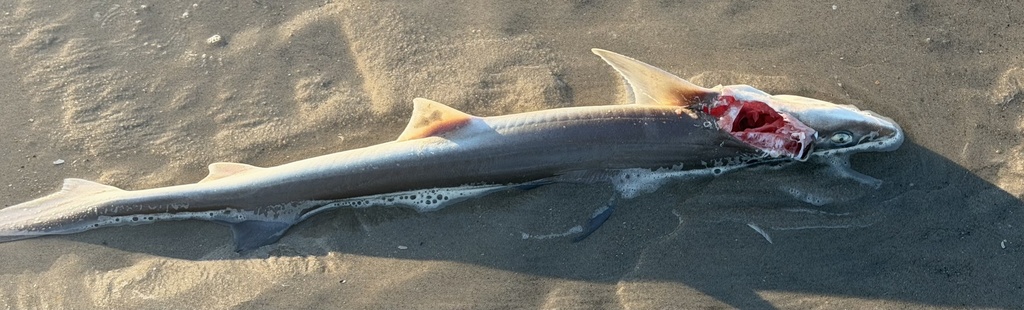
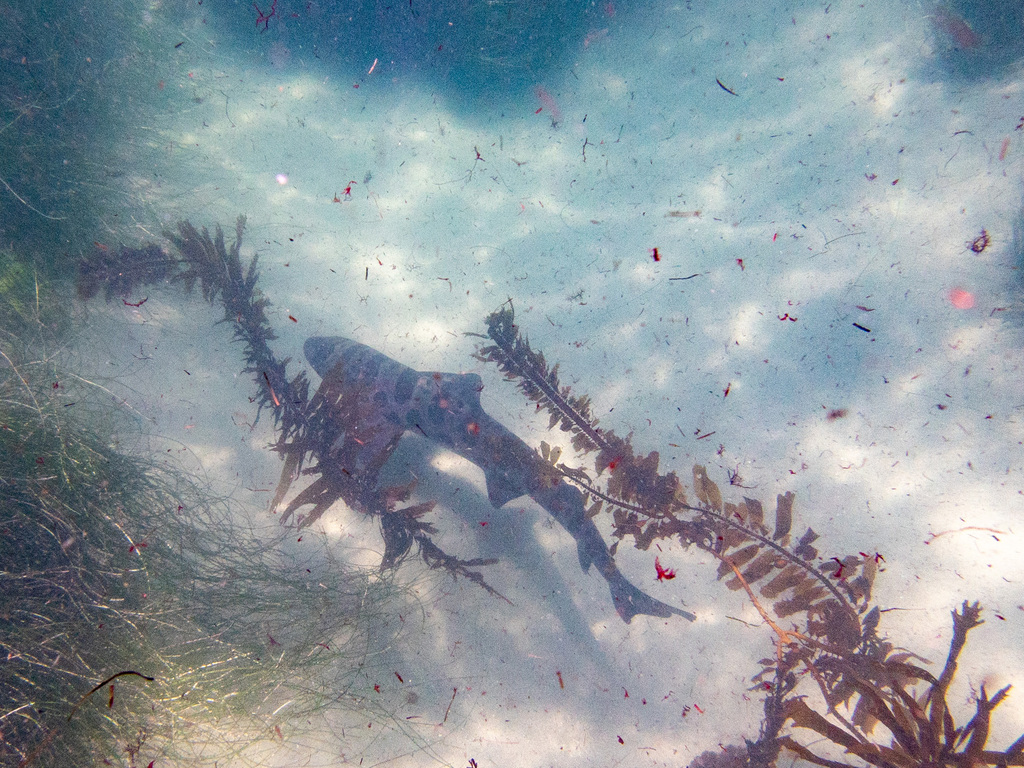
Smooth-hounds are recognised by family characters rather than a single mark: two dorsal fins, neither preceded by a spine; an anal fin; a blunt snout; eyes with a nictitating membrane; and a mouth set under the head, filled with small, pavement-like teeth. FishBase records no fin formula or body shape for this species, so no counts are quoted here. Identification rests on those characters, on photographs, and on the mark the name refers to: a grey-brown upper surface scattered with small white spots. The common smooth-hound is plain grey-brown without them, and the two overlap over much of the range. The belly is pale. Where several Mustelus occur, check dorsal-fin positions and snout shape against a regional guide.
Habitat and behaviour
FishBase describes a common inshore and offshore shark of the continental shelves, from the intertidal down to at least 100 m, preferring sandy and gravelly bottom; the recorded range extends to 350 m. The diet is dominated by crustaceans — crabs, hermit crabs, lobsters and slipper lobsters — which fits a shark that works close to the seabed rather than hunting in midwater. Reproduction is ovoviviparous and aplacental, with 7 to 15 young per litter and a size at birth of about 30 cm.
That depth span is consistent with a shark that shifts between shallow and deeper ground rather than staying in one place. Anglers meet it most often over clean sand and mixed gravel, and the fish in the surf and at estuary mouths tend to be the smaller, younger ones.
Seasonal window
FishBase's spawning table carries no months for this species, so there is no published spawning month to quote. The reproductive data — 7 to 15 young per litter, about 30 cm at birth — describe the species but do not fix the timing.
The practical window is set by water temperature and by where the sharks feed. Along Britain, Ireland and the North Sea coast the fish are most available from late spring through autumn, when shallow sand warms and crab activity picks up; the Iberian and Mediterranean parts of the range fish for longer. On the beach, the moving tide matters more than the hour: a flooding tide over sand banks and the first of the ebb through a gully are the classic times, and a calm night after a settled day often beats bright midday. None of that is a guarantee. A cold snap or a week of onshore wind pushes fish off the shallows, and the same mark can go quiet for days.
Gear and approach
A shore rod of 2.7–3.3 m rated for 2–4 oz, a 5000–6000 size reel, 20–30 lb braid and a 40–60 lb mono leader will handle everything likely from the beach. The teeth are small pavement plates, so heavy mono is usually enough and wire is rarely needed. Fish a running ledger with a 3–6 oz grip lead, heavy enough to hold in a running sea without dragging. Circle hooks in 2/0–4/0 set in the corner of the mouth and make release easier than J-hooks.
Fresh peeler crab is the classic bait; hermit crab, whole squid, mackerel fillet and sandeel all work, and a cocktail of crab and fish holds a scent trail longer. The take is usually a steady pull rather than a rattling bite — tighten down and let the rod load instead of striking hard.
Handling matters more than the fight. Wet your hands or use a mat, support the body with one hand under the belly and one at the pectoral fins, and never lift a smooth-hound by the tail or through the gills. Keep it out of the air briefly, and if it is going back, release it without dragging it over dry sand.
Edibility and regulations
FishBase records the species as both a commercial catch and a gamefish, used fresh and dried salted. The flesh is firm and white, good fried or in soup; bleed and chill the fish promptly, and skin it if the ammonia note that some sharks develop is a concern.
The IUCN Red List category is NT (Near Threatened), assessed on 4 August 2020. FishBase records no CITES or CMS listing, and the species is harmless to humans. A shark producing 7 to 15 pups at a time is not a fast rebuild, so release large females where allowed.
Rules differ by jurisdiction. In EU waters there is no minimum conservation reference size listed for Mustelus asterias, no EU-wide closed season verified and no EU-wide recreational bag limit verified; commercial TAC rules may still apply. In the United Kingdom, the UK MCRS table (updated 3 February 2026) does not list the starry smooth-hound, and no species-specific closed season or bag limit was verified, though IFCA byelaws can add local conditions. In France (DDTM/OFB), Spain (autonomous-community rules), Portugal (DGRM), Ireland, the Netherlands and Belgium, follow any applicable EU MCRS; otherwise no species-specific minimum was verified, and national or regional rules decide.
Where to look
GBIF holds 35,361 occurrence records for the matched taxon, led by Great Britain (18,207), France (12,236), Ireland (2,191) and the Netherlands (855), with smaller counts from the Isle of Man (620), Guernsey (293), Norway (249), Belgium (232), Jersey (101) and Germany (97). FishBase's distribution runs from the British Isles and the North Sea to the Canary Islands, and the habitat keywords are sandy and coastal.
Read those numbers as a picture of where records come from, not as a list of marks. The fish is caught over clean sand, mixed gravel, surf troughs and estuary mouths. Check access, tides and local rules for the stretch in front of you.
How to catch it
Boat bottom fishing
Fished with the listed approach, matched to the recorded depth and size.
Shore casting
Fished with the listed approach, matched to the recorded depth and size.
Where these facts come from
Check these pages before you rely on a size, range or protection status.
- FishBase — Mustelus asterias — FishBase · T2
- GBIF — Mustelus asterias occurrence records — GBIF · T2
- IUCN Red List — Mustelus asterias — IUCN · T1
- Photo record — iNaturalist — iNaturalist · T3
Fish in the same water
These fish live in the same place.

Guides for this water
Technique, gear and safety guides that fit Starry smooth-hound.