
Rig
Rig is a houndshark, not a bony fish. It is also called the spotted estuary smooth-hound; it belongs to the family Triakidae and is found on the continental shelves and in estuaries around New Zealand. The species is recorded from the surface to 860 m, usually within the top 400 m. FishBase also lists gummy shark and spotted dogfish among its English names.
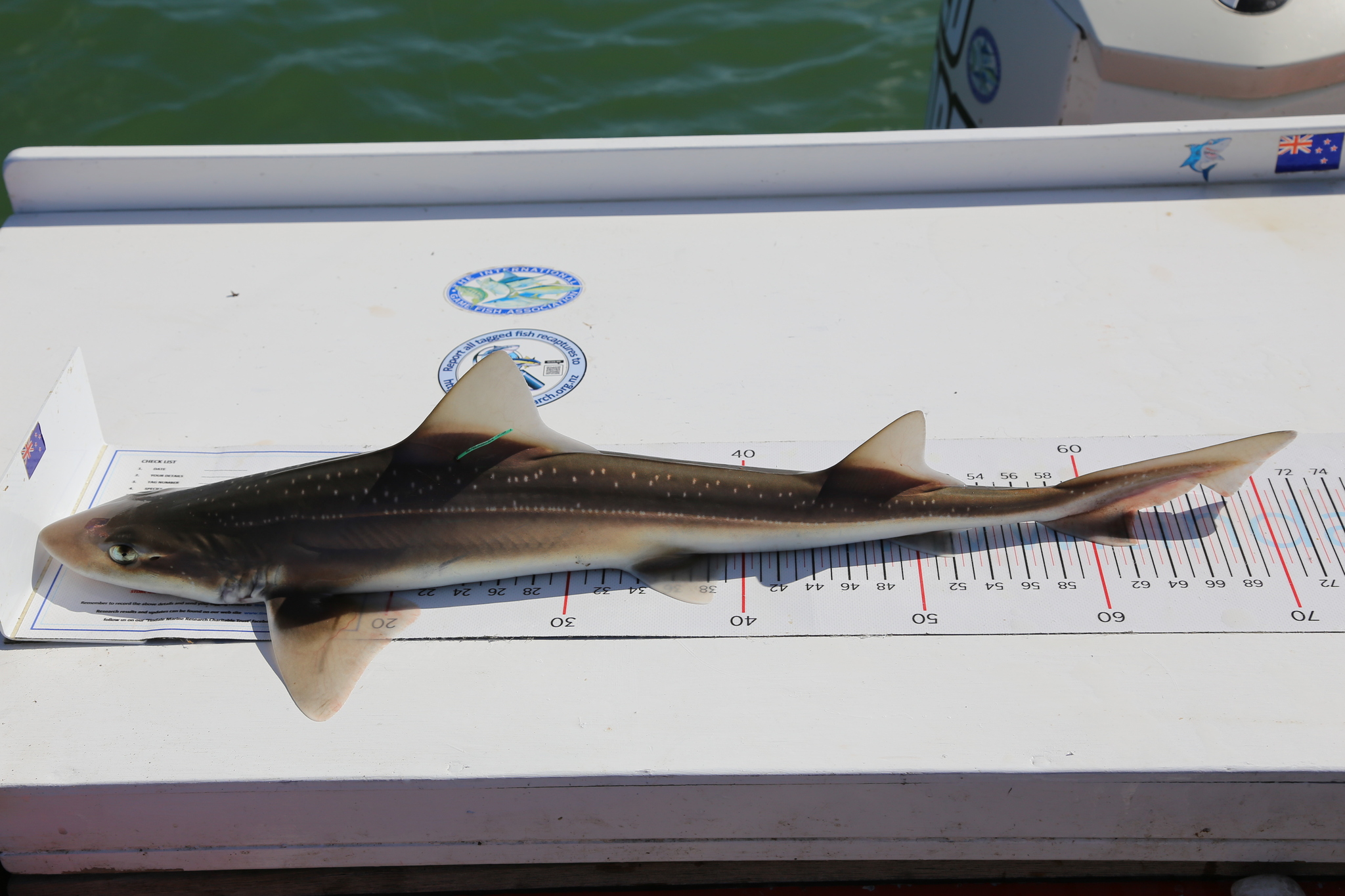
Rig is a houndshark, not a bony fish. It is also called the spotted estuary smooth-hound; it belongs to the family Triakidae and is found on the continental shelves and in estuaries around New Zealand. The species is recorded from the surface to 860 m, usually within the top 400 m. FishBase also lists gummy shark and spotted dogfish among its English names.
Two maximum lengths, one species
Males reach 125 cm TL and females 151 cm TL; the common length is 85 cm TL. No maximum weight and no maximum age are published. Maturity is estimated at 90.9 cm, with a range of 79–100 cm.
The common fish is 5.9 cm below the maturity estimate but inside the range, which starts at 79 cm. So an 85 cm rig may be mature; the page does not give a size at which every fish is mature, and the top of the range, 100 cm, is the only upper marker. The 26 cm gap between the male and female maxima is the only sex split in the size data.
A shark that eats crabs
The diet is crustaceans, especially crabs. The species is found on insular shelves, often close inshore. The habitat keyword is coastal. The depth range is 0–860 m, usually 0–400 m.
The 860 m figure is a record, not a fishing depth; the usual band starts at the surface and ends at 400 m. A crab-eating shark over sand and in estuaries fits the shallow end of that band. No feeding time and no prey other than crustaceans are recorded.
It is ovoviviparous
FishBase records the species as ovoviviparous. The eggs hatch inside the female, and the page gives no litter size and no gestation period. That is live-bearing with internal egg development, not egg-laying.
No female-specific maturity length is given; the 90.9 cm estimate is combined. With females reaching 151 cm and males 125 cm, the combined figure describes a midpoint rather than either sex.
One tag, 1,160 km
The species makes seasonal inshore-offshore movements and extensive coastal migrations; one tagged female moved at least 1,160 km. It is recorded as oceanodromous. It forms schools separated by size and sex.
A 1,160 km movement means a local mark is not a resident population. The page publishes no migration season, so neither the direction nor the timing of the movement is given. The size-segregated schools also mean a mark can hold one sex and one size class.
September to February, with a gap
The spawning months are January, February, September, October, November and December. The regional rows are New Zealand insular shelves in January, February and December, and Kaikoura and Nelson in September–November.
The union is six months, and March to August is blank. Two rows, both New Zealand, cover different coasts and different parts of the window. No temperature figure is published, so the window cannot be tied to a degree value.
5,026 of 5,045 records are New Zealand
FishBase gives the range as Kermadec Islands and New Zealand, with a report from southern Australia. GBIF holds 5,045 records: 5,026 from New Zealand, 6 from Indonesia, 2 from Australia, 2 from Malaysia, 1 from Ecuador, 1 with no country and 7 from other countries.
The Australian total of two records is thin support for "reported from southern Australia". The Indonesian and Malaysian records sit far outside the stated range. The New Zealand total is the distribution; everything else is an edge case.
Shore and boat, both mainstream
Shore casting and boat bottom fishing are both mainstream. The terrain list is sandy bottom, estuary and coastal. The methods fit a shark that feeds on crabs in shallow water.
A 151 cm female is the upper bound and no weight is published, so a rig is built around length rather than mass. The page gives no hook, trace or line specification. The 85 cm common length is the number most fish will meet. Sandy bottom and estuary are both shallow ground, described from two angles.
Clicks, a 2025 finding
Wikipedia records that in 2025 rigs were found to be the first known shark species capable of active sound production, described as clicks. That is a single encyclopedic statement, and it does not change handling. The extract does not say what the clicks are used for. It is a research finding, not a fishing rule.
The same source gives males at 125 cm and females at 151 cm, matching FishBase. It also calls the species a houndshark of the family Triakidae, which is the classification the page uses.
Least Concern in 2017, and a managed catch
The IUCN category is Least Concern, assessed on 22 June 2017. Human uses record a commercial fishery and gamefish. CITES and CMS are both Not Evaluated, and the species is harmless to humans. A 2017 assessment is dated, and the page publishes no stock trajectory. For a species with a commercial catch and a gamefish rating, it is the only assessment on the page.
In New Zealand, MPI sets the amateur saltwater rules: daily bag limits, minimum sizes, method restrictions and accumulation limits, applied by fishery management area (FMA). Marine reserves under the Marine Reserves Act 1971 are no-take, and Hauraki Gulf, Fiordland and Marlborough Sounds carry additional rules, as do temporary closures and rāhui.
No bag number, size limit or closure date is given here, and the page publishes no national size limit to set against the 90.9 cm maturity estimate. Check the current rule for the FMA and the reserve map before the trip.
Where these facts come from
Check these pages before you rely on a size, range or protection status.
- FishBase — Mustelus lenticulatus — FishBase · T2
- GBIF — Mustelus lenticulatus occurrence records — GBIF · T2
- IUCN Red List — Mustelus lenticulatus — IUCN · T1
- Photo record — iNaturalist — iNaturalist · T3
Fish in the same water
These fish live in the same place.

Guides for this water
Technique, gear and safety guides that fit Rig.