
Narrownose smooth-hound
*Mustelus schmitti*, the narrownose smooth-hound, is a small Triakidae of the southwest Atlantic shelf, recorded from southern Brazil to northern Argentina. It reaches 92 cm TL, matures at 58.3 cm and pups 2–7 young at 26 cm. In 2019 IUCN assessed it as Critically Endangered, and the CMS proposal behind that assessment records a decline of more than 80 percent.
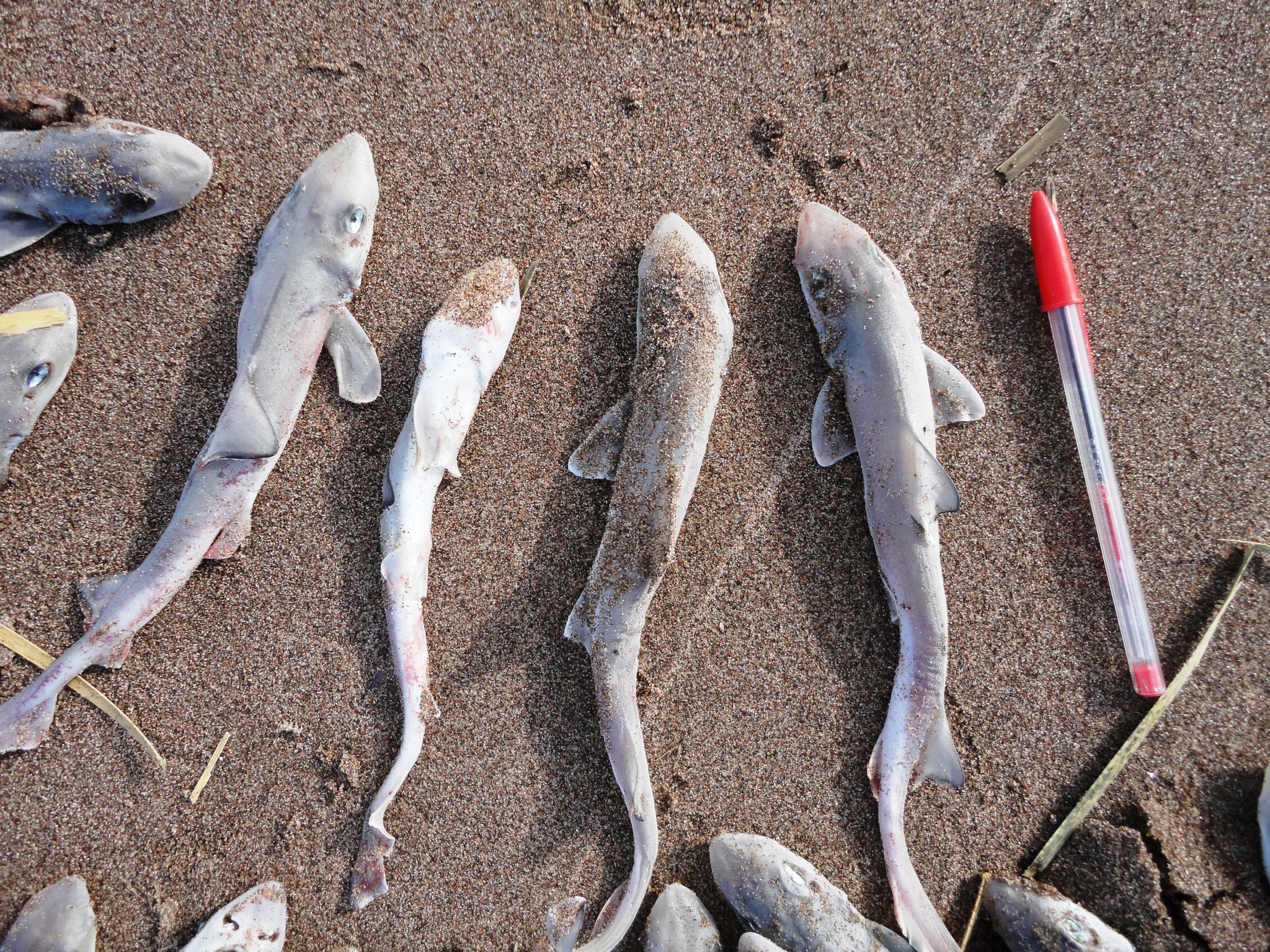
*Mustelus schmitti*, the narrownose smooth-hound, is a small Triakidae of the southwest Atlantic shelf, recorded from southern Brazil to northern Argentina. It reaches 92 cm TL, matures at 58.3 cm and pups 2–7 young at 26 cm. In 2019 IUCN assessed it as Critically Endangered, and the CMS proposal behind that assessment records a decline of more than 80 percent. Brazil prohibits its capture and commercial use. This is the strongest conservation case in this group of species, and the page gives it the space.
Identification
FishBase gives no fin counts, no colour description and no dental formula for this species. The only morphological handle on the page is the common name: a narrow snout on a small, plain shark. That is thin material for field identification, and it matters because the animal is a shark with look-alike relatives in the same water.
The size figures are the working identifiers. Maximum length is 92 cm TL, common length 60 cm, and the length at maturity is 58.3 cm with a reported range of 55–62 cm. The summary on the iNaturalist page gives 74 cm as the maximum, which conflicts with FishBase's 92 cm; the two are not reconciled and the higher figure is used here because it comes from the species page.
No weight is recorded. Maturity at 58.3 cm against a 92 cm maximum means the species matures late relative to its size and leaves only 34 cm of adult growth, which is the shape of a slow reproducer.
Range and habitat
The distribution text is short: southern Brazil to northern Argentina. The environment line adds marine, demersal, oceanodromous, 60–195 m, subtropical, between 28°S and 45°S. The word oceanodromous is the important one: this is a shark that migrates, not a resident of one bay.
GBIF returns 1,607 present records, 1,410 from Argentina, 128 from Brazil and 13 from Uruguay; iNaturalist carries 28 observations. The Argentine share is 88 percent, and the Brazilian share is small even though the range text starts there. That asymmetry may reflect fishing pressure and reporting rather than abundance, but the page does not say.
Habitat is given as the continental shelf, within the 60–195 m band. No substrate, no salinity and no nursery description appear on the FishBase page.
Habits and diet
Diet is recorded only in outline: crabs and probably other crustaceans, presumably small fishes. The page uses "probably" and "presumably", and that hedging is reproduced here rather than resolved.
Reproduction is better documented. The species is ovoviviparous with aplacental development, bearing 2–7 pups, with a size at birth of 26 cm. Length at maturity is 58.3 cm. Two to seven young per cycle is a low output for a fish that is taken in commercial quantities, and it is the biological fact behind the conservation status.
FishBase's own spawning section holds no record for the species. The seasonal reproduction and migration detail used below comes from the CMS proposal, not from a spawning table.
Season and time of day
The CMS proposal gives the seasonal structure: a northern migration from April to November, and southern pupping grounds from December to April. Those are the months to plan around, and they are also the months in which the species is most exposed, because a migration and a pupping season put fish in predictable places.
FishBase itself carries no spawning record, so the CMS dates are the only seasonal information here and should be attributed to that document rather than to a general reference.
Time of day is not recorded. An inference, labelled as one: a 60–195 m demersal shark feeding on crabs and other crustaceans is likely to be most catchable when crustaceans move over open bottom, which in shallow water is the low-light period. At 60–195 m the light argument weakens, and the page gives no diel data to settle it.
Tackle and techniques
At 60–195 m, this is a boat fishery; a shore rod does not reach the band. The page records no method, gear or bait, so the rig must be reasoned from depth, diet and size.
Diet points to crab and crustacean bait, which is inference from the diet line rather than a recorded practice. The size range, 60 cm common and 92 cm maximum, sets a trace that can hold a shark of roughly ten kilograms; the page gives no weight, so that figure is an estimate from length and should be treated as such.
Handling is the part that matters most. A Critically Endangered shark that is prohibited in Brazil and size-limited in Argentina should be released unharmed wherever the law allows capture at all. That means a wire or heavy mono trace cut close to the hook, no lifting by the gills, and no time out of the water beyond a measurement.
Because FishBase gives no fin counts or colour, a captured shark should be photographed and measured rather than assigned to species from memory.
Kitchen and handling
FishBase records the species as highly commercial and utilized for human consumption, with no price, no quality note and no culinary description. There is no weight on the page, so no kilogram grade can be built.
The market picture is split by country. In Brazil, capture and commercial use are prohibited, so a Brazilian kitchen should not be sourcing this fish at all. In Argentina it is landed and sold, and the Buenos Aires recreational rule sets a 60 cm minimum. That minimum sits 1.7 cm above the 58.3 cm length at maturity, which means a legally kept fish is barely an adult and may not have pupped once.
Nothing is recorded about bleeding, storage or cuts. The handling advice that follows from the status is simpler than a culinary note: release the fish.
Regulations and conservation
IUCN lists the species as Critically Endangered, assessed on 1 July 2019. The CMS proposal records a decline of more than 80 percent and names the Brazil prohibition among the responses. The FishBase page gives no trend, no stock estimate and no regional breakdown.
Brazil: capture and commercial use are prohibited under MMA Portaria 148/2022. A recreational angler should treat the species as no-take and release any gatuzo caught; the prohibition is the clearest rule in this group of species.
Argentina, Buenos Aires Province: a recreational licence is required and gatuzo has a 60 cm minimum. No species-specific bag number for gatuzo was located. Other provinces and national waters differ.
Uruguay: DINARA sets the permit conditions and no species-specific recreational size or bag number for gatuzo was located.
The mismatch is the story. A species assessed as Critically Endangered with an 80 percent decline is prohibited in one range state, allowed at 60 cm in another, and has no located species number in the third. The 60 cm Argentine minimum is 1.7 cm above maturity.
How to catch it
Boat bottom fishing
Fished with the listed approach, matched to the recorded depth and size.
Shore casting
Fished with the listed approach, matched to the recorded depth and size.
Where these facts come from
Check these pages before you rely on a size, range or protection status.
- FishBase — Mustelus schmitti — FishBase · T2
- GBIF — Mustelus schmitti occurrence records — GBIF · T2
- IUCN Red List — Mustelus schmitti — IUCN · T1
- Photo record — iNaturalist — iNaturalist · T3
Fish in the same water
These fish live in the same place.

Guides for this water
Technique, gear and safety guides that fit Narrownose smooth-hound.