
Bat ray
Almost nobody targets a bat ray. It arrives as bycatch while someone waits for a halibut on sand, and because it is not the target it is the fish most often dragged up dry, grabbed by the tail, or left on the beach too long. This entry is about release, not recipes. The pair of cephalic fins in front of the eyes is what separates it from a skate.
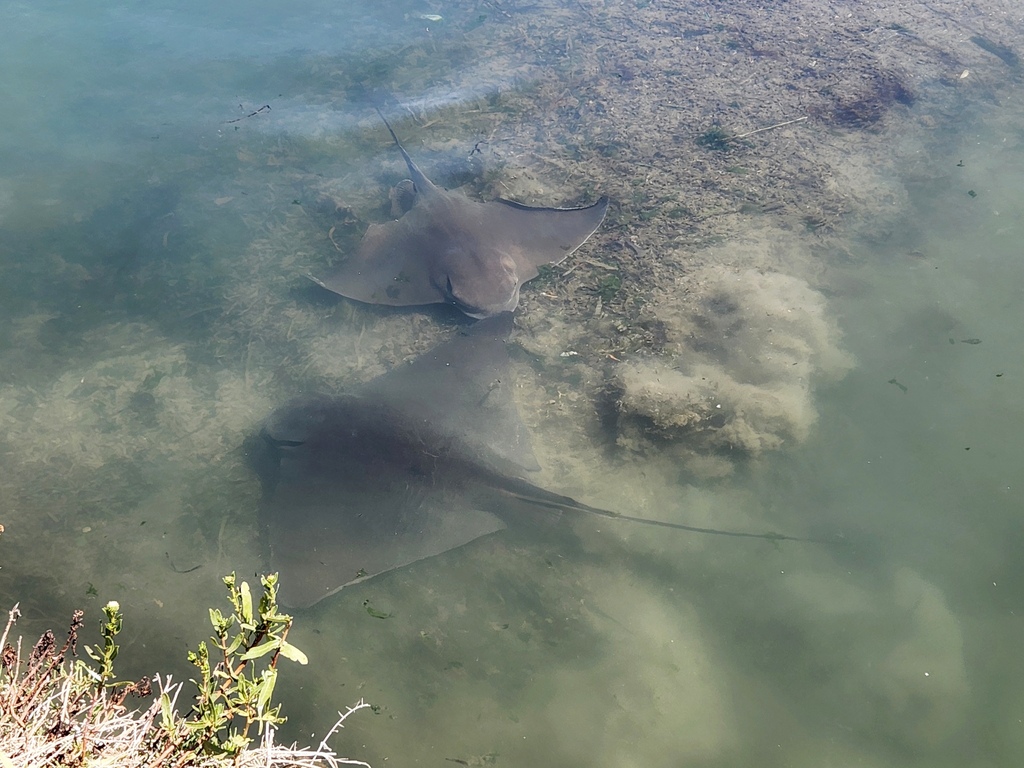
Almost nobody targets a bat ray. It arrives as bycatch while someone waits for a halibut on sand, and because it is not the target it is the fish most often dragged up dry, grabbed by the tail, or left on the beach too long. This entry is about release, not recipes. The pair of cephalic fins in front of the eyes is what separates it from a skate.
Cephalic fins are the difference from a skate
The disc is wider than it is long and roughly diamond-shaped, with pectorals that sweep forward like wings. The tail is a long thin whip carrying a venomous spine near its base. The decisive mark is at the front: two projecting cephalic fins sit ahead of the eyes like a pair of small horns, the signature of the eagle rays. Skates and other rays have no cephalic fins and much thicker tails. The back runs grey-brown to dark brown over a white belly, sometimes blotched. FishBase gives a maximum disc width of 180 cm, a common width of 100 cm and a published maximum weight of 82.1 kg.
Sand and mud, from the bay to the kelp edge
FishBase runs the range from Oregon to the Gulf of California, with the Galápagos included. The ray works over sand and mud from the surface to 108 m, commonly in bays, tidal channels and soft bottom outside river mouths, and also over rock and along the edge of kelp, sometimes burying itself in sand. In Southern California the catch comes from the back of a bay, sand outside a pier and the flat inside a breakwater, and night fishing over shallow sand finds more of them. They travel alone or in groups, and when a group is present several fish come in a row.
Warm months in the shallows
FishBase gives no month-by-month breeding table and notes only that the species is ovoviviparous. In Southern California the fishing follows the warming water, with the most activity in shallow bays from late spring through autumn and fewer fish in slightly deeper water through winter, where they still bite but less often. Night is more productive over shallow sand, and channel mouths after a falling tide are a regular spot. No preferred temperature is given, so judge by water colour and the way the flats warm; in one bay the gap between late spring and midsummer usually matters more than a change of mark.
Bycatch on a halibut rig, and how to avoid it
Most bat rays come on a rig meant for halibut or croaker: sand bottom, light lead, a squid strip or a whole sardine. To cut the bycatch, hold the bait a little off the bottom or avoid the flat where they gather. Once one is hooked, do not lean on light line. The force comes from a wide disc pivoting on the sand rather than from body weight, and a thin leader fails at the tail first. Let the fish stay on the bottom, walk it into shallow water, and handle it in the water instead of dragging it up the beach. If the hook is deep, cut the line.
Heavy line to shorten the fight, not to land it
Use 30 to 50-pound braid, a fluorocarbon leader of 40 pounds or more, and circle or single hooks rather than trebles. The heavy rod is there to shorten the fight, not to haul the fish ashore; a long fight is a long stress load. A landing net is pointless because no hoop holds that disc. Carry long pliers and line cutters, stand in shallow water, and wait until the fish settles before touching it. The tail can whip upward, so stay to the side of the fish rather than straddling the tail, and keep your feet off the disc.
Release rules that matter more than the bag
The flesh is edible but poorly regarded and most fish are released; the wings need fast handling or they turn ammoniac, so this is not a fish to recommend for the table. California covers the bat ray under the general bag in 14 CCR § 27.60: 20 fish of all species combined, no more than 10 of one species, with no size limit and no closed season. The part that matters is release. Do not drag it onto dry sand, do not lift it by the tail, and do not cut a hook out on the beach. The spine near the tail base is venomous and a wound needs medical care. Bays and piers often sit inside MPAs, so check the CDFW notice and the MPA map.
What the sources cover and what they leave to practice
The 180 cm disc width, the 100 cm common width, the 82.1 kg maximum, the 0 to 108 m depth, the Oregon to Gulf of California range, the sand and mud habitat, the ovoviviparous reproduction and the diet all come from FishBase; no maximum age is listed. IUCN has not assessed the species, so the entry records NE. The 20-fish aggregate with a 10-fish cap comes from 14 CCR § 27.60. The cephalic fins and the tail spine are field characters that FishBase's morphology section does not expand on, and the release method reflects common Southern California shore and boat practice rather than a written rule.
How to catch it
Shallow water release
Walk the fish into skinny water on the bottom, stand to its side, and only then unhook or cut free.
Boat bottom fishing
Lifting the bait clear of the sand cuts the number of rays hooked on a flat.
Heavy leader short fight
A 40-pound-plus leader ends the fight quickly instead of grinding it out on the bottom.
Where these facts come from
Check these pages before you rely on a size, range or protection status.
- FishBase — Myliobatis californica — FishBase · T2
- GBIF — Myliobatis californica occurrence records — GBIF · T2
- IUCN Red List — Myliobatis californica — IUCN · T1
- Photo record — iNaturalist — iNaturalist · T3
Fish in the same water
These fish live in the same place.

Acoupa weakfish
- Family
- Sciaenidae
- Depth
- 1–20 m
- Season
- Jan, Feb, Mar, Apr, May, Jun, Jul, Aug, Sep, Oct, Nov, Dec

American angler
- Family
- Lophiidae
- Depth
- 0–800 m
- Season
- Mar, Apr, May, Jun

American eel
- Family
- Anguillidae
- Depth
- 0–464 m
- Season
- Jan, Feb, Mar, May, Jun, Jul
Guides for this water
Technique, gear and safety guides that fit Bat ray.