
Blotcheye soldierfish
The fin counts are the quickest check: eleven dorsal spines with thirteen to fifteen soft rays, and four anal spines with eleven to thirteen soft rays. Four anal spines is the detail that separates it from most of the red fish sharing the same ledge. The lower jaw projects noticeably when the mouth is closed, and the lower half to three-quarters of the inner pectoral axil carries small scales.
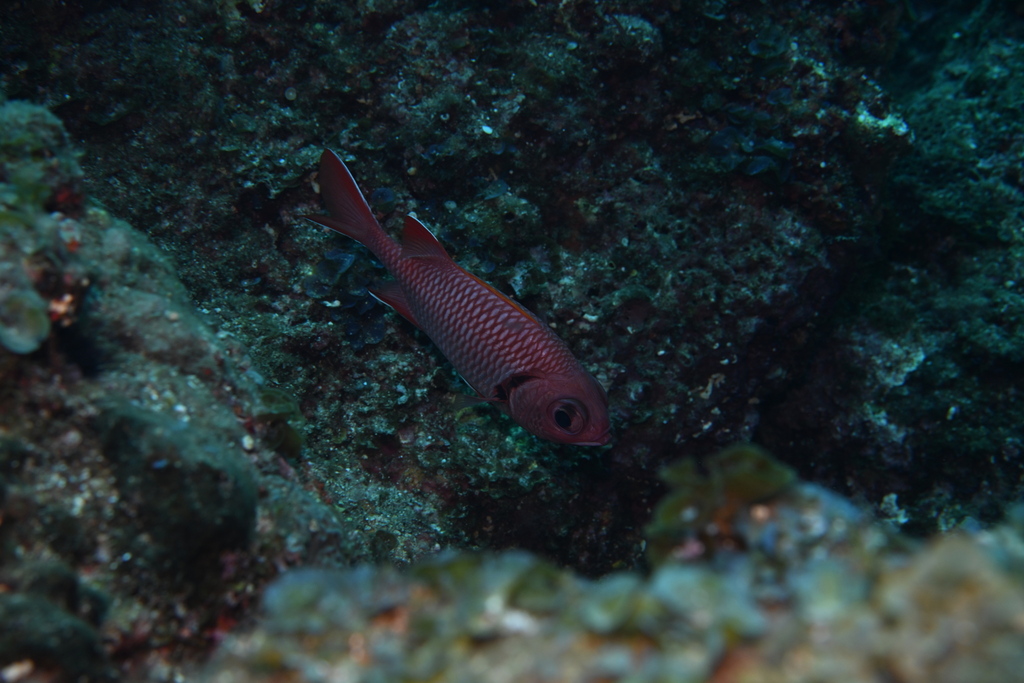
The fin counts are the quickest check: eleven dorsal spines with thirteen to fifteen soft rays, and four anal spines with eleven to thirteen soft rays. Four anal spines is the detail that separates it from most of the red fish sharing the same ledge. The lower jaw projects noticeably when the mouth is closed, and the lower half to three-quarters of the inner pectoral axil carries small scales. Scale centres are silvery pink to pale yellow with red edges, so the body reads as red with a silver sheen rather than flat crimson. The black of the opercular membrane extends below the opercular spine, and the naked part of the pectoral axil is black, which gives the fish its blotcheye look. The outer half of the spinous dorsal is yellow to orange-yellow, the lower half of the other fins is red, and the leading edges are white, sometimes with a black submarginal streak.
Wide range, shallow reef
FishBase gives an Indo-Pacific and eastern Pacific range: East Africa south to Natal but not the Red Sea, east to Clipperton, Cocos and the Galapagos, north to the Ryukyu Islands and south to the Great Barrier Reef, Norfolk Island and Lord Howe Island. It is recorded throughout Micronesia and is described as common across Oceania, absent only from Easter Island. The country list is correspondingly long, from American Samoa and Australia through Hawaii, Japan, Indonesia and the Maldives to Palau and French Polynesia. GBIF holds 6,512 occurrences, led by UM with 1,388, the United States with 1,226, the Northern Mariana Islands with 647, American Samoa with 480, Australia with 407 and Japan with 379. The depth range is 0 to 159 m, but the usual band is 3 to 15 m, which is the part a shore angler can reach. It hides in caves and under ledges on subtidal reef flats, channels and outer reef slopes, and occurs in loose aggregations rather than tight schools.
Night is the season
No spawning months are recorded, so the entry does not pretend to a seasonal spawning window. The latitudinal range is 32°N to 32°S and the species is tropical, so in Hawaii the fish is present year-round and the meaningful cycle is daily rather than annual. FishBase states that the species is almost always caught at night, which is the single most useful line in the record for planning. The first hour after dark and the hour before dawn are the natural edges of that window, and a light over the water concentrates bait and therefore fish. Because the fish feeds mainly on plankton such as crab larvae, it is not a fish you chum heavily; you position a small bait where the current delivers the plankton. Weather still matters: a calm clear night is comfortable and safe on a rocky shore, while swell makes the same ledge dangerous and pushes the fish deeper.
Small baits at the edge of the light
FishBase records shrimp and squid as effective, and the mouth is large enough to take a small strip but the feeding habit is a pick rather than a crush. A small hook with the point just covered, a short leader and a bait that keeps a little tail moving is the right presentation. Fish the dark edge of a light pool rather than the bright centre; the glare hides the line and the fish use the boundary. Rocky shoreline, harbour walls and coral cover all hold fish, and the bait should sink close to the structure rather than sit in open sand. When a fish takes, pull it away from the coral immediately, because a hooked soldierfish heads straight back into the crevice. A second rod set deeper is worth trying if the shallow edge goes quiet, since the species is recorded down to 159 m even though the usual band is much shallower.
Light line, quick hands
The recorded maximum is 30 cm and the common length 22 cm, so a light rod and a fine leader are enough and are also more effective. Small hooks, a light main line and a short fluorocarbon leader let a small bait behave naturally and reduce the chance of the fish seeing the rig. The reel only needs to hold enough line for a short cast and a vertical drop beside structure; capacity matters less than smooth drag at low settings. Coral and rock are the real adversaries, so a leader that can take a rub and a pair of forceps for hook removal are more useful than heavy tackle. A small net helps at a harbour wall, but on a rocky edge a hand lift is often quicker and safer for the fish. Keep the light off the water surface when you are not fishing, and keep your shadow off the edge; both spook fish in shallow water.
No special bag limit, general rules apply
FishBase notes the species is marketed fresh, but in Hawaii it is primarily a shore and night catch rather than a commercial target. HAR 13-95 sets species size and bag limits, and HAR 13-74 governs gear, but no species-specific size or bag limit is listed for this soldierfish in the packet, so the general rules apply. Non-residents need an NRMFL for recreational saltwater fishing, and anyone selling catch needs a CML. MLCD, FRA and other managed areas are closed to taking, and the boundaries follow current DAR maps rather than signs on the shore. Because menpachi is a small fish, the practical conservation question is release rather than quota: keep only what you will eat, and return the rest quickly.
Where the record thins out
The entry draws on FishBase for taxonomy, range, size, depth, diet and behaviour, on GBIF for occurrences and on the DAR pages for rules. iNaturalist holds 1,010 observations, a healthy sample for a reef fish and a useful check on the identification features described above. Maximum weight and maximum age are not recorded, and length at maturity is not given. No spawning months are available, which is why the season field is empty and the seasonality array is all zeros. The IUCN status is Least Concern, assessed in March 2015, and it should be read as a global assessment rather than a local stock statement. Rules and closed-area boundaries change, so confirm the current DAR notice before a night session.
How to catch it
Shore fishing
Fished with the listed approach, matched to the recorded depth and size.
Boat fishing
Fished with the listed approach, matched to the recorded depth and size.
Where these facts come from
Check these pages before you rely on a size, range or protection status.
- FishBase — Myripristis berndti — FishBase · T2
- GBIF — Myripristis berndti occurrence records — GBIF · T2
- IUCN Red List — Myripristis berndti — IUCN · T1
- Photo record — iNaturalist — iNaturalist · T3
Fish in the same water
These fish live in the same place.


Guides for this water
Technique, gear and safety guides that fit Blotcheye soldierfish.