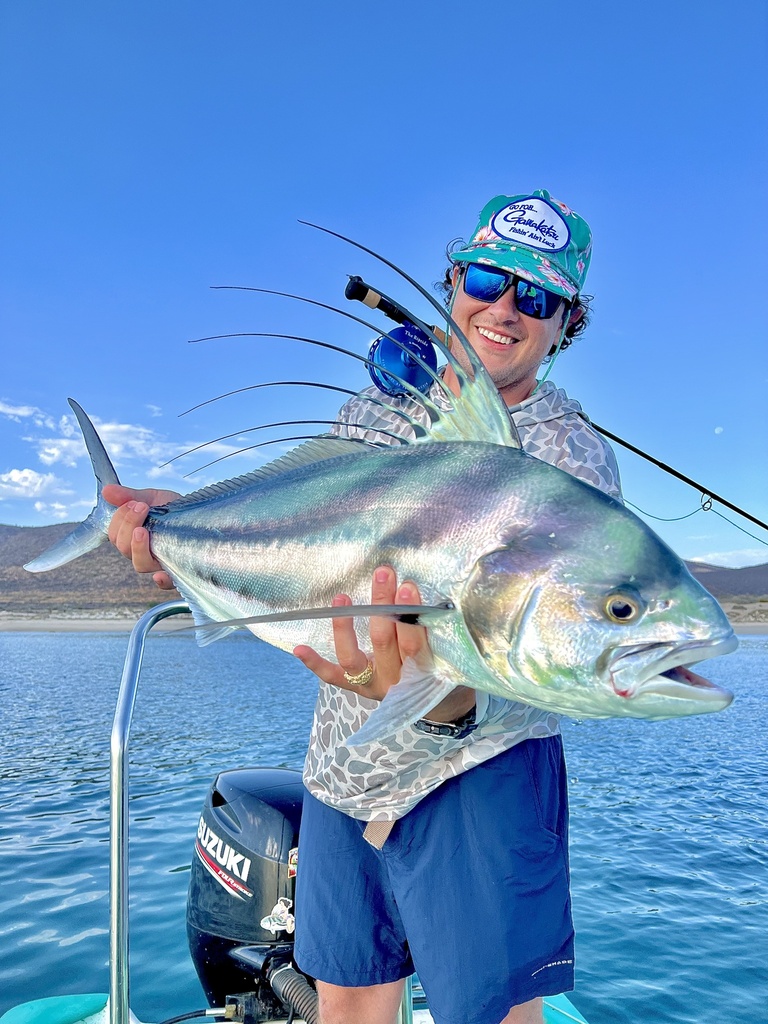
Roosterfish (Nematistius pectoralis) is a fish of the family Nematistiidae. FishBase gives its range as: Eastern Pacific: San Clemente in southern California, USA to Peru, including the Galapagos Islands; rare north of Baja California, Mexico. The rooster comb is the identification: seven very long spines at the front of the dorsal fin. It is recorded in subtropical water. The recorded maxima are 163 cm FL, 51.7 kg. IUCN status: Least Concern (LC). Chinese name: .
Identification
The rooster comb is the identification: seven very long spines at the front of the dorsal fin. The species is the only member of its genus and its family. Maximum length is 163 cm fork length, common length 60 cm total length, and maximum published weight 51.7 kg. Fork length stops at the fork of the tail while total length runs to the tail tip, so the 163 cm record and the 60 cm common figure are two different rulers as well as two different fish. That distinction matters here because the gap between them is large enough to change the tackle list. The body is silvery, the head blunt, and the comb is folded back in a swimming fish.
Habitat and distribution
Eastern Pacific from San Clemente in southern California to Peru, including the Galápagos Islands, and rare north of Baja California. Twelve range states appear, from the United States through Mexico and Central America to Ecuador and Peru. The climate is subtropical, between 33°N and 18°S. Sandy bottom and coastal water are the habitat keywords. Wikipedia calls it a fish of warm shallow water and a strong fighter. In practice that means surf lines, sandy points and the wash around rocky headlands rather than deep water.
Season and fishing approach
The gap between the record and the ordinary fish is the whole story. The 163 cm fork-length fish and the 51.7 kg weight are exceptional; the common length is 60 cm. That is a 2.7-fold difference in length, and it changes the tackle list completely: a 60 cm roosterfish is a light spin or fly target, while the record fish is a heavy-tackle animal. The comb and the fight explain the reputation. Fish the sandy coastal edge and the surf wash, work a surface lure or a live bait along the beach, and treat every fish as a 60 cm fish until the rod says otherwise. The 51.7 kg figure is a record, not a target.
Edibility and regulations
Minor commercial use, and a gamefish. IUCN status is Least Concern, assessed 23 February 2024. For this species both CITES and CMS read Not Evaluated. Wikipedia notes that local artisanal and subsistence fisheries also target the species. Keeping a fish and targeting a fish fall under different rules: a size floor for the first, a date window for the second, and the twelve range states apply both. Because the species is a minor commercial catch and a gamefish at once, a fish released by one boat may be kept by the next. The 60 cm common length is the number to plan around, not the 163 cm record.
Regulations before you keep it
These are the published regulations for this fish. Read the number first. The notice below it is the actual regulation.
Bag limit1
2 fish per angler per day across sábalo, dorado, roosterfish and baya · counts as 5 against the 10-fish limit
Mexico · MX
Mexico sets a shared cap of two fish per angler per day across sábalo, dorado, roosterfish (pez gallo) and baya, counted as five fish of other species within the ten-fish daily limit.
No minimum size is set in the standard; sizes and closures are set by DOF notices. Shoreline, boat and underwater permits differ (clause 4.3).
En el caso de sábalo, dorado o pez gallo, el límite máximo será de dos ejemplares de cualquiera de tales especies, los que también serán equivalentes a cinco organismos de otras especies.
Every record above names its source and the date it was retrieved. See the regulation register for the full list, or how to read these regulations.
Where these facts come from
Check these pages before you rely on a size, range or protection status.
-
FishBase — Nematistius pectoralis
— FishBase · T2
-
GBIF — Nematistius pectoralis occurrence records
— GBIF · T2
-
IUCN Red List — Nematistius pectoralis
— IUCN · T1
-
Photo record — iNaturalist
— iNaturalist · T3