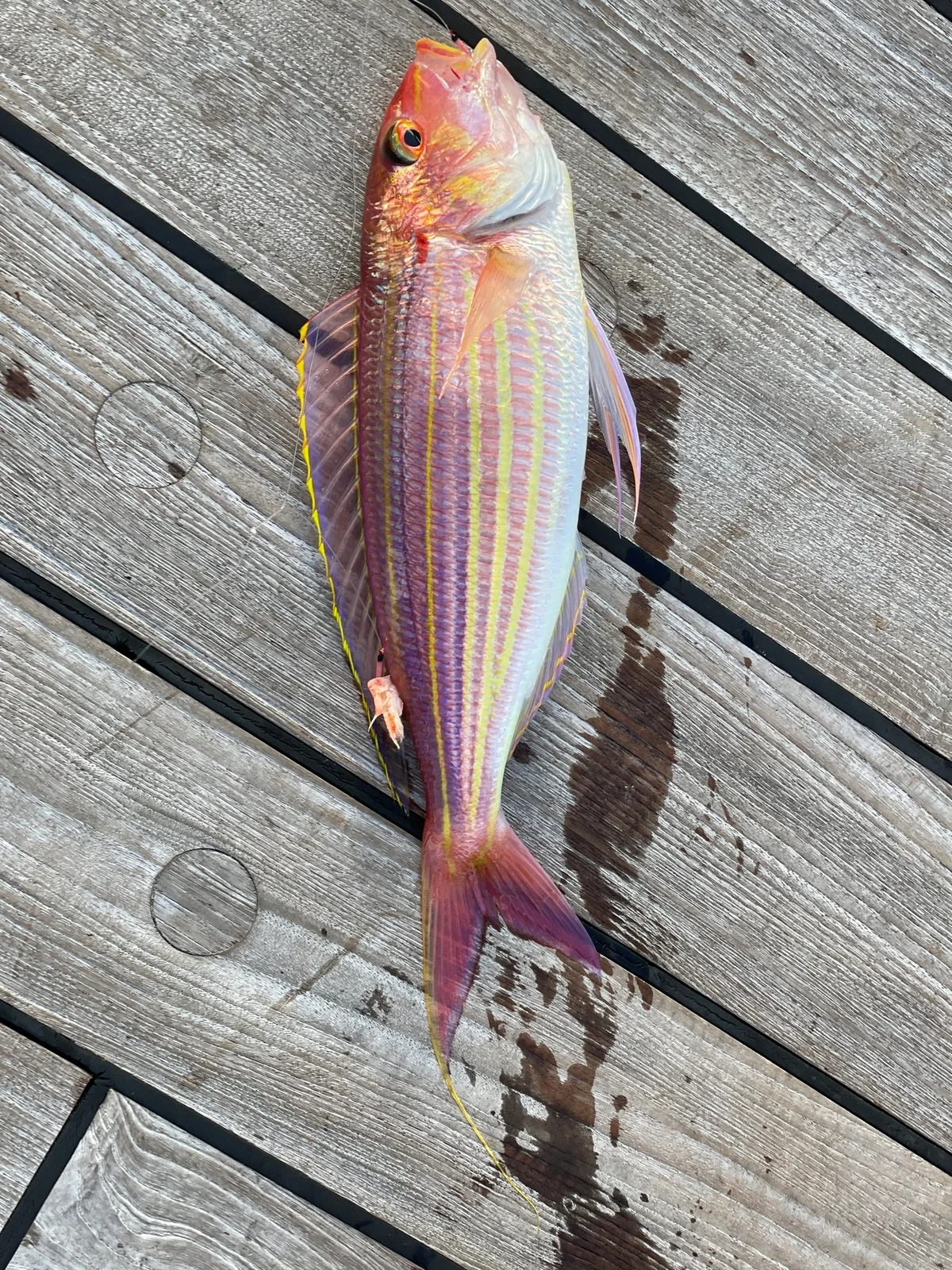
The golden threadfin bream is a pink-and-yellow shelf fish of the family Nemipteridae, named for the elongated upper ray of its tail fin. It is found across the western Pacific, between southern Japan and north-western Australia, including the Arafura Sea, usually over sand and mud in 18–33 m, though the recorded range extends from 1 to 220 m. It is both a commercial catch and a recognised gamefish, which makes it a realistic small-boat target along its range. Maximum standard length is 35 cm with a common length of 23 cm, and IUCN assessed the species as Vulnerable in 2009.
Two gold threads, one fish
The English names pick out different parts of the same animal. FishBase's principal is Golden threadfin bream, the FAO and Australian lists agree on Golden threadfin bream, Hong Kong SAR also carries Golden thread, and Malaysia carries plain Threadfin bream. Australia adds Yellow-lipped threadfin-bream. One name advertises the long upper fin ray, the other the colour of the lips; neither describes the whole fish. Chinese splits the same way. and mean "gold-thread fish" and match the English, while , the FishBase principal, is the name of a conifer, and and carry the thread and the yellow into other compounds. Japanese is Ito-yori-dai, and iNaturalist settles on Golden Threadfin Bream.
For a page, the useful decision is narrow: use the FAO form in the title and keep the local names in the alias list, because a market name such as will not lead a reader to a threadfin without the scientific name.
Counts that stop short
Taxonomy puts the species in Nemipteridae, order Eupercaria/misc. The morphology block is short: anal spines 3, anal soft rays 8, body fusiform, cross-section oval. Dorsal spines, dorsal soft rays, vertebrae and total length counts are all blank. Three anal spines is a useful character, because it separates the threadfin breams from the spiny-rayed groups around them, but one character is not a key. The capture gives no description of the long dorsal filament that the English name refers to.
That gap matters at family level. Nemipteridae holds several similar pink-and-yellow breams, and the page has neither a fin formula nor a photograph note that would let a reader separate this species from its congeners. The name and the three anal spines are the whole of the diagnostic material.
One to 220, mostly 18 to 33
The environment line reads: marine, demersal, non-migratory, depth 1–220 m with a usual band of 18–33 m, tropical, 39°N–20°S and 106°E–140°E. There is no temperature figure, so the tropical label and the latitude range carry the climate. The usual band is shallow, inside the range of a small boat, and the maximum of 220 m is the exceptional end rather than the working depth.
Two bottom keywords are recorded, sandy and muddy, and the diet is crustaceans, fishes and molluscs. Three prey groups describe a generalist on soft ground. The habitat line and the depth line together say that this is a shelf fish of sand and mud, not a reef fish, and the non-migratory flag says the stock is local rather than oceanodromous.
Southern Japan to the Arafura Sea
FishBase's distribution text is one sentence: the western Pacific from southern Japan to north-western Australia and the Arafura Sea. The country table has fourteen rows, all native, from Australia, China, Hong Kong SAR, Indonesia and Japan through Korea, Macao SAR, Malaysia, the Ogasawara and Ryukyu islands, the Philippines, Taiwan region, Thailand and Viet Nam. The list describes a continuous tropical and subtropical shelf coast rather than a set of isolated records.
GBIF returns only two distribution rows, one without a country code and one for Taiwan, China, with one marked native and one carrying no means. That is too thin to map a range, and the page should not read it as a second opinion. iNaturalist holds 40 observations, a small number for a fish that is landed commercially across the region.
Hong Kong spring, Fukuoka summer
Three spawning rows are carried. Hong Kong SAR, China runs March to May; a second Hong Kong SAR, China row, with no locality specified, runs February to June; and the row off Fukuoka runs June to August. The combined window is February to August. Read by locality, the northern Japanese fish spawn later than the Hong Kong SAR, China fish, which is the expected direction across a north–south range.
The capture supplies no temperature threshold, so no thermal cue can be tied to the timing. Depth at spawning is likewise unrecorded, though the usual band is shallow. The page can state the local windows and the north–south order; it cannot state a trigger.
Thirty-five centimetres, twenty-three common
The size line gives a maximum of 35.0 cm SL for a male or unsexed fish and a common length of 23.0 cm SL. No maximum weight and no maximum age are recorded. Maturity is entered as "Lm ?" with a range beginning at 15 cm. So the capture contains a maturity range without a central value, and the page should not invent one.
The numbers still support a simple reading. If maturity begins near 15 cm and the common length is 23 cm, most of the fish a fishery meets are adults; the 35 cm maximum is the old tail of the distribution. That is an inference from two figures, not a stock assessment, and the capture supplies no age structure to test it.
Vulnerable since 2009
IUCN lists the species as Vulnerable, assessed 29 January 2009. The assessment is old by the standards of the other pages in this group, and the capture gives no later revision. The human-use line is commercial, with gamefish yes. Wikipedia's extract says only that the fish is a western Pacific nemipterid and names the family; it carries no conservation or fishery material.
Two flags and an old assessment are all the record contains. There are no landing figures, no stock assessment and no method. A reader should treat the Vulnerable listing as the position at the assessment date, not as a claim about the present.
A boat fish over sand and mud
The usable picture is compact: a golden, yellow-lipped bream of the western Pacific shelf, usually 18–33 m over sand and mud, spawning from February to August with a north–south lag, maturing from about 15 cm and reaching 35 cm, assessed Vulnerable in 2009 and landed commercially.
Depth and bottom type are what an angler can use here, and the capture stops there. It records no method, bait, hook size or regulation, and the gamefish flag is not a rule. The usual band is within small-boat range, but anyone keeping a fish should check the local size and bag limit first.
Regulations before you keep it
These are the published regulations for this fish. Read the number first. The notice below it is the actual regulation.
Minimum size1
Fork length ≥175 mm
China — Fujian · CN-FJ
Fujian commercial catch standard (Fujian Fisheries Notice 2018 No. 114): the minimum catch size for red filament threadfin bream is fork length ≥ 175 mm; smaller individuals count as juveniles. The notice does not address recreational angling, so whether an angler must release an undersized fish depends on the local fisheries authority.
Season / closure1
From 12:00 on May 1 to 12:00 on September 1, September 16 or August 16, depending on the area
China — national · CN-NATIONAL
All Chinese coastal waters (MAR Notice 2023 No. 1): the summer moratorium starts at 12:00 on 1 May and ends at 12:00 on 1 September, 16 September or 16 August depending on the sea area, and applies to capture operations. All gear types except hook-and-line are closed; rod-and-line fishing is outside the moratorium gear list, but hook-and-line vessels must still report port entry and exit, and coastal provinces may adopt stricter measures.
The closure has three area-based windows, all starting at 12:00 on May 1 and ending at 12:00 on September 1, September 16 or August 16.
Every record above names its source and the date it was retrieved. See the regulation register for the full list, or how to read these regulations.
Where these facts come from
Check these pages before you rely on a size, range or protection status.
-
FishBase — Nemipterus virgatus
— FishBase · T2
-
GBIF — Nemipterus virgatus occurrence records
— GBIF · T2
-
IUCN Red List — Nemipterus virgatus
— IUCN · T1
-
Photo record — iNaturalist
— iNaturalist · T3