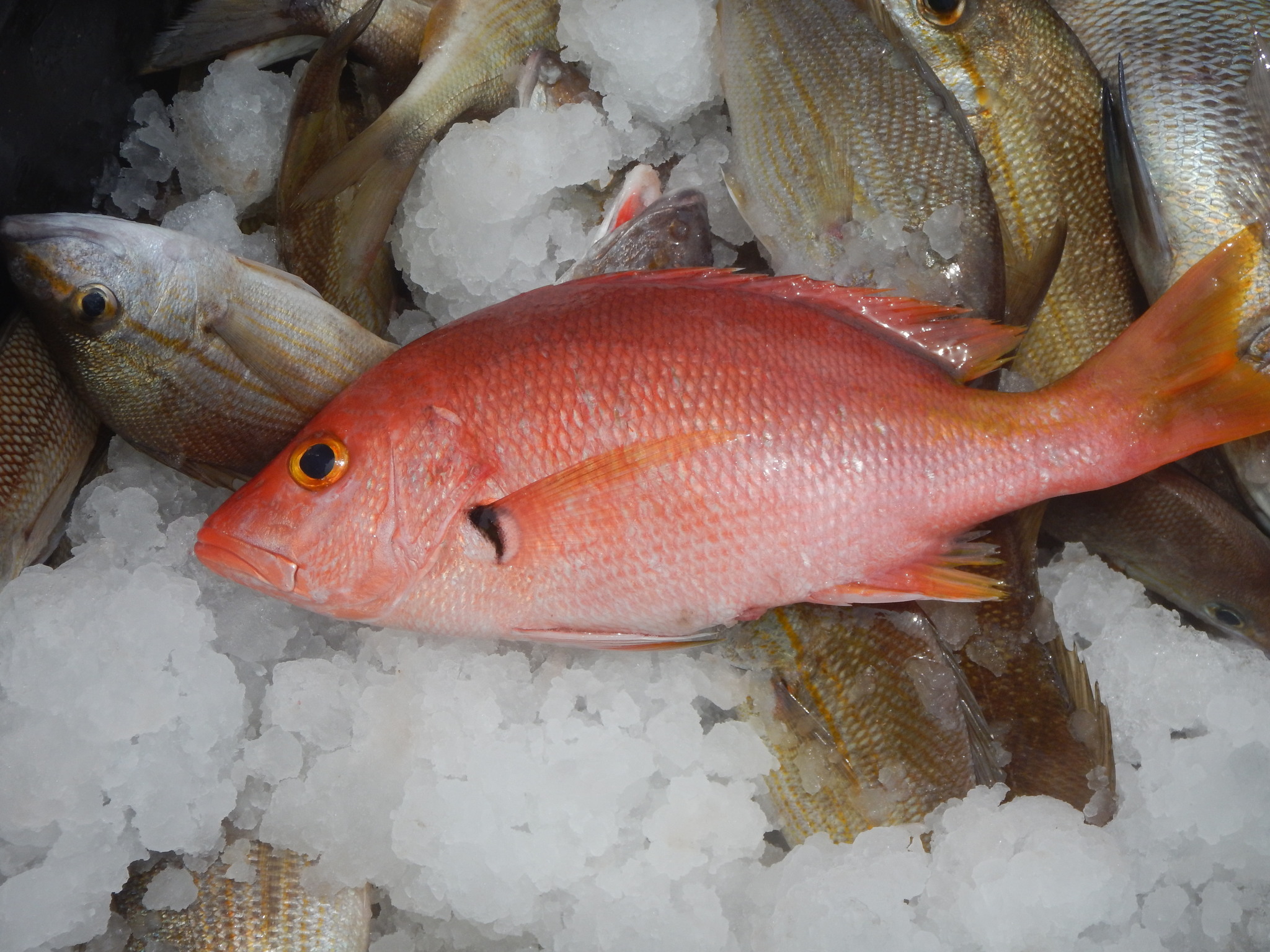
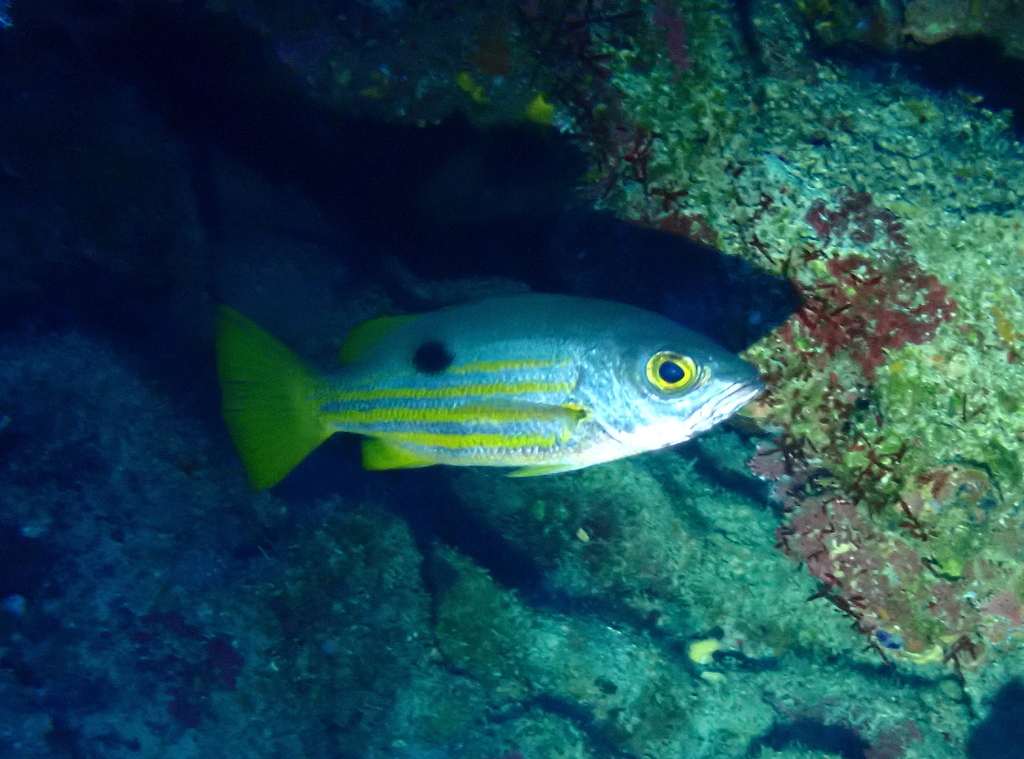
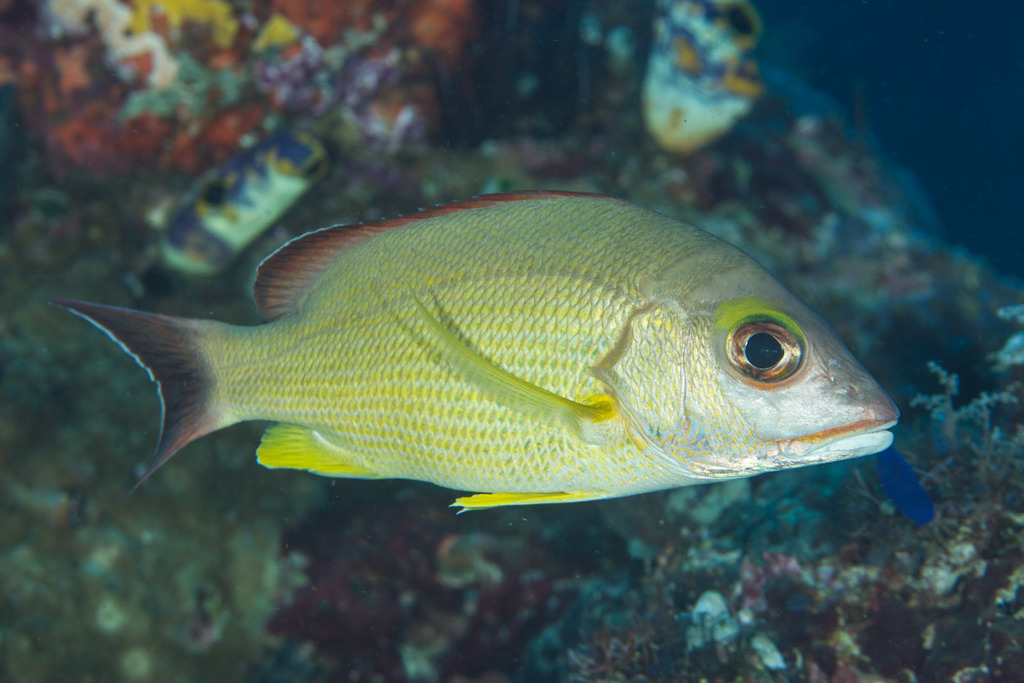
Yellowtail snapper (Ocyurus chrysurus) is a fish of the family Lutjanidae. FishBase gives its range as: Western Atlantic: extending northward to Massachusetts, USA and Bermuda and southward to southeastern Brazil, in Gulf of Mexico and Antilles (Anderson, pers. comm.). It is recorded from 0 to 180 m, in subtropical water. The recorded maxima are 86.3 cm TL, 4.1 kg, 19 years. Diet includes crustaceans, fishes, molluscs, zooplankton and worms. IUCN status: Data Deficient (DD). Chinese name: .
Three rulers on one fish
NOAA Fisheries gives the species as 8–14 inches in typical length, up to 34 inches, and 2–5 pounds in typical weight, up to 11 pounds. It puts lifespan at 6–14 years, up to 28 years. Every one of those figures is in imperial units, on a page written for a United States audience.
FishBase gives 86.3 cm maximum total length, 40 cm common total length, 4.1 kg maximum weight and 19 years maximum age. The units are metric and the length is explicitly total length.
The PLOS study from the southern Gulf of Mexico works in fork length: 17.7–38.9 cm FL across sampled fish, with estimated asymptotic lengths between 38.36 and 41.59 cm FL depending on the site. Fork length ends at the tail notch, so it is shorter than total length by the length of the caudal fin.
Thirty-four inches, converted
Thirty-four inches is 86.36 cm, which rounds to the 86.3 cm that FishBase prints. On the maximum, the two sources agree exactly once the units are matched. That agreement is worth stating because it shows the conversion is not the problem.
The problem is the word “length”. NOAA does not say whether 34 inches is total length or fork length. FishBase does. A 34-inch fork length would exceed 86.3 cm total length, and the apparent agreement would disappear.
Eleven pounds, converted
Eleven pounds is 4.99 kg. FishBase puts the published weight maximum at 4.1 kg. The gap is 0.89 kg, and neither page explains it. A maximum weight and a maximum length are usually recorded from different specimens, sometimes from different decades.
The typical range is easier to use. NOAA's 2–5 pounds converts to 0.9–2.3 kg, and that band is where the typical fish sit. The 11-pound figure is an outlier at the top of the same distribution, not a second typical value.
Twenty-eight years or nineteen
NOAA's maximum lifespan is 28 years. FishBase's maximum reported age is 19 years. The PLOS study estimated maximum ages of 15.5 to 22.41 years from otolith annuli, depending on the site, and reported observed fish from age 0+ to 12 years.
Three numbers from three methods: a lifespan statement, a database maximum, and a modelled estimate from aged hardparts. The PLOS range overlaps both of the other figures without matching either. A 28-year fish may exist; it is not the age a growth model predicts for the stock.
The maturity window
FishBase puts length at first maturity at 23.8 cm; the range runs 14–31 cm. That is an unusually wide range around a single point, and it covers both the juvenile weed-bed fish and the adult reef fish.
The PLOS study estimates age at maturity at about 1.3 years for females and slightly under one year for males. An age-based estimate and a length-based estimate are not interchangeable: one says how long the fish has lived, the other says how big it is when the transition happens, and a slow-growing fish can reach the length without reaching the age.
Zero to one hundred eighty metres
FishBase's depth field reads 0–180 m, usually 10–70 m. NOAA says adults live in sandy areas near offshore reefs at 10–70 m. The usual band and the NOAA statement match; the 180 m figure is the outer record, not the working depth.
The habitat description is more useful than the depth number. Adults are coastal, mostly around coral reefs, usually seen well above the bottom and often in aggregations. Juveniles are found over weed beds and feed mainly on plankton. That is a pelagic-to-benthic transition, not a single depth preference. For geography, GBIF's 59 statements reduce the range to three water bodies — Western Atlantic Ocean, North West Atlantic, Gulf of Mexico — and add a Brazilian state checklist naming Alagoas, Bahia, Ceará, Rio de Janeiro, São Paulo and ten other states. That is coarser than NOAA's Massachusetts-to-Brazil line in one direction and finer in another.
The common band is the fishing band
NOAA's 8–14 inches converts to 20–36 cm. FishBase's common length is 40 cm TL. The two common bands overlap at the top of NOAA's range but do not coincide: one tops out at 36 cm, the other centres on 40 cm.
For gear, that argues against rigging for the 34-inch fish. The 20–36 cm band is what a typical trip produces, and a light rod with small hooks and a soft presentation matches it. The 86 cm fish exists, but it is a record, not a planning figure.
Fishing to the ruler you can measure
Measure every fish the same way and write down which way that was. If the local rule is in total length, use a flat board with the tail squeezed; if it is in fork length, stop at the notch. Converting after the fact is where the 34-inch and 86.3 cm agreement turns into an argument.
Fish the 10–70 m band around reef structure, and keep a small bait moving above the bottom rather than on it. The juveniles over weed beds are a different target at a different depth, and mixing the two produces a trip that catches neither well.
Finally, treat the maximums as separate records. A 4.99 kg fish and a 4.1 kg fish are both “maximum published weight”, from different samples. The ruler that matters on the boat is the one that measures the fish on the deck.
Regulations before you keep it
These are the published regulations for this fish. Read the number first. The notice below it is the actual regulation.
Minimum size1
≥10.5 in (267 mm) fork length
Puerto Rico · PR
Puerto Rico requires yellowtail snapper (colirrubia) to be at least 10.5 inches (267 mm) fork length; smaller fish must be returned to the sea.
Puerto Rico sets no daily bag for yellowtail; the 5 per person / 15 per boat combined snapper-grouper-parrotfish bag is a federal EEZ rule.
(Ocyurus chrysurus) menores de 10.5" pulgadas (267 mm) de largo horquilla (LH) capturadas por cualquier método de pesca
Every record above names its source and the date it was retrieved. See the regulation register for the full list, or how to read these regulations.
Where these facts come from
Check these pages before you rely on a size, range or protection status.
-
FishBase — Ocyurus chrysurus
— FishBase · T2
-
GBIF — Ocyurus chrysurus occurrence records
— GBIF · T2
-
IUCN Red List — Ocyurus chrysurus
— IUCN · T1
-
Photo record — iNaturalist
— iNaturalist · T3