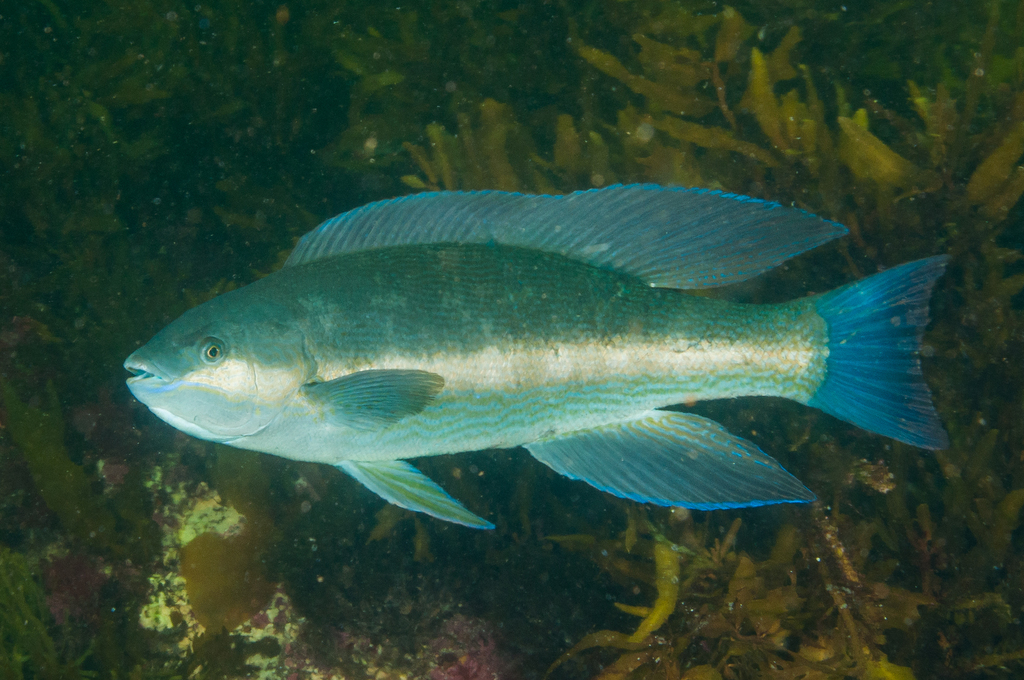
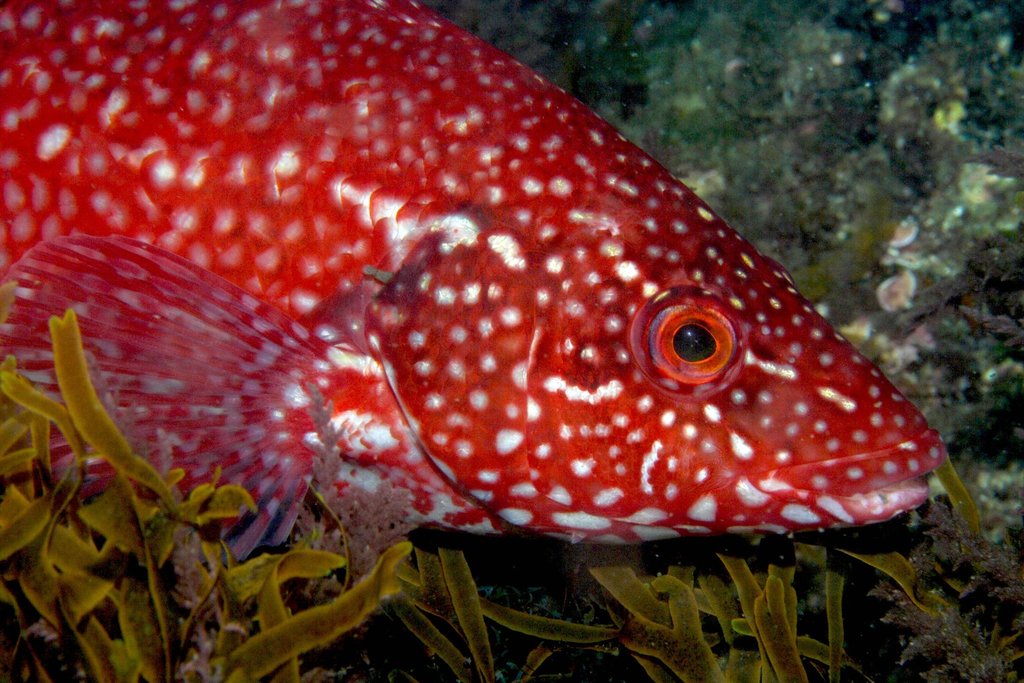
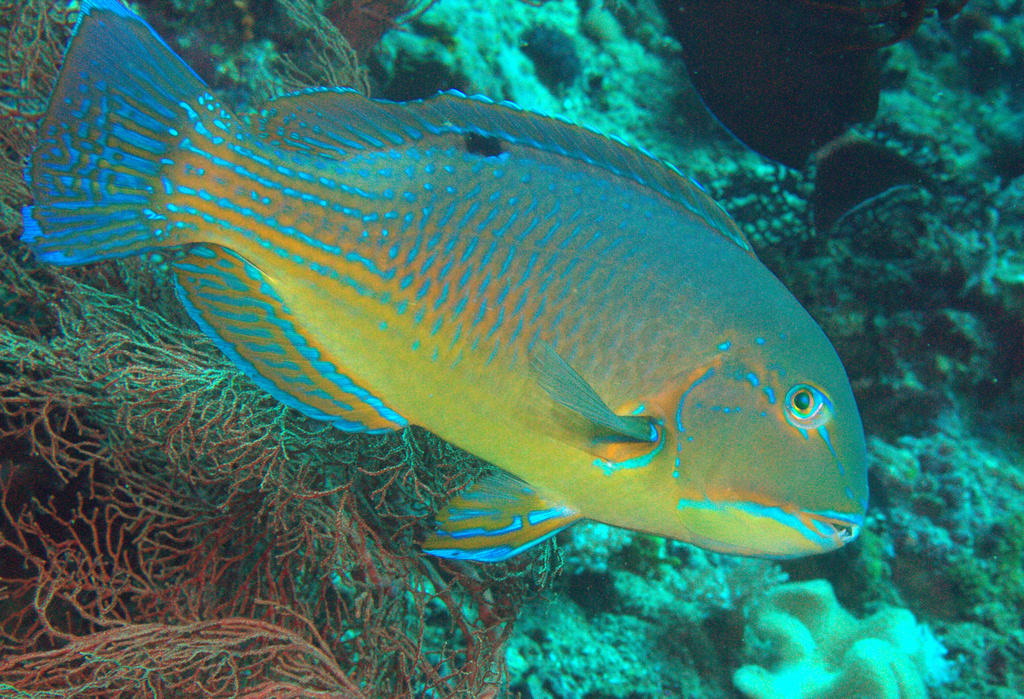
Butterfish is a New Zealand weed whiting that lives in the first 20 m and eats brown algae. FishBase uses Butterfish as the English name, with greenbone as the alternative. Wikipedia gives the Māori names mararī and rarī. The page gives a length, a weight, an age and a diet, and leaves the rest blank. It publishes no common length, so there is a ceiling but no ordinary size.
40 cm, 1.5 kg, 11 years
The maximum is 40 cm SL, the heaviest published weight is 1.5 kg and the oldest reported age is 11 years. Maturity is estimated at 24.6 cm, with a range of 23–26.48 cm. No common length is published.
Maturity at 24.6 cm is 61.5 percent of the 40 cm maximum, so a full-grown fish is well past its maturity size. The missing common length is the bigger gap: without it the page has no "ordinary fish" figure, only a ceiling. A 1.5 kg fish and an 11-year fish are both records, and the page does not say they are the same fish.
Labridae in FishBase, Odacidae in older text
FishBase places the species in Labridae, the wrasses. Wikipedia describes it as a weed whiting of the family Odacidae. The page follows FishBase and records Labridae.
This is a classification difference, not two species. The common name weed whiting comes from the older family placement, and it still describes the diet better than the current family name does. The family name changed; the fish did not.
Zero to 20 metres
The depth range is 0–20 m. The species inhabits shallow inshore waters where rocks and brown algae are abundant. The habitat keywords are rocky and coastal.
The latitude span is 35°S to 48°S and the longitude span 166°E to 179°E, under a subtropical label. Twenty metres is the whole vertical range, so this is a shore and shallow-boat fish rather than a deep-reef target. No usual depth band is given, which makes the 20 m ceiling the only depth statement.
It grazes brown algae
The species browses on algae and feeds mainly on brown algae: Carpophyllum, Lessonia and Macrocystis. Wikipedia describes shallow rocky areas with brown algae growth, mainly Carpophyllum, upon which it grazes.
No invertebrate prey is recorded. That makes it a grazer rather than a baitfish eater, and the page gives no secondary prey to fall back on. Three brown algae genera are named, and no red or green alga is recorded. The diet is the most specific part of the record.
349 of 363 records are New Zealand
FishBase gives the range as New Zealand and probably Australia; the country list names only New Zealand. GBIF holds 363 records: 349 from New Zealand, 4 from Australia, 1 from Egypt and 9 from other countries.
The Egyptian record sits outside the stated range and is not treated here as part of it. The four Australian records are consistent with "probably Australia" but too few to confirm a resident population.
Ten months of spawning, with April to June blank
The spawning table marks January, February, March and July through December. The regional rows are Cook Strait in January–March and July–December, and Otago in January and August–December.
The union is ten months, and April, May and June are absent. Both rows are New Zealand, and neither covers the whole country. Ten months is a long window, and a spawning table is not a closed season. No temperature figure is published, so the window cannot be tied to a degree value.
Rock fishing is the mainstream method
Rock fishing is mainstream and shore casting is secondary. The terrain list is rocky shore, reef and seagrass. The 20 m ceiling keeps the methods shallow.
Seagrass appears in the terrain list but not in the habitat keywords, which name rock and coast. That is a small mismatch rather than a contradiction: a rock mark can sit next to a seagrass bed. The 20 m ceiling means a shore or rock angler is already fishing inside the range. The page publishes no gear specification for either method.
Greenbone, and a minor commercial catch
Human uses record a minor commercial fishery and nothing else: no gamefish entry, no aquaculture, no aquarium trade. iNaturalist carries 268 observations. No flesh-quality note and no handling note are published.
Greenbone is the Wikipedia title and butterfish the FishBase name; both refer to the same species. The page does not explain either name. The 1.5 kg maximum comes with no length for that weight, so the two records cannot be tied together.
Least Concern in 2009, and MPI rules
The IUCN category is Least Concern, assessed on 18 September 2009. CITES and CMS are both Not Evaluated, and the species is harmless to humans. A 2009 assessment is old for a species with a minor commercial catch. The page publishes no landings series, so the category cannot be read as a stock trend.
In New Zealand, MPI sets the amateur saltwater rules: daily bag limits, minimum sizes, method restrictions and accumulation limits, applied by fishery management area (FMA). Marine reserves under the Marine Reserves Act 1971 are no-take, and Hauraki Gulf, Fiordland and Marlborough Sounds carry additional rules, as do temporary closures and rāhui.
No bag number, size limit or closure date is given here, and the page publishes no national size limit to set against the 24.6 cm maturity estimate. Check the current rule for the FMA and the reserve map before the trip.
Regulations before you keep it
These are the published regulations for this fish. Read the number first. The notice below it is the actual regulation.
Minimum size1
≥35 cm
New Zealand — South East · NZ-SE
New Zealand sets a 35 cm minimum length for butterfish (greenbone).
At Kaikōura the daily limit is 10. Lyttelton Harbour/Whakaraupō is closed to butterfish.
Butterfish (Greenbone) | 15 | 35 | 108
Bag limit1
15 fish per fisher per day
New Zealand — South East · NZ-SE
New Zealand allows 15 butterfish per fisher per day.
At Kaikōura the daily limit is 10. Lyttelton Harbour/Whakaraupō is closed to butterfish.
Butterfish (Greenbone) | 15 | 35 | 108
Every record above names its source and the date it was retrieved. See the regulation register for the full list, or how to read these regulations.
Where these facts come from
Check these pages before you rely on a size, range or protection status.
-
FishBase — Odax pullus
— FishBase · T2
-
GBIF — Odax pullus occurrence records
— GBIF · T2
-
IUCN Red List — Odax pullus
— IUCN · T1
-
Photo record — iNaturalist
— iNaturalist · T3